According to WRAP, UK households waste approximately 70 kg of edible food per person every year — worth around £1,000 for a family of four. A large share of this waste comes down to one simple problem: not knowing how long different foods actually last in the fridge, and either throwing things out too soon or holding on too long.
Fango is a food expiry reminder app that tracks expiry dates automatically, but knowing the real storage times matters just as much. This guide covers all the main food groups — meat, fish, dairy, leftovers and vegetables — based on UK Food Standards Agency guidance.
- Your fridge should be between 0°C and 5°C — a warm fridge shortens everything’s shelf life
- Raw chicken and fresh fish: 1–2 days; beef steaks 4–5 days
- Cooked food and leftovers: 2–4 days — only if cooled properly within 2 hours
- Most food waste comes from forgotten food, not short storage times — track what you have
Fridge temperature — the foundation of everything
Before diving into individual foods, it helps to understand why fridge temperature matters so much. The UK Food Standards Agency recommends keeping your fridge between 0°C and 5°C. Above 5°C, bacteria multiply rapidly — this range is known as the temperature danger zone.
For the household version of this problem — remembering the dates for everything you buy — see our guide to choosing an expiry date tracker.
Many fridges run warmer than people realise — the built-in temperature display is often inaccurate. A separate fridge thermometer (a few pounds) lets you check the real temperature. Dropping it by even one or two degrees can meaningfully extend the life of everything inside.
Raw fish should be stored on the coldest shelf — the bottom — ideally at 0–3°C.
Raw meat — fridge storage times
Raw meat always carries a safety risk. The Food Standards Agency advises following the use-by date on the packaging above all else. The times below are general guidelines — always prioritise the label. Specific guides: chicken · ground beef · pork · bacon · ham.
Chicken is the most perishable of all common meats. If you won’t cook it the same day or the next, freeze it immediately after buying. The same rule applies to mince — cook it or freeze it quickly.
Fresh fish — the shortest fridge life
Fish deteriorates faster than meat because its cell structure is looser and its microbial activity remains high even at cold temperatures. Cook fresh fish as soon as possible after buying. Specific guides: salmon · shrimp.
Always store raw fish on the bottom shelf of the fridge — so any leaks don’t drip onto other food. If you won’t cook fresh fish within two days, freeze it straight away. Frozen fish keeps for 3–4 months.
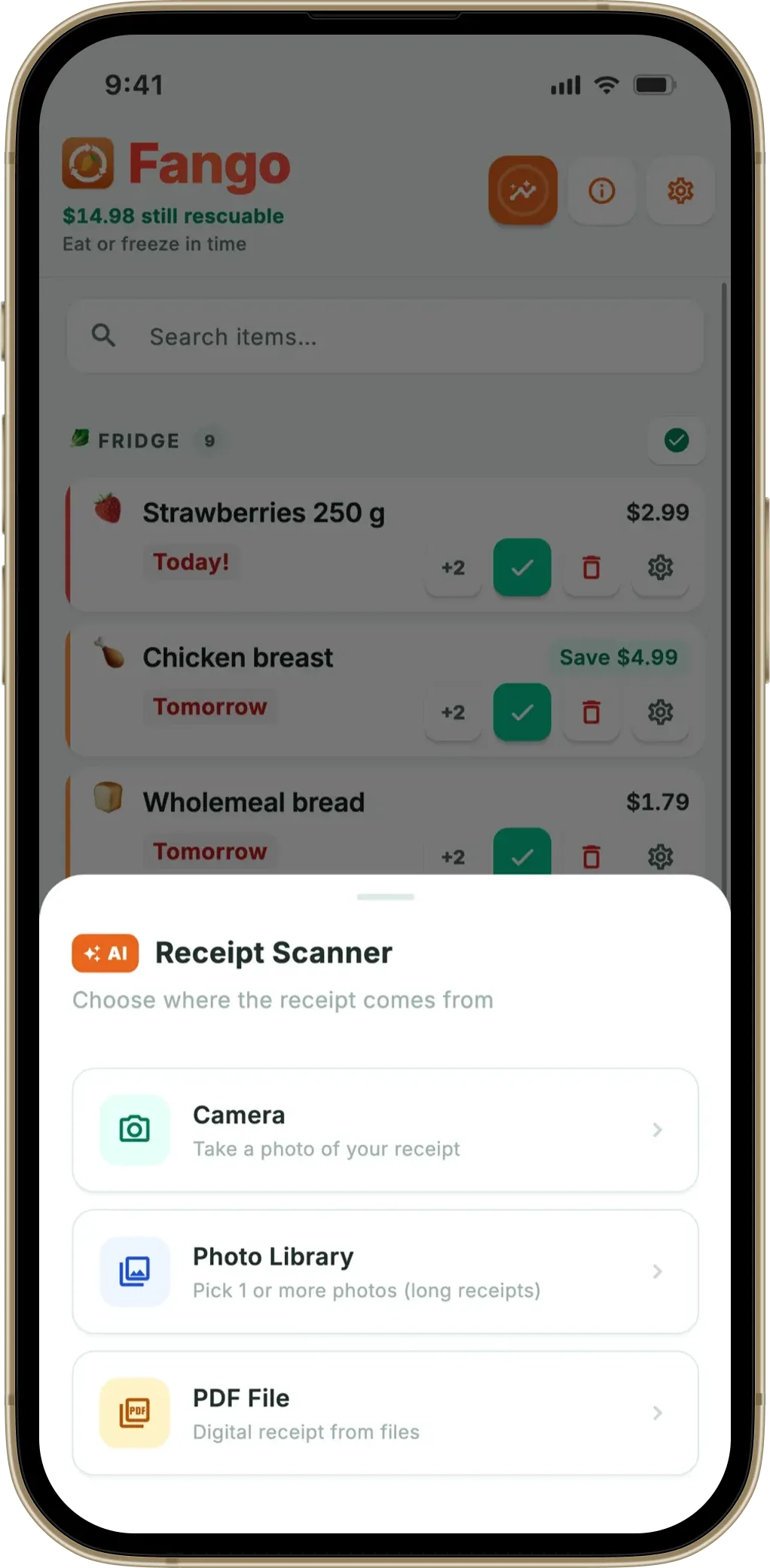
Scan your grocery receipt — AI reads the products and adds them to your fridge automatically. You get a push notification 1–14 days before expiry. No sign-up, fridge data stays on your device by default.
Download on the App Store Get it on Google PlayFree for a month · No sign-up · iOS and Android
Dairy — how long does it last once opened?
For most dairy products, the best-before date on unopened packaging is a quality indicator, not a safety deadline. Once opened, shelf life drops significantly because the sealed, sterile environment is broken. Specific guides: milk · yoghurt · cheese · butter. And if you can’t finish a tub in time, you can even freeze yoghurt.
If you spot mould on hard cheese, you don’t necessarily need to throw the whole block away — cut off the mouldy area with a margin of at least 2.5 cm around and below it, and the rest is safe to eat. For soft cheeses and cream cheese, mould means the whole product goes in the bin.
Cooked food and leftovers — 2–4 days, no more
Leftovers are one of the most common sources of food waste — not because people don’t want to eat them, but because they forget what’s in the fridge. According to the Food Standards Agency, cooked food lasts 2–4 days in the fridge — but only when cooled properly first. Specific guides: cooked chicken · rice · spaghetti · pasta sauce. And for ideas before they’re due, see how to use up leftovers.
Cooling correctly matters as much as storage time. Food must reach fridge temperature (0–5°C) within two hours of cooking. Fastest method: divide large pots into smaller, shallower containers and place them in cold water before transferring to the fridge. Always reheat leftovers to at least 70°C before eating.
Vegetables and fruit — wide variation
Vegetables and fruit vary more than any other food group. Carrots can last weeks; fresh berries or herbs might only keep for a day or two. Specific guides: lettuce · strawberries · avocado. Opened dips like hummus sit somewhere in between — a few days once the seal is broken.
Bananas and tomatoes don’t belong in the fridge — cold damages their texture and flavour. Tomatoes keep best at room temperature away from direct sunlight.
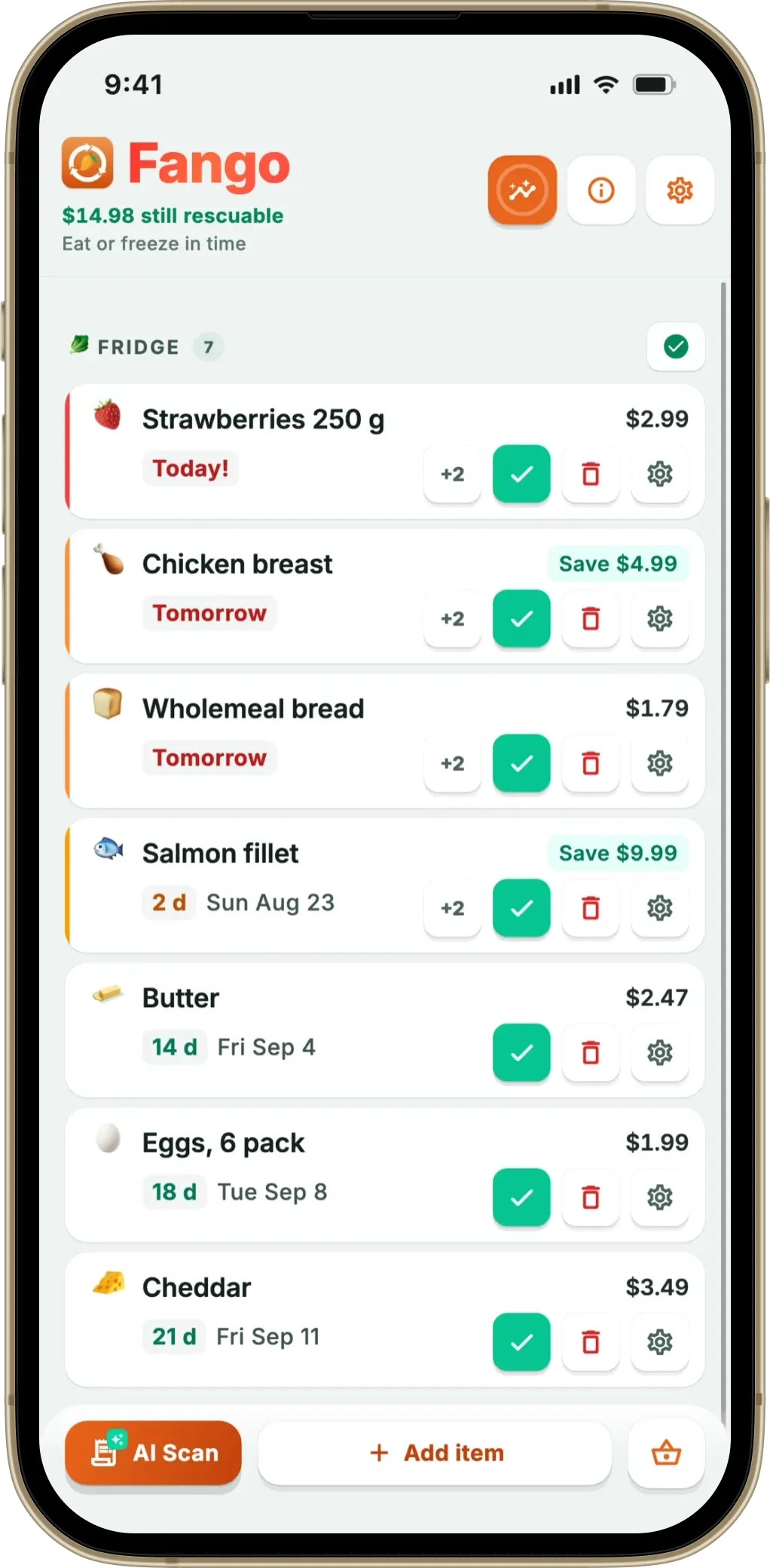
Fango sorts everything by reminder date and colour-codes the urgent items in red. The home screen widget shows what to use next without opening the app.
Download on the App Store Get it on Google PlayFree for a month · No sign-up · iOS and Android
How to tell if food in the fridge has gone off
When you’re unsure, use a three-sense check before throwing food out or eating it. Important: this applies only to best-before products. Raw meat, fresh fish and other use-by products must always be discarded after their date — never rely on sight or smell alone.
-
1
Look — any mould, unusual discolouration or sliminess? Slime on the surface is a clear sign of spoilage.
-
2
Smell — is the odour normal? Sour, rotten or distinctly off smells indicate spoilage. Milk and meat make this obvious quickly.
-
3
Texture — slime, stickiness or curdling. If anything seems off, discard it.
Rule of thumb: if any sense raises doubt, throw it out. But a date passing is not on its own enough reason to throw away hard cheese, dry pasta or other long-lasting foods — they may still be perfectly good.
5 tips for better fridge management
Shelf life is shaped mostly by fridge temperature and storage method — and by not letting food get forgotten at the back of the shelf.
-
1
Label leftovers with the date. When you put cooked food in the fridge, write the date on the lid with a marker or tape. You’ll always know at a glance how old something is.
-
2
Keep your fridge at 0–5°C. Check with a separate thermometer — the built-in one can be wrong. Every extra degree of warmth shortens everything’s shelf life.
-
3
Raw meat and fish on the bottom shelf. Always store them at the coldest point, where any leaks won’t drip onto other food below.
-
4
Use FIFO — first in, first out. Older items go to the front, new ones go to the back. This way you always use the oldest things first and nothing gets forgotten.
-
5
Use the Fango app. Fango tracks reminder dates and sends you a reminder before things go off — no sticky notes or mental arithmetic needed.
WRAP estimates that UK households waste food worth £17 billion every year — roughly £1,000 for a family of four. A significant share of that comes from not knowing what’s in the fridge or when it expires. That’s exactly the problem Fango is built to solve.
Frequently Asked Questions
How long do leftovers last in the fridge?
Cooked food and leftovers last 2–4 days in the fridge — but only if cooled properly first. Food should reach fridge temperature (0–5°C) within two hours of cooking. Divide large portions into smaller containers to speed up cooling, and always reheat to at least 70°C before eating.
What is the correct fridge temperature?
The UK Food Standards Agency recommends keeping your fridge between 0°C and 5°C. Above 5°C, bacteria multiply rapidly — this is known as the danger zone (8–63°C). Use a separate fridge thermometer for an accurate reading, as built-in displays can be unreliable.
How long does raw chicken last in the fridge?
Raw chicken lasts 1–2 days in the fridge. It is highly perishable, so cook it as soon as possible after buying or freeze it immediately. Always follow the use-by date on the packaging.
How long does fresh fish last in the fridge?
Fresh fish lasts 1–2 days in the fridge. Store it on the coldest shelf — the bottom — at around 0–3°C. Smoked salmon lasts 3–5 days once opened. If you won’t cook it within two days, freeze it immediately.
How do you know if fridge food has gone off?
Check food with your senses: look (mould, unusual colour), smell (sour, rotten or off odour) and texture (slime, stickiness or curdling). If any of them raises doubt, throw it away — and remember they can reveal spoilage without ever confirming that food is safe. Remember: raw meat and fish must always be discarded after their use-by date — never rely on smell or appearance alone.