The world wastes over 1 billion tonnes of food every year — and households are responsible for 60% of it. According to the UN Environment Programme’s Food Waste Index Report 2024, that works out to roughly one in five meals bought at home ending up in the bin. The USDA estimates the average US family of four loses around $1,600 of food a year.
Scan your grocery receipt with your camera — AI identifies the products and adds them to your digital fridge automatically. You get a push notification 1–14 days ahead. No sign-up required. Fridge data stays on your device by default.
Download on the App Store Get it on Google PlayFree for a month · No sign-up · iOS and Android
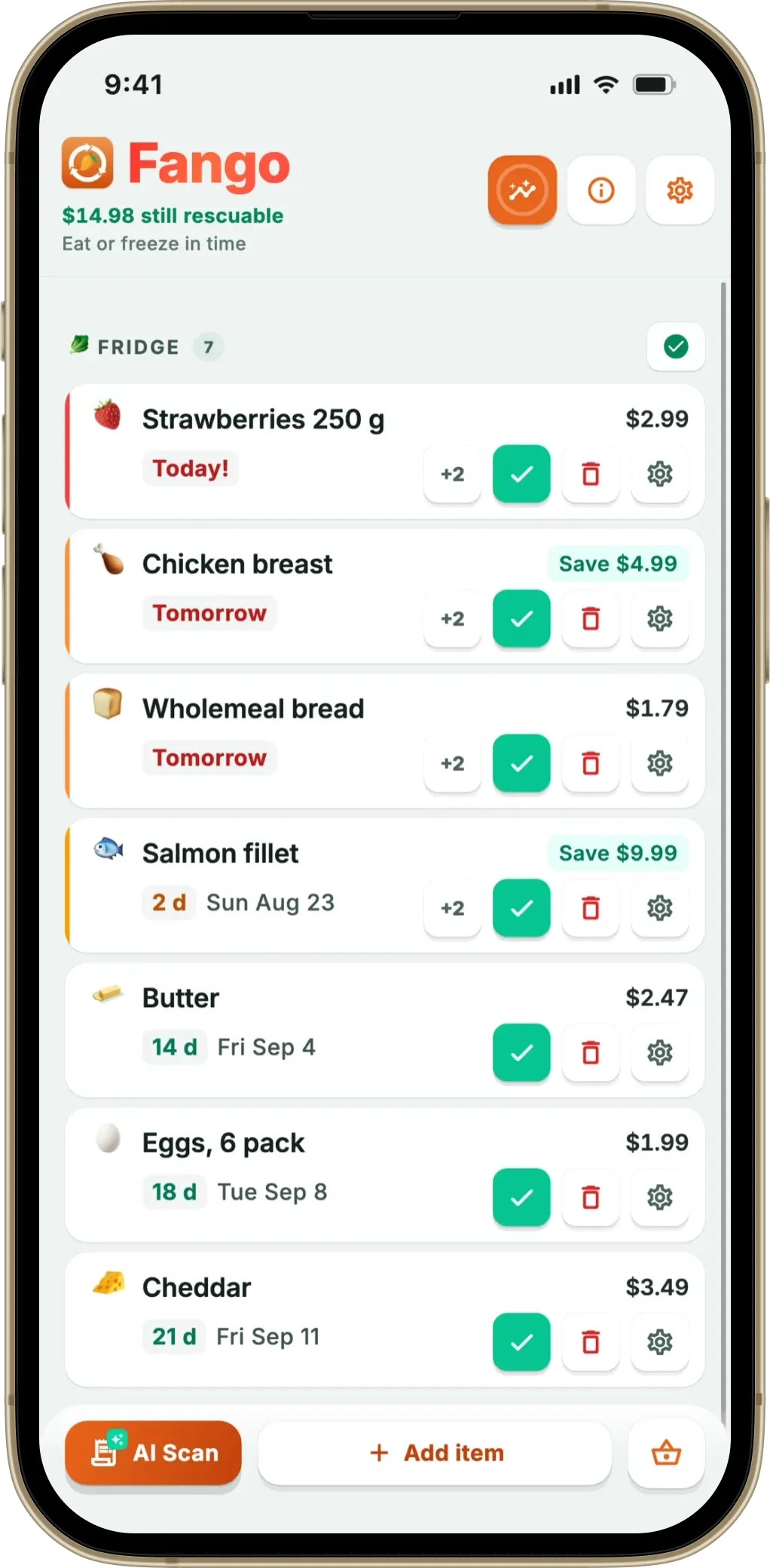
The good news is that reducing food waste at home doesn’t require a lifestyle overhaul. Small, consistent habits can cut your household’s waste in half — and put hundreds of dollars back in your pocket. Digital tools help too: the Fango app automatically reminds you in time, so nothing gets forgotten at the back of the fridge.
- Households cause 60% of global food waste — over 1 billion tonnes wasted every year
- Small consistent habits — shopping list, FIFO fridge, meal planning — can cut household waste in half
- Freeze early — don’t wait until the last day; most foods keep well for months in the freezer
- Track expiry dates automatically with an app — the most practical single fix, no daily effort needed
Why household food waste matters
Food waste isn’t just a money problem — it’s an environmental one. According to WRAP, food waste contributes around 8–10% of total global greenhouse gas emissions — five times more than aviation. Every item thrown away represents wasted water, energy, and land used to grow it.
The feature that matters most in any of these apps is the reminder — see what a good expiry date tracker app does differently.
In European households, the most wasted foods are fresh fruit and vegetables, followed by bread, potatoes, and leftovers — according to Eurostat. These are typically the items that get pushed to the back of the fridge, forgotten, and discarded. The main cause isn’t carelessness — it’s lack of visibility. When you can’t see what you have, you can’t use it in time.
7 practical tips to reduce food waste at home
-
1
Check your fridge before you shop
One of the most common causes of food waste is buying duplicates — picking up something you already have at home. Before every grocery run, spend two minutes checking your fridge, freezer, and pantry. Write your shopping list based only on what you’re actually missing. This single habit reduces both waste and spending with minimal effort.
-
2
Plan meals for the week
Meal planning is one of the most effective ways to reduce food waste. When you know roughly what you’ll cook each day, you buy only what you need — and nothing extra. You don’t need a rigid plan: even deciding on the main protein and vegetables for each day is enough to avoid the impulse purchases that end up uneaten. Flexible planning that lets you swap days around also helps reduce stress.
-
3
Organise your fridge with FIFO
FIFO — “First In, First Out” — is the stock rotation method used in professional restaurant kitchens. The principle is simple: older items go to the front, newer items go behind them. When you come home from the shop, move existing food to the front before stacking new purchases behind it. This ensures that items nearing their expiry date stay visible, not buried at the back.
-
4
Track expiry dates actively
This is where most households fall short. Expiry dates are printed on every package, but checking them daily is impractical. Fango solves this automatically: scan your grocery receipt with your phone camera, and the AI reads the products and adds them to your digital fridge. You receive a push notification 1–14 days ahead — no manual checks needed, so you stop finding out-of-date food at the back of the fridge.
-
5
Freeze before it’s too late
The freezer is one of the most underused tools in the fight against food waste. Most foods — bread, meat, fish, many vegetables — freeze well and keep for months without significant loss of quality. The key is timing: freeze items while they’re still fresh, not on the day they expire. A good rule of thumb is to freeze anything you won’t realistically use within the next two days. See our complete guide to freezing food for step-by-step instructions on any food type. And if something is already near its date, here’s exactly what to do when food is about to expire.
-
6
Store food correctly
Proper storage can significantly extend how long food lasts. Your fridge should be set to 0–5°C (32–41°F) — many home fridges run warmer than this. Some foods actually keep better outside the fridge: bananas, tomatoes, and avocados deteriorate faster when refrigerated. Fresh herbs stay fresh longer stored upright in a glass of water. Bread goes stale fastest in the fridge — store it at room temperature or freeze it. For a detailed guide, see: food storage tips — 9 rules for less waste, or a dedicated home food storage app to keep track of it all.
-
7
Do one “use-it-up” meal per week
Set aside one evening each week to cook from whatever is left in the fridge. Think of it as a creative challenge: build a meal around the vegetables, leftovers, and odds and ends that need using before the next shop. This clears the fridge, prevents waste, and often produces surprisingly good food — flavours that have had time to develop. It’s one of the simplest weekly habits you can build.
The expiry problem — and how to fix it automatically
Tip four — tracking expiry dates — is the step where most people give up. Doing it manually is tedious, and in a busy household, things slip through. By the time you notice a product has expired, it’s too late.
The practical fix is to let an app handle it for you.
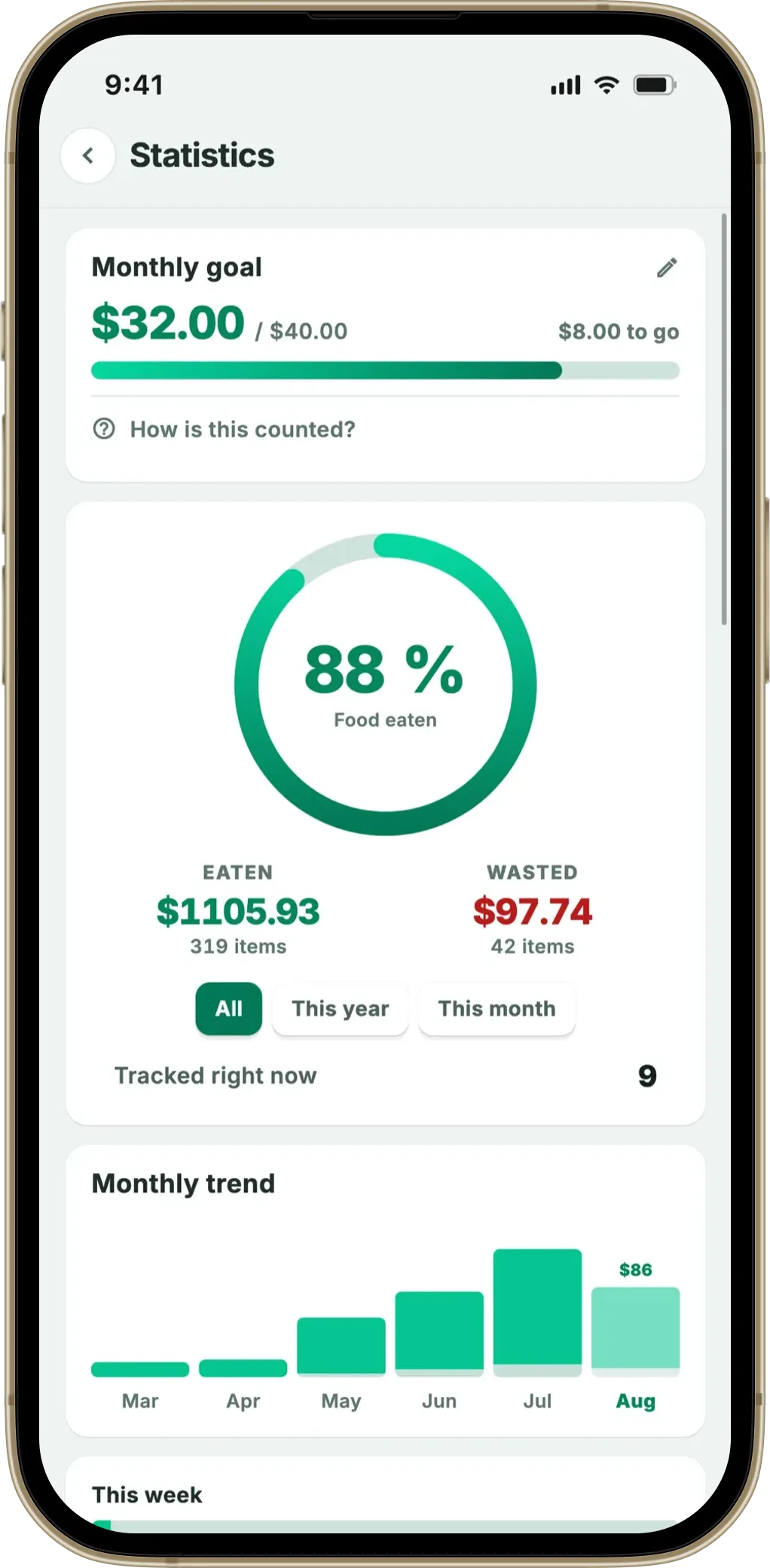
Fango works like this: you photograph your grocery receipt with your phone’s camera. The built-in AI reads the products automatically and adds them to your digital fridge. From that point on, Fango sends you a push notification before anything is about to expire — so you can use it in time instead of throwing it away.
The app requires no registration, and your data stays on your device by default. Fango is free to try for one month, then from $2.99/month.
Scan your grocery receipt with your camera — AI identifies the products and adds them to your digital fridge automatically. You get a push notification 1–14 days ahead. No sign-up required. Fridge data stays on your device by default.
Download on the App Store Get it on Google PlayFree for a month · No sign-up · iOS and Android
Small changes, real savings
Reducing food waste at home doesn’t require perfection. You don’t need to implement all seven tips at once. Pick one or two that feel easiest and build from there:
- Write a shopping list before you go to the store
- Sketch out a rough meal plan for the week
- Move older items to the front of the fridge when unpacking groceries
- Freeze anything you won’t use in the next two days
- Track expiry dates — ideally with an app, so you don’t have to think about it
Even one of these habits, applied consistently, will reduce your household’s food waste over time — and the savings add up faster than you might expect.
Frequently Asked Questions
What is the most effective way to reduce food waste at home?
The most effective single step is actively tracking expiry dates before food gets forgotten at the back of the fridge. Combined with a shopping list, FIFO fridge organisation (older items at the front), and freezing surplus before it expires, households can cut their food waste in half. Digital tools like Fango automate the expiry tracking — scan your receipt and the app reminds you in time.
How much food does the average household waste every year?
According to WRAP, UK households throw away around £17 billion of food per year — about £1,000 for a family of four (roughly 70 kg per person). In the US, the USDA estimates the equivalent figure is around $1,600 per family of four annually. Globally, households are responsible for 60% of all food waste — over 600 million tonnes per year.
What is the FIFO method for fridge organisation?
FIFO stands for First In, First Out — the stock rotation method used in professional kitchens. When you come home from shopping, move existing food to the front of the fridge and put new purchases behind. This keeps items nearing their expiry date visible so they get used first, instead of being pushed to the back and forgotten.
Does meal planning really help reduce food waste?
Yes — meal planning is one of the most consistently effective approaches. When you know roughly what you will cook each day, you buy only what you need and nothing extra. Even a loose plan — choosing the main protein and vegetables for each day — reduces impulse purchases and means you use up what you bought.
- UNEP: Food Waste Index Report 2024 — Think Eat Save: Tracking Progress to Halve Global Food Waste
- Eurostat: 130 kg of food wasted per person annually in the EU (2025)
- WRAP: UK Food Waste & Food Surplus — Key Facts
- WRAP: Food waste contributes 8–10% of global emissions
- WRAP: Household Food and Drink Waste in the UK 2022