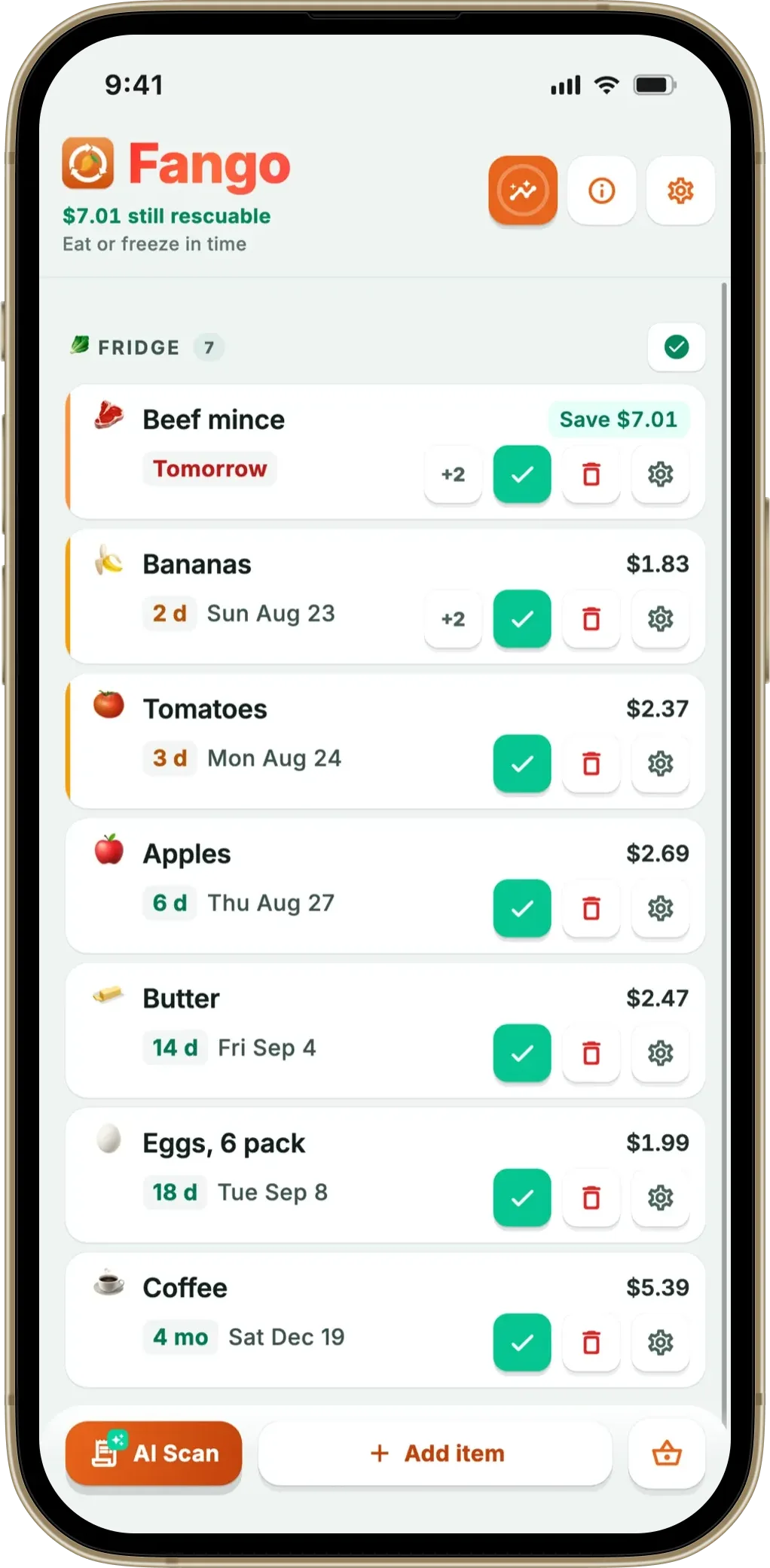
Yes — butter is one of the best dairy products to freeze. Its high fat content means it survives freezing with almost no change in taste or texture. Salted butter can be frozen for up to 12 months and unsalted for up to 6 months at best quality, and properly wrapped frozen butter is indistinguishable from fresh once thawed. For a broader guide covering all foods, see: how to freeze food — complete guide. Wondering about other dairy? Read can you freeze cheese — all types covered. Fango tracks your butter’s expiry date alongside the rest of your fridge so you always know when it’s time to use or freeze it.
Fango tracks all your dairy reminder dates and sends a push notification a few days before anything is about to run out. Scan your grocery receipt and it adds products automatically. No sign-up, fridge data stays on your device by default.
Download on the App Store Get it on Google PlayFree for a month · No sign-up · iOS and Android
- Salted butter — up to 12 months frozen; salt slows rancidity
- Unsalted butter — up to 6 months frozen; best quality for baking
- Texture and taste — almost no change; the main risk is freezer burn from poor wrapping
- Tip — frozen butter can be grated directly into pastry dough without thawing
How Long Can You Freeze Butter?
How to Freeze Butter
-
1
Keep in original wrapping if foil-wrapped. Foil wrapping is excellent for freezing — it protects against freezer burn. If the butter is in a cardboard box, remove the cardboard but keep the inner foil wrapper.
-
2
Add extra protection for long storage. Place the wrapped butter in a zip-lock freezer bag and squeeze out all the air. This extra layer prevents the butter from absorbing freezer odours over several months.
-
3
Freeze in portions if you use small amounts. Cut a 250g block into quarters before freezing, wrapping each separately. You only defrost what you need rather than the whole block.
-
4
Label with the freeze date. Butter all looks the same frozen — label salted vs unsalted and the date so you know which to use first.
How to Thaw Frozen Butter
The best way to thaw butter depends on how quickly you need it:
If keeping track of dates like these by hand is the part that never sticks, an expiry date tracker app can do it from your grocery receipt.
- Overnight in the fridge — best method; slow thawing preserves texture perfectly. Move from freezer to fridge the day before you need it.
- Room temperature — leave on the counter for 1–2 hours. Fine for most uses; butter softens evenly.
- Grated directly from frozen — the best technique for pastry, scones, and biscuits. Grate frozen butter on a box grater directly into flour. The tiny pieces of cold butter create flaky layers without any thawing required.
- Do not microwave butter to thaw — it melts unevenly, creating pools of liquid fat and a changed texture
- Do not refreeze butter that has been fully thawed and left at room temperature for more than a few hours
Does Freezing Affect Butter’s Taste or Texture?
Almost not at all — which is why butter is considered one of the most freezer-friendly foods. The high fat content (around 80%) means there is relatively little water to form ice crystals, so the structure is largely preserved during freezing and thawing.
The only real risk is freezer burn, which happens when butter is not wrapped tightly enough and the surface dries out and oxidises. Freezer-burned butter develops a slightly stale or rancid off-flavour on the surface. It is still safe to eat — you can scrape off the affected layer — but the quality is reduced. Proper wrapping prevents it entirely.
Butter can also absorb strong odours from other foods in the freezer (fish, garlic, spices). The double-wrap method — original foil plus an outer zip-lock bag — prevents this.
How to Tell If Butter Has Gone Bad
Freezing buys you months, but butter does eventually turn — and the signs are the same whether it has been frozen or kept in the fridge. Rancid butter smells sour, cheesy, or like old cooking oil, and the surface often looks darker or waxy compared with the pale interior. A bitter or “soapy” taste is the clearest signal. Rancidity is an oxidation process, not bacterial growth, so rancid butter rarely makes you ill — but the flavour ruins anything you cook with it.
This is the same quality-versus-safety distinction that applies to most dated foods: the printed date is usually a best-before date about quality, not a hard safety cutoff. If you are weighing up whether to freeze a block before it turns, the rule is simple — freeze it while it still smells clean. Dairy with a higher water content, like soft cheese, behaves differently in the freezer; see can you freeze cheese for how that compares. To stop butter being forgotten in the door of the fridge in the first place, a fridge tracker app can flag it a few days before the date.
Fango tracks all your dairy reminder dates and sends a push notification a few days before anything is about to run out. Scan your grocery receipt and it adds products automatically. No sign-up, fridge data stays on your device by default.
Download on the App Store Get it on Google PlayFree for a month · No sign-up · iOS and Android

Related reading: Can You Freeze Hummus.
Frequently Asked Questions
Can you freeze butter?
Yes — butter is one of the best dairy products to freeze. Its high fat content means almost no change in taste or texture after freezing and thawing. Salted butter freezes well for up to 12 months; unsalted butter for up to 6 months at best quality.
How long can you freeze butter?
Salted butter keeps for up to 12 months frozen; unsalted butter for up to 6 months at best quality. Both remain safe beyond these times but the flavour may gradually fade.
Does freezing change the taste or texture of butter?
No — properly wrapped frozen butter is indistinguishable from fresh once thawed. The only quality risk is freezer burn from poor wrapping, which creates an off-flavour on the surface.
How do you thaw frozen butter?
Best method: move to the fridge 24 hours before you need it. For immediate use, leave at room temperature for 1–2 hours. For pastry, grate it directly from frozen into the flour — no thawing needed.
Can you freeze salted and unsalted butter?
Yes — both freeze well. Salted butter keeps slightly longer (up to 12 months) because salt slows rancidity. Unsalted is best used within 6 months for optimal baking results.
Can you refreeze butter?
Yes, if it was thawed in the fridge and never left at room temperature for more than a couple of hours. Butter’s high fat and low water content means refreezing causes little quality loss. Avoid refreezing butter that has fully softened on the counter — the texture suffers and any absorbed odours stay locked in.
Is it better to freeze butter in foil or plastic?
Foil first, then plastic. The original foil wrapper blocks light and air far better than a plastic tub lid, and a zip-lock freezer bag over the top adds a second barrier against freezer odours. Plastic wrap alone is the weakest option because it lets odours through over several months.