The world throws away over 1 billion tonnes of food every year — and households are the biggest single source. According to the UNEP Food Waste Index Report 2024, roughly 631 million tonnes of that total comes from homes — 60% of all food waste globally. In the EU alone, food waste across the entire supply chain amounts to around 130 kg per person per year. Because households are the largest slice, the most direct lever an individual has is tracking what they buy — which is the whole premise of a food waste app.
Scan your grocery receipt — AI identifies your products and adds them to your digital fridge. You get a push notification 1–14 days ahead. No sign-up. Fridge data stays on your device by default.
Download on the App Store Get it on Google PlayFree for a month · No sign-up · iOS and Android
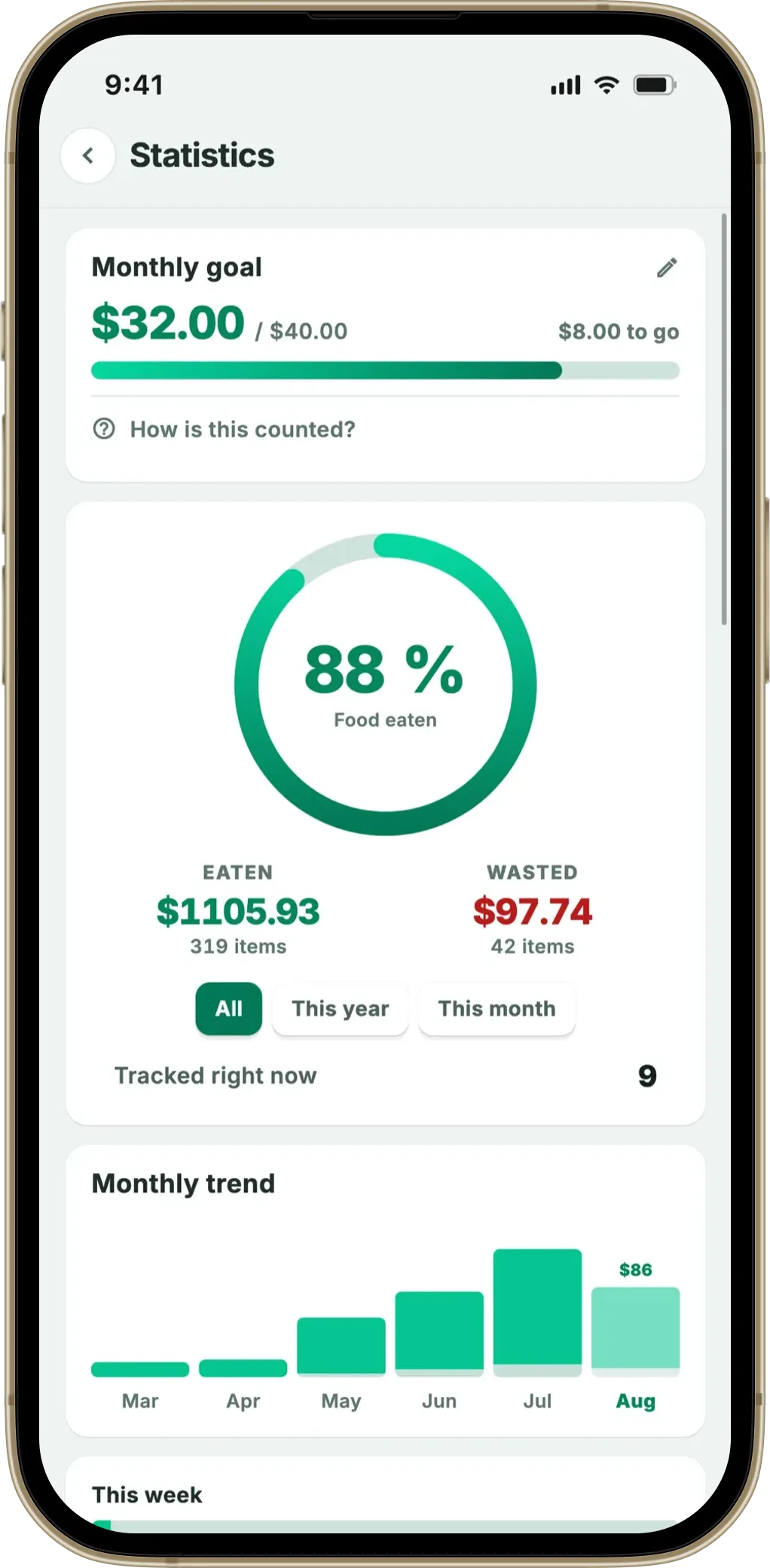
This article brings together the key facts on food waste: where it comes from, what it costs, and what it means for the environment. All figures are based on published research from UNEP, Eurostat, and WRAP.
- 1.05 billion tonnes of food wasted globally per year — 60% from households (UNEP 2024)
- UK households waste £17 billion/year in food (~£1,000 for a family of four); US families ~$1,600 — mostly perfectly edible
- 8–10% of global greenhouse gas emissions come from food waste — five times more than aviation
- Households generate 53% of all EU food waste — more than manufacturing, retail and food service combined
How much food is wasted globally and in the EU?
In 2022, the world generated 1.05 billion tonnes of food waste — equivalent to roughly one-fifth (19%) of all food available to consumers (UNEP Food Waste Index Report 2024). That works out to about 132 kg per person globally across retail, food service, and household levels combined.
If you are choosing between apps, our guide to picking an expiry date tracker lists the features that decide whether you are still using it a month later.
In the European Union, Eurostat data from 2025 puts total food waste at around 130 kg per person per year across the full supply chain. Households account for 69 kg of that — 53% of the EU total.
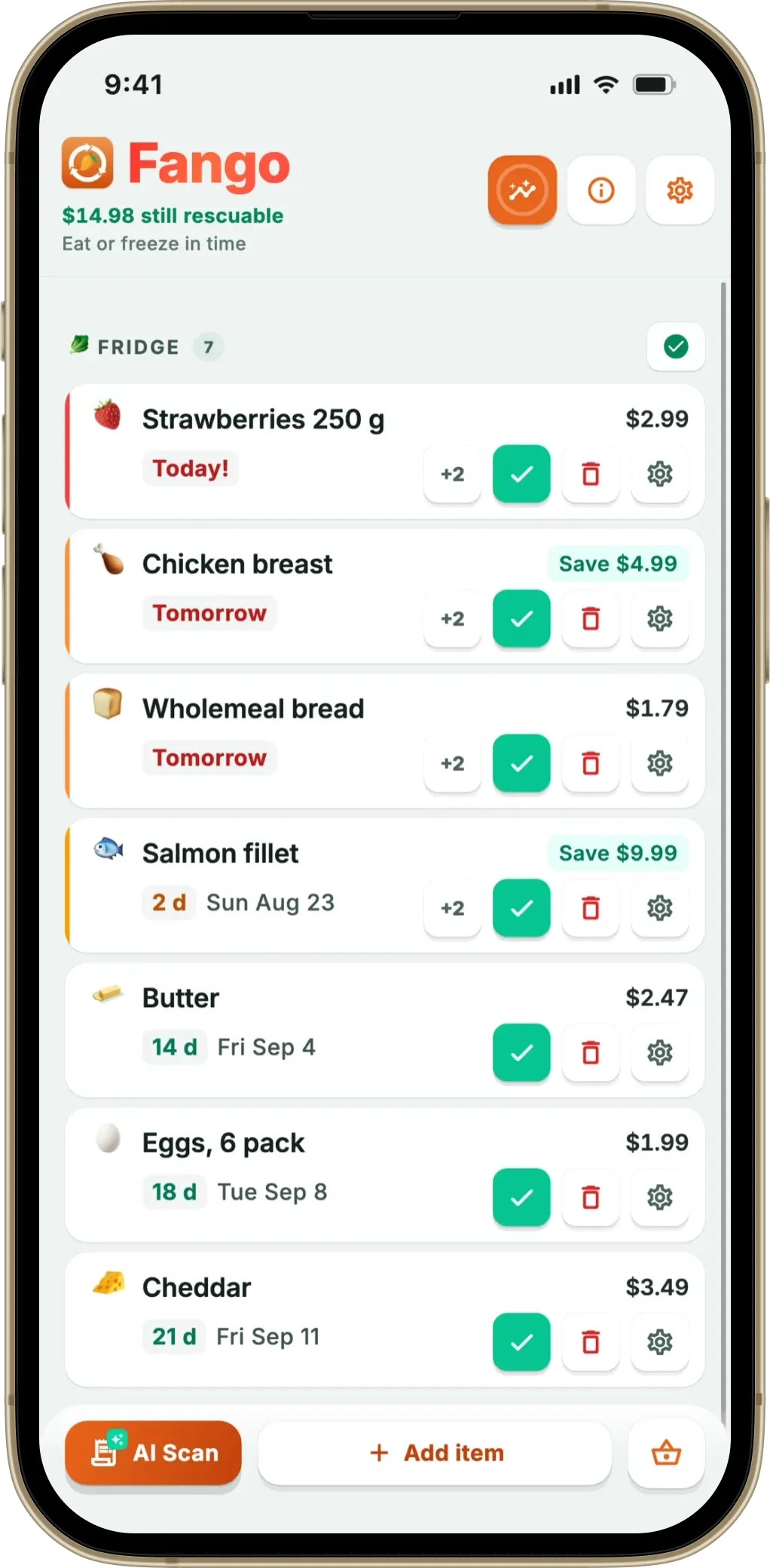
The Fango app was built specifically to address household food waste: scan your grocery receipt, and AI tracks your products and reminds you in time.
Where does food waste come from — by supply chain stage
Food waste doesn’t only happen in kitchens. It accumulates at every step of the food system, from farms to consumers. In the EU, the breakdown by supply chain stage is as follows (Eurostat 2025):
Households are by far the biggest contributor — generating more waste than manufacturing, retail, and food service combined. This makes individual behaviour one of the most powerful levers for reducing the total.
What food is wasted the most?
In households, the most wasted foods are perishables — items with the shortest shelf lives:
Vegetables and fruit are wasted most often because they deteriorate quickly and their condition can be hard to judge. Bread goes stale or mouldy before it gets eaten. Meat and fish represent a smaller share of total waste by weight, but their production is so resource-intensive that even small quantities wasted carry a disproportionate environmental cost.
What does household food waste cost?
The financial impact of food waste on individual households is substantial. According to WRAP, UK households throw away around £17 billion worth of food every year — about £1,000 for a family of four (roughly £250 per person). In the United States, the USDA estimates the equivalent figure at around $1,600 per family of four annually. For a per-week breakdown and where the money actually goes, see how much money food waste costs.
That’s a meaningful sum in any household budget. Halving your food waste would save a typical family £400 per year — without changing what you eat, only how you manage it.
The environmental impact of food waste
Food waste isn’t just a financial problem — it’s one of the most significant environmental issues we face. Growing, processing, and transporting food consumes water, land, and energy. When food is thrown away, all those resources are wasted along with it.
According to WRAP, food waste is responsible for approximately 8–10% of total global greenhouse gas emissions — five times more than the entire aviation industry. If food waste were a country, it would be the third largest emitter in the world, after the US and China.
Meat and dairy waste carries a particularly heavy environmental burden. Although they make up a relatively small share of household waste by weight, the emissions from their production mean that wasting even small quantities has an outsized climate impact.
Is the situation improving?
At the retail level, there has been measurable progress. Many retailers have cut waste significantly through dynamic pricing, donation programmes, and better inventory systems. The EU has set a target to halve food waste per capita at retail and consumer levels by 2030.
At the household level, change is slower. Despite rising food prices in recent years, the volume of household food waste has not declined significantly in most countries. One persistent barrier is practical: tracking expiry dates manually is tedious, and in a busy household things get forgotten. Fango addresses this directly — scan your receipt and the app handles the tracking automatically.
Scan your grocery receipt — AI identifies your products and adds them to your digital fridge. You get a push notification 1–14 days ahead. No sign-up. Fridge data stays on your device by default.
Download on the App Store Get it on Google PlayFree for a month · No sign-up · iOS and Android
What can you do?
The statistics show the scale of the problem, but change starts at home. Households represent 53% of all EU food waste (Eurostat), which means individual habits have real leverage. Four concrete steps:
- Check what you have before you shop. Buying duplicates — picking up something you already have — is one of the most common causes of waste. A two-minute fridge check before every grocery run pays for itself quickly.
- Organise your fridge FIFO-style: older items at the front, new ones behind. Items near their expiry date stay visible instead of being pushed to the back and forgotten.
- Freeze early — don’t wait until the last day. Meat, fish, bread, and many vegetables keep for months in the freezer with little loss in quality.
- Track expiry dates actively. This is where most households fall short. Expiry dates are on every package, but checking them daily is unrealistic. Fango solves this: scan your receipt, AI adds your groceries, and you get a push notification in time.
Want a practical guide to cutting waste at home? Read our articles on how to reduce food waste at home — 7 practical tips and how to save money on groceries.
Frequently Asked Questions
How much food is wasted globally every year?
According to the UNEP Food Waste Index Report 2024, the world generates approximately 1.05 billion tonnes of food waste every year — equivalent to around 132 kg of wasted food per person globally. This represents about 19% of all food available to consumers.
What percentage of food waste comes from households?
Households are the single biggest source of food waste — responsible for approximately 60% of global food waste. In the EU, Eurostat data shows households generate 53% of all EU food waste, or around 69 kg per person per year. This is more than manufacturing, retail, and food service combined.
What does food waste cost an average family?
According to WRAP, UK households throw away £17 billion worth of food every year — around £1,000 for a family of four (roughly £250 per person). In the US, the USDA estimates the figure at around $1,600 per family of four annually. For a typical household, halving food waste could save £500 per year without changing what you eat.
What is the environmental impact of food waste?
According to WRAP, food waste contributes approximately 8–10% of total global greenhouse gas emissions — five times more than the entire aviation industry. If food waste were a country, it would be the world’s third-largest emitter after the US and China. Every item thrown away represents wasted water, land and energy used to grow and transport it.
- UNEP: Food Waste Index Report 2024 — Think Eat Save: Tracking Progress to Halve Global Food Waste
- Eurostat: 130 kg of food wasted per person annually in the EU (2025)
- Eurostat: Food waste and food waste prevention — estimates (supply chain breakdown)
- WRAP: UK Food Waste & Food Surplus — Key Facts
- WRAP: Food waste contributes 8–10% to global greenhouse gas emissions