It depends entirely on the type. On hard cheese like cheddar or parmesan, you can cut off at least 2.5 cm (1 inch) around and below the mould and safely eat the rest. On soft cheese — and anything shredded, sliced, or crumbled — mould spreads invisibly through the cheese, so the whole thing should go in the bin. That one distinction, hard versus soft, answers almost every “can I still eat this?” cheese question.
Log cheese when you open it and Fango reminds you in time. No sign-up, your fridge data stays on your device by default.
Download on the App Store Get it on Google PlayFree for a month · No sign-up · iOS and Android
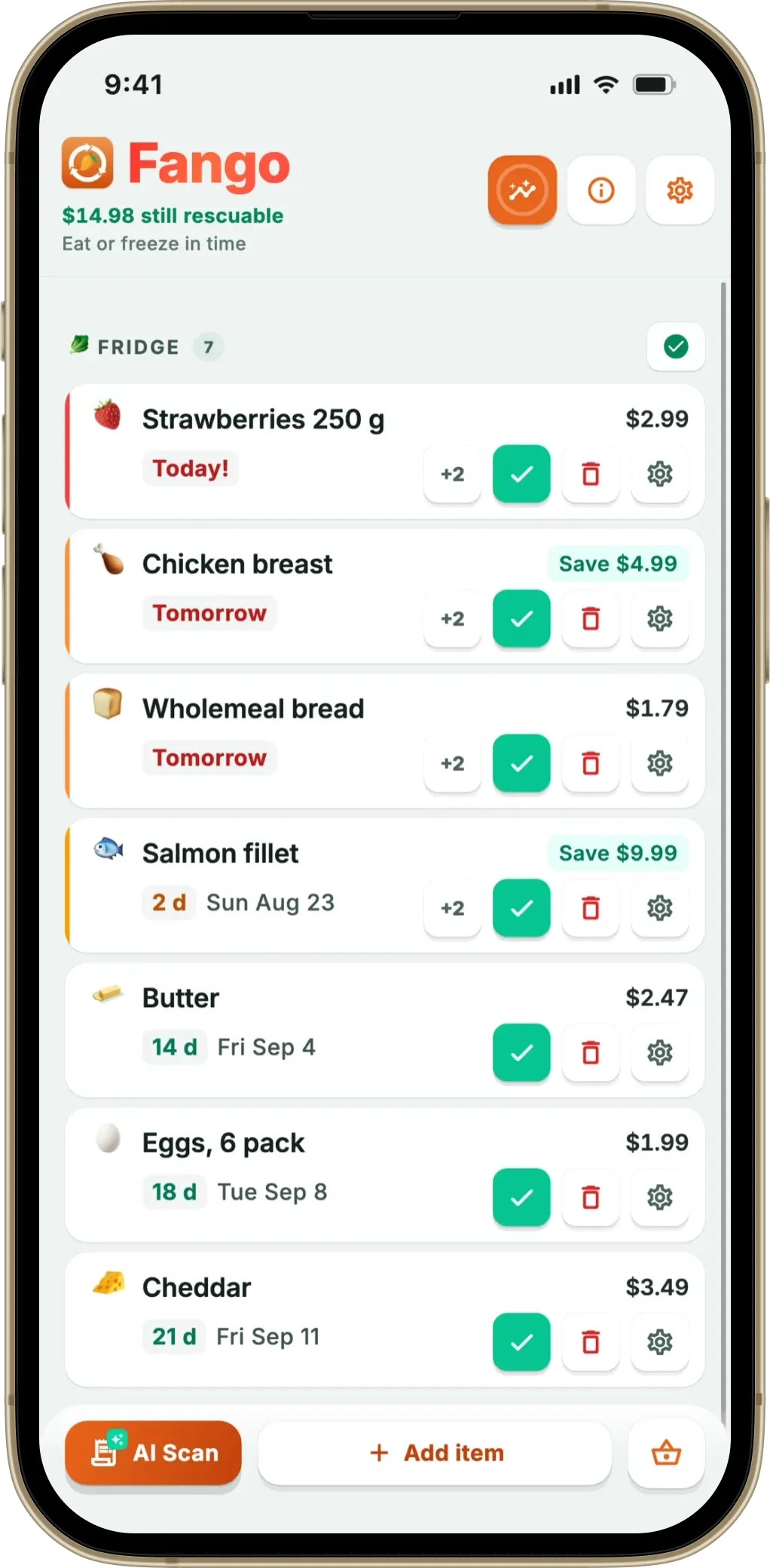
The best outcome, of course, is using cheese before it ever grows mould. Fango lets you log cheese when you open it and set an expiry reminder, so the block gets eaten while it’s still good rather than rediscovered fuzzy at the back of the fridge.
- Hard cheese — cut 2.5 cm (1 inch) around the mould, eat the rest
- Soft / shredded / sliced — throw the whole thing away
- Blue cheese and Brie — their own mould is safe; unexpected mould isn’t
- Keep the knife out of the mould so you don’t spread spores
Hard Cheese: Cut the Mould Off and Eat the Rest
For firm, low-moisture cheeses — cheddar, parmesan, gruyère, manchego, and similar — surface mould is salvageable. According to the USDA’s guidance on moulds, mould has a hard time penetrating dense cheese, so cutting it away leaves the rest safe to eat.
For the household version of this problem — remembering the dates for everything you buy — see our guide to choosing an expiry date tracker.
-
1
Cut at least 2.5 cm (1 inch) around and below the spot. Don’t just shave off the fuzzy bit — remove a generous margin in every direction, including underneath.
-
2
Keep the knife out of the mould. Avoid touching the blade to the mould itself, or you’ll carry spores onto the clean cheese. Wipe or wash the knife afterwards.
-
3
Re-wrap in fresh paper. Cover the trimmed cheese with new waxed or greaseproof paper, not the old wrapping. The rest of the block is then good to eat.
Soft Cheese: Throw the Whole Thing Away
Soft, high-moisture cheeses are the opposite — and this is where people most often get it wrong. Cream cheese, cottage cheese, ricotta, mozzarella, and any shredded, sliced, or crumbled cheese should be discarded entirely if mould appears. The USDA is clear that in soft and porous foods, mould roots spread deep below the surface, and invisible bacteria can grow alongside the mould.
If the fridge is where food gets lost, a fridge tracker app puts everything in it on one list with dates.
So with soft cheese, there’s no safe margin to cut around — the part that looks clean may not be. Bin the whole tub or block. The same applies to grated or sliced hard cheese: once it’s broken into pieces, mould and spores move between them too easily to trust. When in doubt with anything soft or shredded, throw it out. For more on handling mould across your kitchen, the NHS advises against eating mouldy soft foods.
Blue Cheese and Brie: When Mould Is Meant to Be There
Some cheeses are made with mould, and that mould is perfectly safe. The blue veining in Stilton, Roquefort, gorgonzola, and Danish blue comes from edible cultures added during production, as does the soft white rind on Brie and Camembert. Eating these as intended is completely fine.
The catch: if a different mould turns up where it shouldn’t — a fuzzy pink, grey, or green patch on the cut face of a blue cheese, or unusual growth on a Brie’s surface — don’t try to rescue it. These are soft cheeses, so treat unexpected mould the same way: discard the whole piece. The rule is simple — the mould that came with the cheese is safe; the mould that arrived later is not.
Quick Reference: Cut It or Bin It?
The short verdict for the cheeses people ask about most.
How to Stop Cheese Going Mouldy
Cheese moulds faster than it needs to when it’s wrapped badly or forgotten. A few habits keep every block fresher for longer.
-
1
Wrap it to breathe. Use waxed or greaseproof paper rather than tight cling film, which traps moisture and speeds up mould. Keep cheese at 0–5°C. See how long cheese lasts for type-by-type times.
-
2
Use a clean knife each time. Cutting cheese with a board or knife that touched mould or other food introduces spores. A clean cut keeps the block clean.
-
3
Freeze hard cheese you won’t finish. Cheddar and similar freeze well — see can you freeze cheese for which types work and how to thaw them.
-
4
Log it when you open it. Add cheese to Fango with a reminder so it’s eaten in time. For storage across your whole fridge, see how long food lasts in the fridge.
Log cheese when you open it and Fango reminds you in time. No sign-up, your fridge data stays on your device by default.
Download on the App Store Get it on Google PlayFree for a month · No sign-up · iOS and Android
Related reading: Can You Eat Mouldy Bread.
Frequently Asked Questions
Can you eat mouldy cheese?
It depends on the type. On hard cheese like cheddar or parmesan you can cut off at least 2.5 cm (1 inch) around and below the mould and eat the rest. On soft cheese, shredded, sliced, or crumbled cheese, mould can spread invisibly, so the whole thing should be thrown away.
How much do you cut off mouldy hard cheese?
Cut at least 2.5 cm (1 inch) around and below the mould spot, keeping the knife out of the mould itself so you don’t spread spores to the clean cheese. The rest of a firm cheese like cheddar is then safe to eat.
Can you cut mould off soft cheese?
No. Soft cheeses such as cream cheese, cottage cheese, ricotta, and mozzarella have high moisture, so mould roots and bacteria spread through them. If a soft cheese is mouldy, discard the whole thing rather than cutting around it.
Is the mould in blue cheese safe?
Yes. The blue veining in cheeses like Stilton or Roquefort, and the white rind on Brie and Camembert, are made with safe, edible moulds added during production. But if a different, unexpected mould appears on these cheeses, treat them as soft cheese and throw them away.
What happens if you eat mouldy cheese by accident?
A small amount usually causes no harm, but some moulds produce mycotoxins or bacteria that can cause stomach upset, nausea, or an allergic reaction. If you feel unwell after eating mouldy cheese, especially with severe or lasting symptoms, seek medical advice.
How do you stop cheese going mouldy?
Keep cheese wrapped in waxed or greaseproof paper rather than cling film, stored at 0–5°C, and use a clean knife each time. Hard cheese also freezes well if you won’t finish it in time.
The habit that saves the most cheese: log it in Fango when you open it and set a reminder. You’ll finish each block while it’s good — and the fuzzy-surprise discovery becomes a thing of the past.