“Tracking” sounds like it belongs in a fitness app — graphs and weekly summaries and a faint suggestion you should be doing better. For food expiry, the same idea has a cleaner pay-off. WRAP estimates the average UK household wastes £1,000 of edible food a year — and that number is invisible until something counts it. Fango counts it. Items you eat go on one side, items you bin go on the other, and the difference is the money you didn’t throw away this month.
This is the part of an expiry app most people skip past on day one and care about by month three. Here’s what’s worth tracking, what the numbers actually mean, and how the trends shift behaviour without nagging.
- Three numbers matter — items eaten, items wasted, money saved
- Trends stabilise around month three — first few weeks are noisy
- Repeat-offender lists are where the savings hide — same item, every month, binned
- Fango currency — receipts in EUR/SEK/USD/GBP etc. all convert to your home currency for totals
Tracking vs Reminding — The Difference
A reminder app tells you about today: “the chicken expires tomorrow”. A tracking app tells you about the last 30 days: “you saved £62, wasted £18, and the salad you buy weekly went off three times in a row.” Both matter, but they answer different questions.
The feature that matters most in any of these apps is the reminder — see what a good expiry date tracker app does differently.
Reminders prevent one waste event. Tracking changes what you put in the trolley next time. NRDC research found 73% of people misread “best before” as a safety deadline — meaning a lot of “wasted” food was probably edible. Tracking surfaces this pattern: if you’re consistently binning yoghurt one day after its date, that’s a habit to change, not a fridge to optimise. Apps built specifically to check expiry dates — or a broader expiry date app, an expiration date app, or a product expiration date app — help surface exactly this pattern.
The Three Numbers Worth Watching
-
1
Items eaten this month. The good number. Each time you mark an item as eaten, this goes up. A typical household sees 40–80 a month depending on how much you cook at home.
-
2
Items wasted this month. The number the app helps you reduce. Each “binned” tap adds to this. The honest target isn’t zero — it’s a stable single-digit count for a household of one or two, low double digits for a family.
-
3
Money saved this month. Calculated from the receipt-scanned price of each item you ate. This is the figure that makes the daily habit feel worth it — typically £20–80 a month for a household that uses the app consistently.
Fango stores prices in their original currency from the receipt, then converts to your home currency for the totals using daily exchange-rate data. If you shop across Sweden and Finland in a week, both receipts contribute to the same EUR or GBP total.
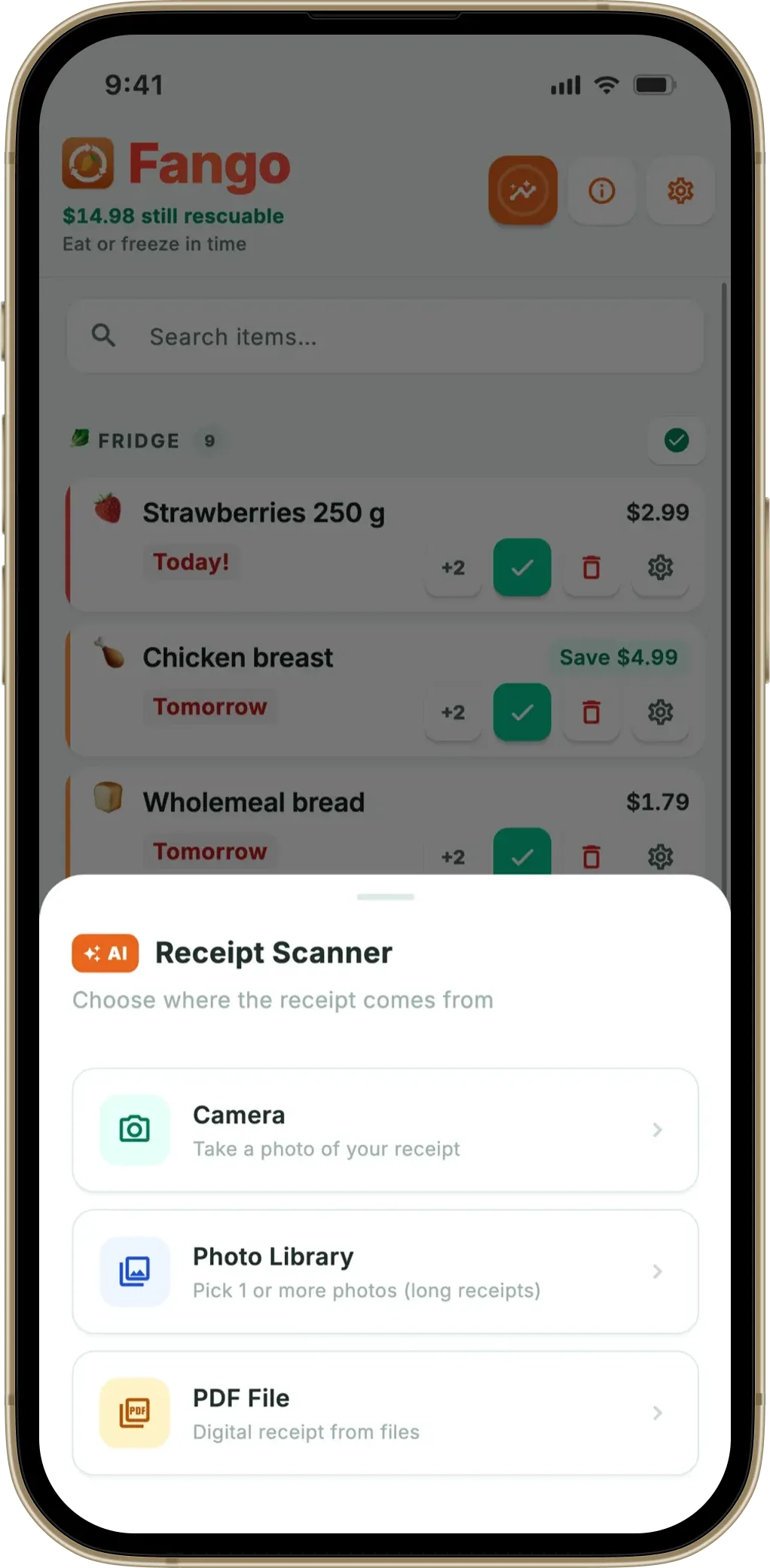
Fango shows weekly and monthly totals for items you ate, items you binned, and the money value of food saved. Trends stabilise by month three. No sign-up — your stats stay on your phone by default, not on a server.
Download on the App Store Get it on Google PlayFree for a month · No sign-up · iOS and Android
What the First Three Months Look Like
The data only starts being useful once you have a comparable second period. The pattern most users see:
- Month 1 — noisy. You’re learning to scan receipts and mark items, you forget some. Stats are incomplete.
- Month 2 — the habit stabilises. Wasted-item count usually drops 30–50% from month 1, often just because seeing the list is a nudge.
- Month 3 onward — the numbers level out. Real trend lines start to mean something. Repeat-offender items become visible.
Repeat Offenders — Where the Money Actually Hides
The single most useful pattern a tracking app surfaces is repeat waste of the same item. Common ones:
- Bagged salad — bought weekly, eaten twice, binned by Friday
- Coriander, parsley, dill — bought for one recipe, half the bunch wasted
- Greek yoghurt, large pot — three uses then forgotten at the back
- Cooked chicken — Sunday roast leftovers, binned by Wednesday
- Sourdough — too much for two people in five days
None of these can be “fixed” by a reminder — you already knew you bought a bag of rocket. They’re fixed by changing what’s on the next shopping list. The tracking screen makes the change visible without anyone having to lecture you.
Tracking the Bigger Picture
UK household food waste sits at around 70 kg of edible food per person per year, according to WRAP’s household waste figures. The personal version of that number is the one your tracking app can show you in real money. £1,000 a year across a family of four is roughly £250 per person — and getting that down by even 30% is the equivalent of a paid weekend away every year.
You don’t need to track to know that figure exists. You probably do need to track to believe it applies to you. For most people the “£0 wasted” weeks aren’t realistic, but a steady halving over six months absolutely is. For practical tactics that move the number, see how to reduce food waste at home and how to save money on groceries.
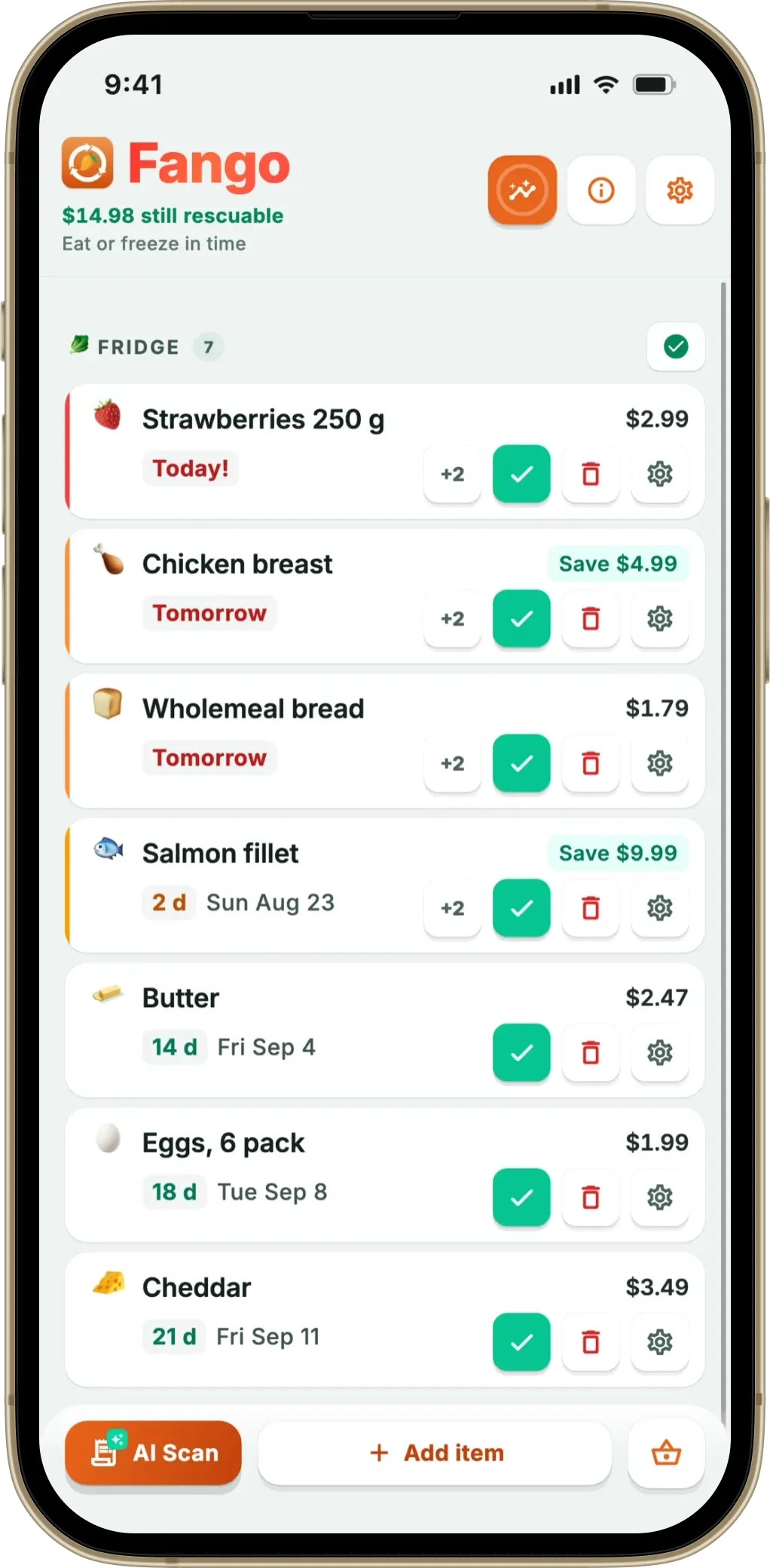
Fango sorts everything by reminder date and colour-codes the urgent items in red. The home screen widget shows what to use next without opening the app.
Download on the App Store Get it on Google PlayFree for a month · No sign-up · iOS and Android
What Tracking Doesn’t Do
It doesn’t replace cooking skills, planning, or knowing how long things actually last. It just makes the cost of forgetting visible. If you’re already great at using everything up, the numbers will be quietly green — which is its own reward, but won’t transform anything. If your bin tells a different story than your fridge, the tracking screen is where the gap shows up.
It also doesn’t share your data anywhere. Fango stores everything locally — no account, no cloud sync by default, and your fridge contents stay on the device unless you share them with your family. The stats live on the device that earned them.
Frequently Asked Questions
Is the tracking part free to try?
New users get a 1-month free trial of Fango with full access — that includes unlimited AI receipt scans and the stats screen. After the trial it’s from $2.99/month or $22.99/year, which is what makes long-term tracking worthwhile since the numbers only get useful around month three.
Can I export the tracking data?
Not currently. The stats screen shows weekly and monthly totals on-device. Because the statistics are calculated on the device, there’s no export endpoint — that’s the trade-off for not having an account.
Do the price totals include scanned items only, or manual items too?
Both — if you add a manual item with a price, it counts. Receipt-scanned items carry their printed price automatically. Items added without a price simply don’t contribute to the money totals, only to the eaten/wasted counts.
What about items I buy without a receipt?
Add them manually. Type the product name, accept the suggested expiry, optionally enter a price. They join the same list and contribute to the same stats. Receipt scanning is the bulk-input shortcut, not the only path.