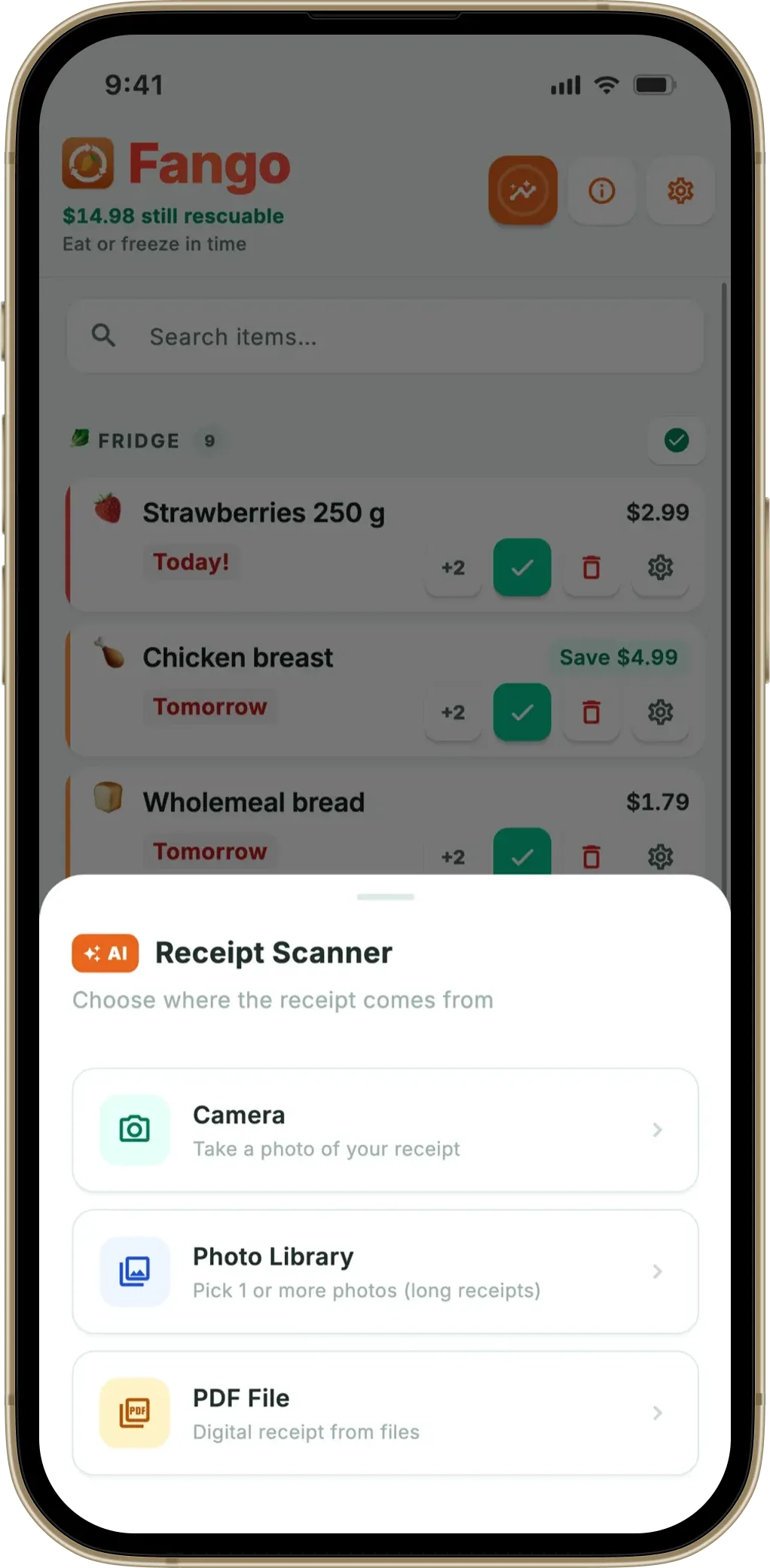
There are four reliable ways to tell if an egg has gone bad — and the most important one takes less than 10 seconds. UK Food Standards Agency guidance notes that eggs carry a best before date, not a use-by date, which means they may still be edible after the date shown — but checking freshness before you crack one into a recipe can save you from an unpleasant surprise. Fango lets you log your eggs and set a reminder before the best-before date, so you always know what’s in the fridge.
Here are the four tests, in the order you should try them.
- Float test — sinks flat = fresh; stands upright = older; floats = discard
- Smell test — the definitive check: a bad egg has an unmistakable sulphurous smell after cracking
- Visual check — pink, green or black discolouration means discard immediately
- Best before ≠ use-by — eggs past their best before may still be safe; use the tests above to check
Test 1: The Float Test (Before Cracking)
Fill a bowl or glass with cold water and lower the egg in gently. What it does tells you a lot about how old it is.
This is exactly the kind of date an expiry date tracker app reminds you about before it passes.
The float test works because eggshells are porous. As an egg ages, moisture evaporates through the shell and air enters, enlarging the air cell inside. A larger air cell makes the egg more buoyant. A floating egg is not automatically rotten — but it is old, and quality (particularly the yolk and white structure) has declined. The smell test will give you the final answer.
Test 2: The Smell Test (After Cracking)
This is the most reliable test and the one that gives a definitive answer. Crack the egg into a bowl — not directly into your recipe.
A bad egg has a strong, unmistakable sulphurous or “rotten” smell. It is not subtle. You will know immediately. If the egg smells like this, discard it and the bowl’s contents, and wash the bowl thoroughly.
A fresh egg has a mild, neutral or slightly eggy smell — nothing offensive. A sulphurous smell is a clear signal to discard, but its absence is not proof of the opposite: use the smell test to rule an egg out, never to rule one in.
Test 3: The Visual Check (After Cracking)
After cracking the egg into a bowl, look at the contents before using them:
-
1
Yolk — A fresh egg has a round, firm, high-standing yolk. An old yolk is flat and spreads across the bowl. A yolk with pink, green, or black discolouration means the egg is rotten — discard it immediately.
-
2
White (albumen) — A fresh egg white is thick and gelatinous, staying close to the yolk. An older egg white is thin and watery, spreading widely. Very thin whites indicate age. Discolouration (pink, green) in the white is a sign of bacterial contamination.
-
3
Shell (before cracking) — Fresh eggs have a slightly rough, chalky shell. An old or bad egg may have a slimy or powdery coating. Visible mould on the outside of the shell is a clear sign to discard without cracking.
- Pink or iridescent white = bacteria contamination — discard immediately
- Green ring around hard-boiled yolk is normal (iron/sulphur reaction) — not a safety issue
- Blood spots in the yolk are harmless — a natural occurrence, safe to eat
- Mould on the shell = discard without cracking
Log your eggs when you buy them — Fango sends a push notification before the best-before date. No float test needed when you know the exact date. No sign-up, fridge data stays on your device by default.
Download on the App Store Get it on Google PlayFree for a month · No sign-up · iOS and Android
Test 4: The Candle Test (Without Cracking)
Hold the egg up to a bright light source — a torch or sunlight works well. A fresh egg is mostly opaque with a small, defined air cell at the wide end. As the egg ages, the air cell grows larger and you can see it clearly. A very large air cell or movement of the contents when you tilt the egg indicates it is old. This test is less precise than the float test but works without water.
How Long Do Eggs Last?
For the full breakdown with storage tips, see: how long do eggs last in the fridge?
Should You Keep Eggs in the Fridge?
In the UK, yes. UK eggs are not washed before sale — their natural protective coating (the cuticle) is intact, which means they can safely be stored at room temperature for a week or two. However, refrigerating eggs keeps them fresh for significantly longer (3–5 weeks) and is the recommended practice. Once an egg has been refrigerated, don’t move it back to room temperature — the resulting condensation can promote bacterial growth.
American eggs are washed before sale, removing the cuticle, which is why US guidelines require refrigeration. UK eggs may be sold and stored at room temperature, but the fridge is still the better option for longevity.
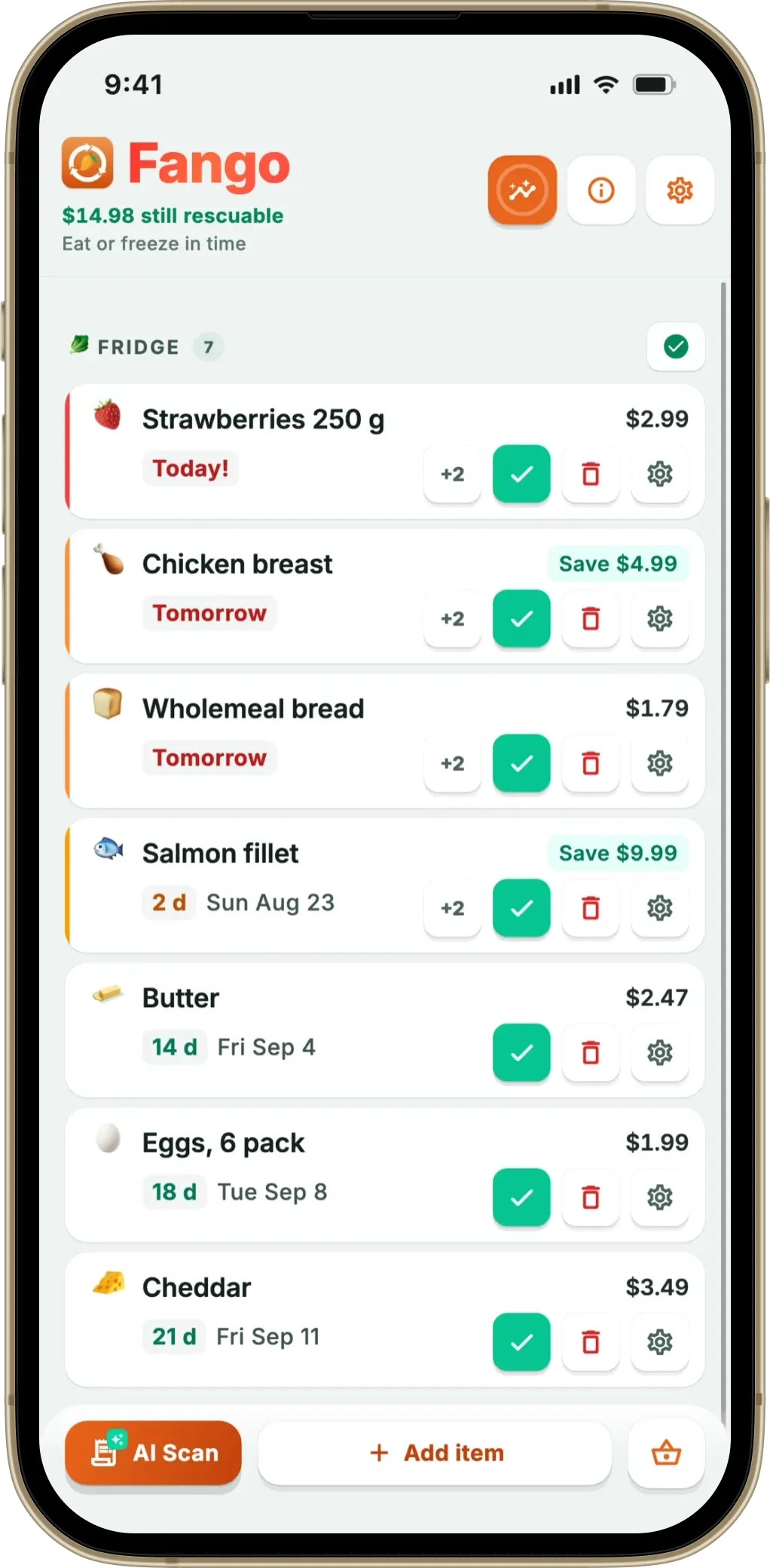
Fango sorts everything by reminder date and colour-codes the urgent items in red. The home screen widget shows what to use next without opening the app.
Download on the App Store Get it on Google PlayFree for a month · No sign-up · iOS and Android
Can You Eat Eggs Past Their Best Before Date?
Eggs in the UK carry a best before date — typically 28 days from laying. This is a quality indicator, not a safety deadline, the same distinction explained in our best before app guide. After the best before date, the egg may be safe to eat but its quality (flavour, yolk firmness, white structure) has declined.
Use the float test and smell test to assess freshness. A floating egg, a sulphurous smell, or pink, green or black discolouration each mean discard. Passing all three does not prove an egg is safe — it only means nothing has shown up — so cook eggs thoroughly and treat the best before date as the limit rather than stretching it.
- Do not eat eggs more than 2 weeks past their best before date
- Vulnerable groups (pregnant, elderly, young children, immunocompromised) should follow the best before date strictly
- Always cook eggs thoroughly when in doubt — avoid runny yolks in older eggs
Related reading: How to Tell if Yogurt Is Bad.
Frequently Asked Questions
How can you tell if an egg is bad without cracking it?
Use the float test: place the egg in a bowl of cold water. A fresh egg sinks and lies flat. An egg that stands upright or floats is older. A floating egg should be smell-tested after cracking before eating.
Does a floating egg mean it’s rotten?
Not necessarily — it means it’s old. The air cell inside has expanded as moisture evaporated through the porous shell. A floated egg may still be safe; crack it into a bowl and smell it. A sulphurous smell means rotten; a neutral smell means it may still be edible.
What does a bad egg smell like?
A bad egg has a strong, unmistakable sulphurous or “rotten egg” smell. It is not subtle — you will know immediately when you crack one open. Fresh and slightly old but still safe eggs have a mild, neutral smell.
Can you get sick from eating a bad egg?
Yes. Spoiled eggs can carry Salmonella and cause food poisoning — symptoms include nausea, vomiting, diarrhoea, stomach cramps, and fever, typically starting 6–72 hours after consumption. Cooking thoroughly reduces (but does not eliminate) risk from spoiled eggs; the safest approach is not to eat a bad egg.
Can you freeze eggs?
You cannot freeze whole eggs in their shell — they will crack. But you can beat the yolk and white together and freeze the mixture in an airtight container for up to 12 months. Alternatively, freeze yolks and whites separately. Thaw in the fridge and use within 24 hours. Full guide: can you freeze eggs?
The simplest way to avoid the guessing game entirely: log your eggs in Fango when you buy them. You’ll get a reminder before the best-before date — no float test required.