Most food tracking apps start with the same screen: “Create an account to continue.” That means entering an email address, choosing a password, finding the verification link, accepting a privacy policy — and by the time you’re done, the groceries are already in the fridge. Untracked. Fango skips all of that: download the app, open it, and you’re tracking immediately. No account, no forced cloud, no friction.
Scan your grocery receipt — AI identifies the products and adds them automatically. Get a push notification in time. No sign-up, no email, your fridge data stays on your device by default.
Download on the App Store Get it on Google PlayFree for a month · No sign-up · iOS and Android
According to UNEP, around a fifth of the food available to consumers globally is wasted every year. WRAP estimates UK households alone throw away around 6.4 million tonnes of food annually — worth £17 billion. A significant share of that waste happens at home — in the fridge, where things quietly expire before anyone notices. The best tool for reducing that waste is one you actually use consistently. And consistency starts with removing barriers. Looking for a full overview? See our guide to the best food waste app and how fridge tracker apps work.
- No account needed — download and start tracking immediately
- Your fridge data stays on your device by default — no cloud sync, no user account
- Full features without sign-up: AI receipt scanning, push reminders, fridge tracker
- Privacy by design — no email stored, no usage data linked to your identity
Why most food waste apps require an account
Account-based food apps are the norm for a few business reasons. Cloud storage makes it possible to sync data across multiple devices — your phone, your partner’s phone, a tablet. Subscription billing requires a user identity to attach to. And usage analytics — which screens people visit, which features they use — are far easier to collect when each user has a unique identifier.
If you are choosing between apps, our guide to picking an expiry date tracker lists the features that decide whether you are still using it a month later.
None of these are sinister. But they do mean the app is collecting and storing data about you on a server somewhere. Your grocery habits. What you eat. How often you shop. That data is useful to the company building the app — and it becomes a liability if they ever get breached. It’s the same reason a genuinely privacy-first food app keeps everything local, and why a food app with no cloud sync by default has nothing on a server to lose in the first place.
The real cost of registration friction
Food tracking is a habit. Like any habit, it only works if the barrier to doing it is low. You come home from the supermarket, bags in hand, and you need to open the app and scan or enter what you bought. If that step requires opening an app, logging in, or waiting for a sync — it doesn’t happen.
Research consistently shows that apps lose a substantial share of new users at the registration step. More importantly, for an app you’re supposed to use every time you shop — typically two or three times a week — any extra tap or second of friction compounds. Over weeks, the habit either forms or it doesn’t.
A food tracking app that you don’t open every time you shop is just another app on your phone. It doesn’t reduce food waste. The registration requirement, however reasonable it seems, works against the habit it’s supposed to support.
How Fango works without an account
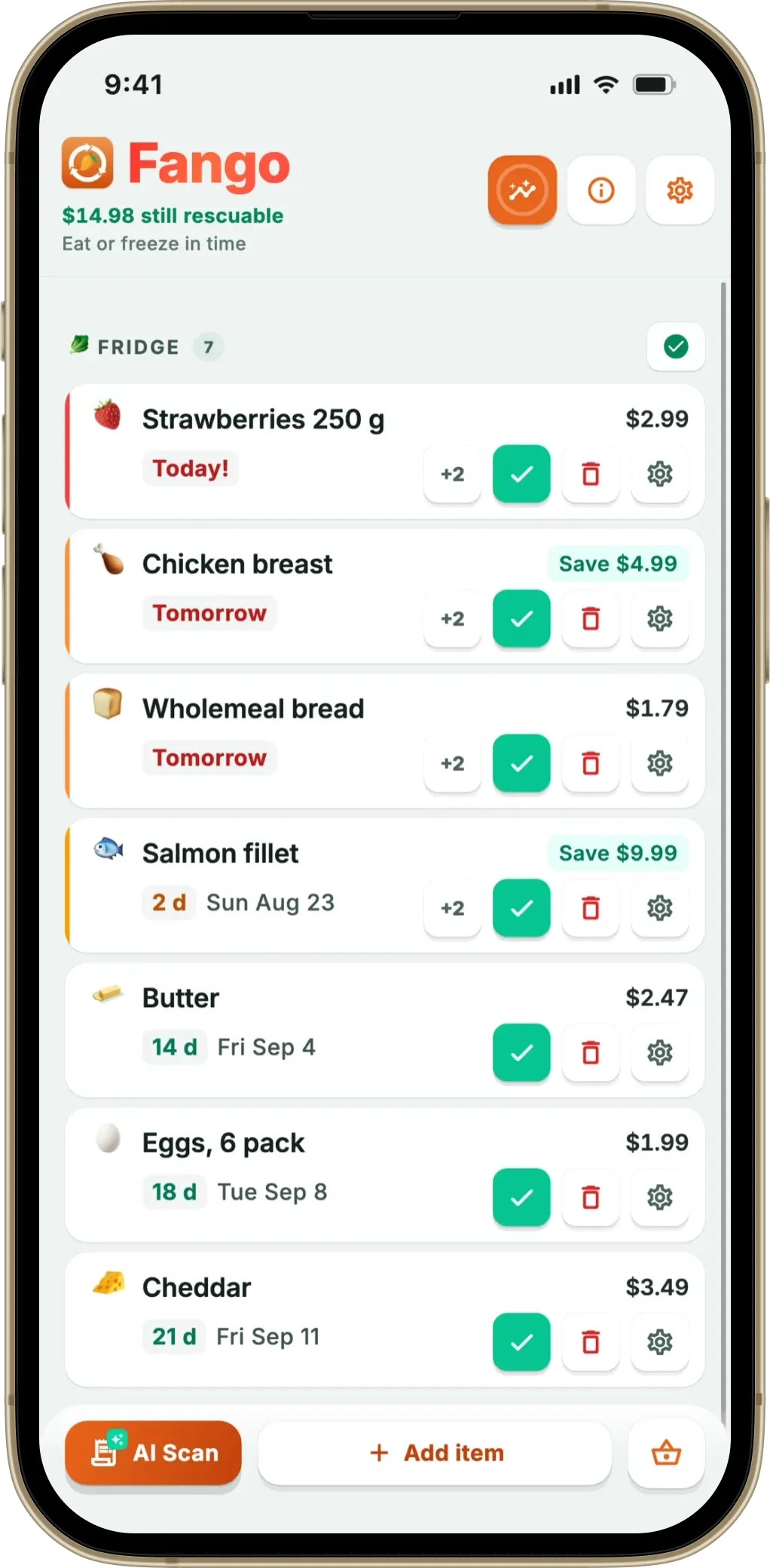
When you download Fango, there is no sign-up screen. You open the app and you’re looking at your fridge — empty, ready to be filled. From that moment:
-
1
Scan your receipt. Point your phone camera at your grocery receipt. Fango’s AI reads the products, estimates reminder dates based on the item type, and adds them to your fridge automatically. The scan itself takes seconds; the whole process, review included, is under a minute.
-
2
Add items manually if needed. Anything not on a receipt — produce bought loose, items from the market — can be added manually with a name, category and expiry date.
-
3
Set your reminder window. Choose how many days before expiry you want a push notification. The default is three days, but you can set anything from one to fourteen.
-
4
Get notified in time. Fango sends a push notification when something in your fridge is approaching its reminder date. You see it on your lock screen — no app-opening required to be reminded.
The fridge list itself lives entirely on your device. The product names, dates and quantities you save stay on your phone by default unless you share the fridge with your family. The one exception is receipt scanning: when you photograph a receipt, the image is sent to an AI service (Anthropic Claude, via a Supabase proxy) for product recognition, then discarded — Anthropic does not train on the data, and Fango itself has no server holding your grocery history.
What you get without paying or signing up
Fango is free to download and free to try for one month, with no account required. After the trial it’s from $2.99/month or $22.99/year. Here’s what’s included:
No account vs account-based: a comparison
| Feature | Fango (no account) | Typical account-based app |
|---|---|---|
| Time to first use | Immediately after download | After sign-up and email verification |
| Data location | On your device | On the company’s servers |
| Privacy | No account · no food or receipt data collected | Email + usage data stored |
| Works offline | Yes (except receipt scan) | Varies — often requires sync |
| Multi-device sync | ✓ in household sharing | Yes |
| Risk if app shuts down | Your data stays on your phone by default | Data may be lost |
← scroll →
Scan your grocery receipt — AI identifies the products and adds them automatically. Get a push notification in time. No sign-up, no email, your fridge data stays on your device by default.
Download on the App Store Get it on Google PlayFree for a month · No sign-up · iOS and Android
Is it safe to use an app with no account?
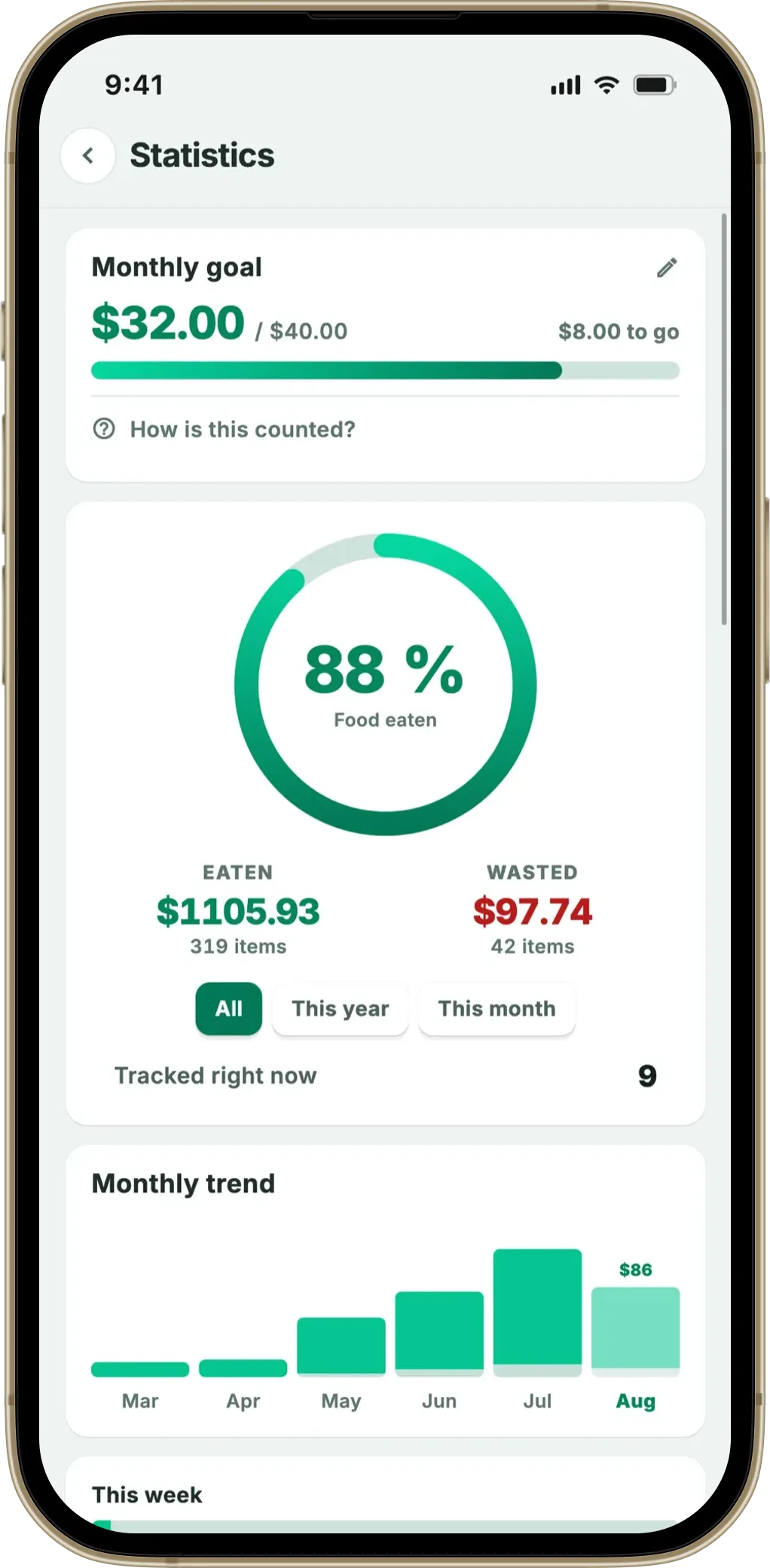
The short answer: yes — and in some ways it is more secure than an account-based app. When there is no account, there is nothing to breach on a server. No database of email addresses and hashed passwords that could be exposed in a data leak. Your grocery data exists only on your phone, protected by your phone’s own security: Face ID, Touch ID, fingerprint or your passcode.
The tradeoff is that there is no automatic cross-device sync and no cloud backup by default unless you opt into family sharing. If you switch phones, you start fresh. For most people tracking a single household fridge, that’s a perfectly acceptable trade for the privacy and simplicity it offers.
The same applies to the shopping list. It reads your fridge list and your scanned receipts to suggest what is running low, but the whole calculation runs on the phone. No account, and by default nothing synced to a server. Sharing the list is still possible without one: an invite code puts it on up to four phones in the same household. It is the same trade-off the rest of the app is built on.
Frequently Asked Questions
Does Fango work without an account?
Yes. Fango requires no account, no email and no password. You download the app and start tracking immediately. Your fridge data — product names, expiry dates, quantities — is stored locally on your device. The one exception is optional receipt scanning: the image is sent via Supabase Edge Function to Anthropic Claude AI for product recognition, then discarded. Anthropic does not train on the data.
Does a food waste app work offline?
Fango works offline for all core features: viewing your fridge, editing products, and receiving push notifications. An internet connection is only needed when scanning a grocery receipt with AI, as the image needs to be processed. Once the products are added, everything works fully offline.
Can I sync Fango between multiple devices?
Fango keeps your data on your own device by default. Your fridge data stays on your phone by default — there is no cloud sync between devices. This is an intentional privacy-first choice: no account means no user identity attached to your grocery data.
Is it safe to use a food app with no account?
Yes — it is actually more private. With no account, there is no email address stored on a server, no password to leak, and no browsing or usage data linked to your identity. Fango stores everything locally on your device, which is protected by your phone’s own security (Face ID, Touch ID, fingerprint or passcode).
Is Fango free?
Yes. Fango is free to download with no registration required, and free to try for one month. After the trial it’s from $2.99/month or $22.99/year, with every feature carrying on unchanged.