A food tracking app needs to know exactly what’s in your fridge — which is also a detailed map of what you eat, when you shop and how much you spend. According to the NRDC, 73% of people read a date label as a safety deadline rather than a quality guide, so the apps that help are genuinely useful. But most of them want an account and quietly upload that grocery history to their servers. Fango takes the opposite approach: a privacy-first food tracking app keeps everything on your phone unless you choose to share it.
Scan your grocery receipt — AI reads the products and adds them to your fridge automatically, then reminds you 1–14 days ahead. No sign-up, no cloud account by default, all data stays on your device by default.
Download on the App Store Get it on Google PlayFree for a month · No sign-up · iOS and Android
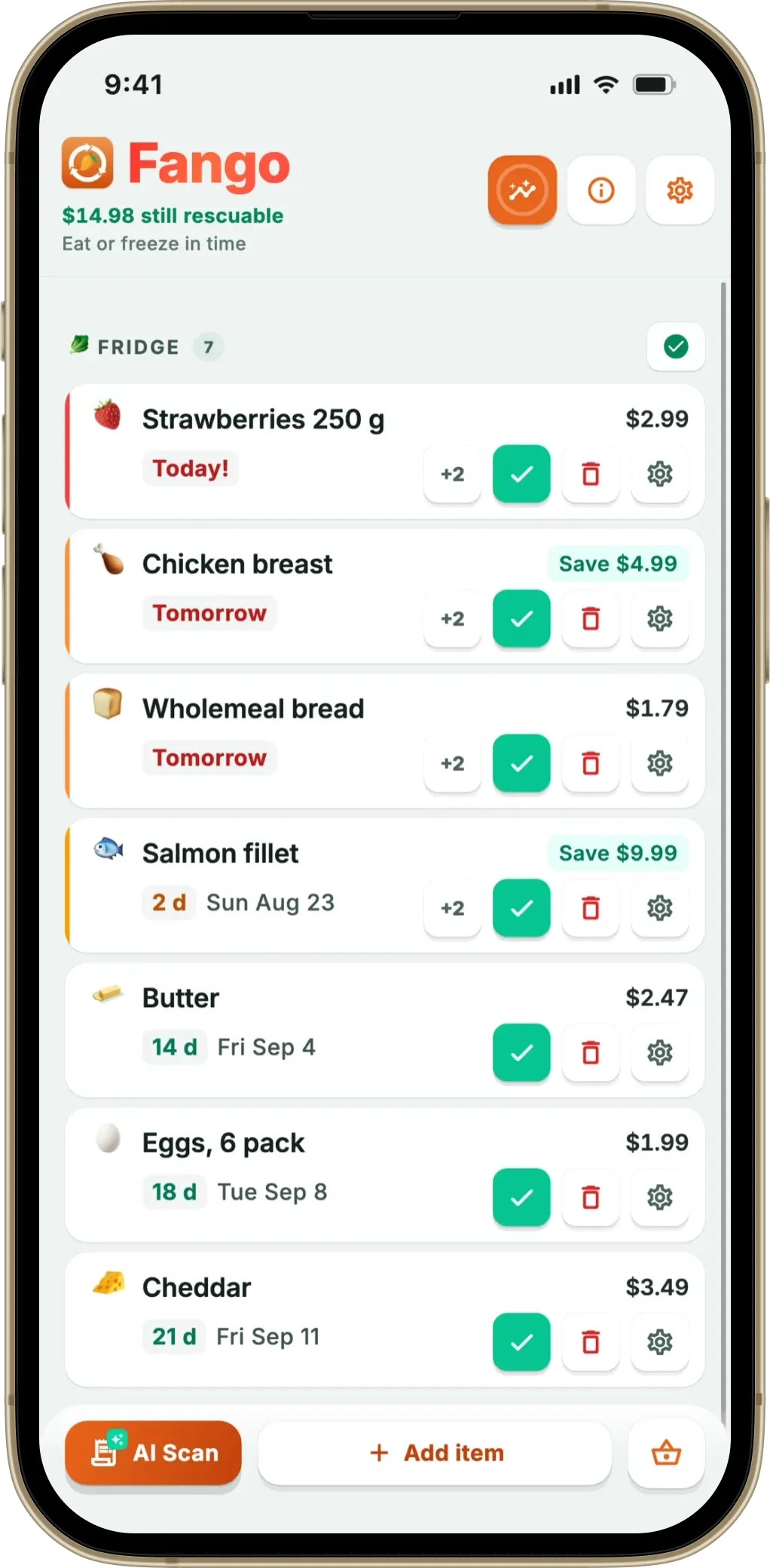
This guide explains what “privacy-first” actually means for a food app, why most apps want your data anyway, and exactly how Fango keeps your list, dates and spending on your device — with no account behind it.
- Privacy-first = local-first — your product list, expiry dates and statistics live on your phone by default, not a company server.
- No account, no email — Fango works with zero sign-up, so there’s nothing to leak, sell or breach.
- Data minimisation — unless you share a household, the only thing that leaves your phone is the receipt during a scan, sent once to read the products, then discarded.
- The trade-off — without family sharing there is no automatic cross-device sync; your data stays on the device you installed it on.
What “privacy-first” actually means in a food app
A privacy-first food app stores your data on your own device instead of a company server, works without an account, and never sells or shares your grocery history. The only data that should leave your phone is the minimum a single feature needs — and only for the moment it needs it. Everything else stays local.
The feature that matters most in any of these apps is the reminder — see what a good expiry date tracker app does differently.
In practice that breaks down into four tests you can apply to any app on the store:
- Local storage — your fridge list, dates and stats are saved on the phone and, unless you share them, not mirrored to a database.
- No mandatory account — you can use the core features without handing over an email or creating a password. A food waste app with no registration has nothing to breach in the first place.
- Data minimisation — the app collects the least it can, not the most it can get away with.
- No third-party tracking — no advertising SDKs quietly profiling you across other apps.
Why food tracking apps usually want your data
Most food apps want your data because their business model depends on it, or because cloud sync is simpler to build than local-first storage. An account lets them store your inventory on a server, run features across devices, send marketing email — and, in some cases, build an aggregate picture of shopping habits that has value of its own.
None of that is necessary to do the actual job. The job is small and personal: keep a list of what you bought, estimate when each item goes off, and remind you in time. A well-built fridge tracker app can do all of that on the phone itself. The cloud account is there for the company’s convenience far more often than yours — and once your grocery history is on someone else’s server, a data breach somewhere else becomes your problem too.
How Fango keeps your data on your device by default
Fango stores your product list, reminder dates and saving statistics locally on your phone. There is no user account, so none of it is tied to an identity or copied to a server you don’t control. Data leaves the device in exactly two situations, and you choose both: a receipt scan, where the image is read and then discarded, and household sharing, where the contents of a shared fridge travel through a server so the rest of your household can see them. Switch neither on and nothing leaves the phone.
Here’s the full data path when you scan a receipt:
-
1
On iOS, the text is read on the phone. Google’s on-device ML Kit recognises the receipt text locally, and only that text — not the photo — is sent to the AI to identify products.
-
2
On Android, the image is sent once. The receipt photo is sent to the AI vision model a single time to read the products, then it isn’t stored.
-
3
The result comes back to your phone. The recognised products land in your list locally. From that point everything — dates, edits, statistics, reminders — happens on the device.
So, household sharing aside, the receipt is the only thing that ever travels, it travels once, and it isn’t kept. Your ongoing fridge list goes to a server only if you share it. You can read more about the scanning step in our guide to the grocery receipt scanner app and how the AI reads your receipt. If you’re weighing up the risk itself, see is it safe to scan your receipts with an app.
Privacy-first vs a typical cloud food app
The clearest way to see the difference is side by side. A typical cloud app trades your data for convenience features; a privacy-first app keeps the data and asks you to live without a couple of those features.
| What happens to your data | Fango | Typical cloud food app |
|---|---|---|
| Account / email required | ✗ None | ✓ Usually |
| Fridge list stored on a server | ✗ On device by default | ✓ In the cloud |
| Grocery history tied to your identity | ✗ No identity to tie it to | ✓ Often |
| Personal cross-device sync | ✗ Not offered | ✓ Yes |
| Marketing email after sign-up | ✗ No address to email | ✓ Common |
← scroll →
What you give up — and what you don’t
Being honest about the trade-off matters. Keeping data on the device means there is no cloud copy unless you share a fridge, so two things work differently than in an account-based app. Everything else — scanning, reminders, statistics — is exactly the same.
You give up automatic cross-device sync. Your list lives on the phone you installed Fango on. If you switch phones, your data doesn’t follow you through a cloud login. A device-level backup (iCloud or Android backup) can carry it across, but there’s no Fango account doing it for you.
You give up server-side recovery. If you delete the app without a device backup, the list is gone, because it was never anywhere else. That’s the flip side of “never on a server.”
You don’t give up the core job. AI receipt scanning, on-device expiry tracking, push reminders with one-tap actions and your savings statistics all work fully offline after a scan. If anything, a privacy-first app is more reliable day to day, because it isn’t waiting on a server to load your fridge. For most people the trade is simple: lose sync, keep your grocery history to yourself.
Scan your grocery receipt — AI reads the products and adds them to your fridge automatically, then reminds you 1–14 days ahead. No sign-up, no cloud account by default, all data stays on your device by default.
Download on the App Store Get it on Google PlayFree for a month · No sign-up · iOS and Android
How to choose a privacy-first food app
If you’re comparing options, the privacy claims worth trusting are the ones that are structural, not promised. An app that has no account literally cannot leak your account. Run through this short checklist before you install anything:
-
1
Check whether an account is required. “Works with no sign-up” is the strongest privacy signal there is — it means there’s no central database of users to begin with.
-
2
Read what leaves the device. A privacy-first app should be able to tell you exactly what’s sent and when. For Fango it’s one thing: the receipt, once, during a scan.
-
3
Look for data minimisation, not promises. “We won’t sell your data” is weaker than “we never collect it.” Prefer apps that don’t gather it in the first place.
-
4
Decide if you need sync. If you genuinely need the same list on two phones, a cloud app may suit you. If you don’t, local-first gives you the same result with far less exposure.
Once you’ve settled the privacy question, the rest of the comparison is about the actual features. Our roundup of the best food waste tracker apps and the guide to reducing food waste at home cover what to look for next — and if budget is the deciding factor, see the best free food waste app.
Frequently Asked Questions
What makes a food tracking app privacy-first?
A privacy-first food app stores your data on your own device instead of a company server, works without an account or email, and never sells or shares your grocery history. The strongest signal is structural: an app that has no account literally cannot leak your account. The only data that should ever leave your phone is the minimum a single feature needs — and only for the moment it needs it.
Does Fango upload my grocery list to the cloud?
No. Your product list, expiry dates and statistics stay on your device by default. The only thing that leaves your phone is the receipt during a scan: it’s sent once to the AI to read the products, then it isn’t stored. The one exception to local storage is household sharing, which you switch on yourself and in which the shared fridge passes through a server to reach the other members. Nothing is linked to an account, because there is no account.
Can I use a food tracking app without an account?
Yes. Fango needs no sign-up, email or password — you install it and start scanning straight away. The trade-off is that without a cloud account there’s no automatic sync between your own devices, so unless you share a household, your data lives on the phone you installed it on. A device-level backup can move it to a new phone.
Is a privacy-first food app free to try?
Fango is free to try for a month, with no account: you get full access to every feature during the trial. After that it’s a monthly or yearly subscription, with the price for your country shown in the app. Privacy is identical during the trial and afterwards — the data stays on your device by default either way.