Almost everyone underestimates how much food they throw away, because it never happens all at once. A yoghurt here, half a bag of salad there, a forgotten pack of chicken — each feels too small to count, and together they add up to a startling amount by the end of the month. You can’t cut waste you can’t see, so the first real step is measuring it. This guide covers a simple way to track how much food you waste, what’s actually worth measuring, and how to make it stick without turning your kitchen into a spreadsheet.
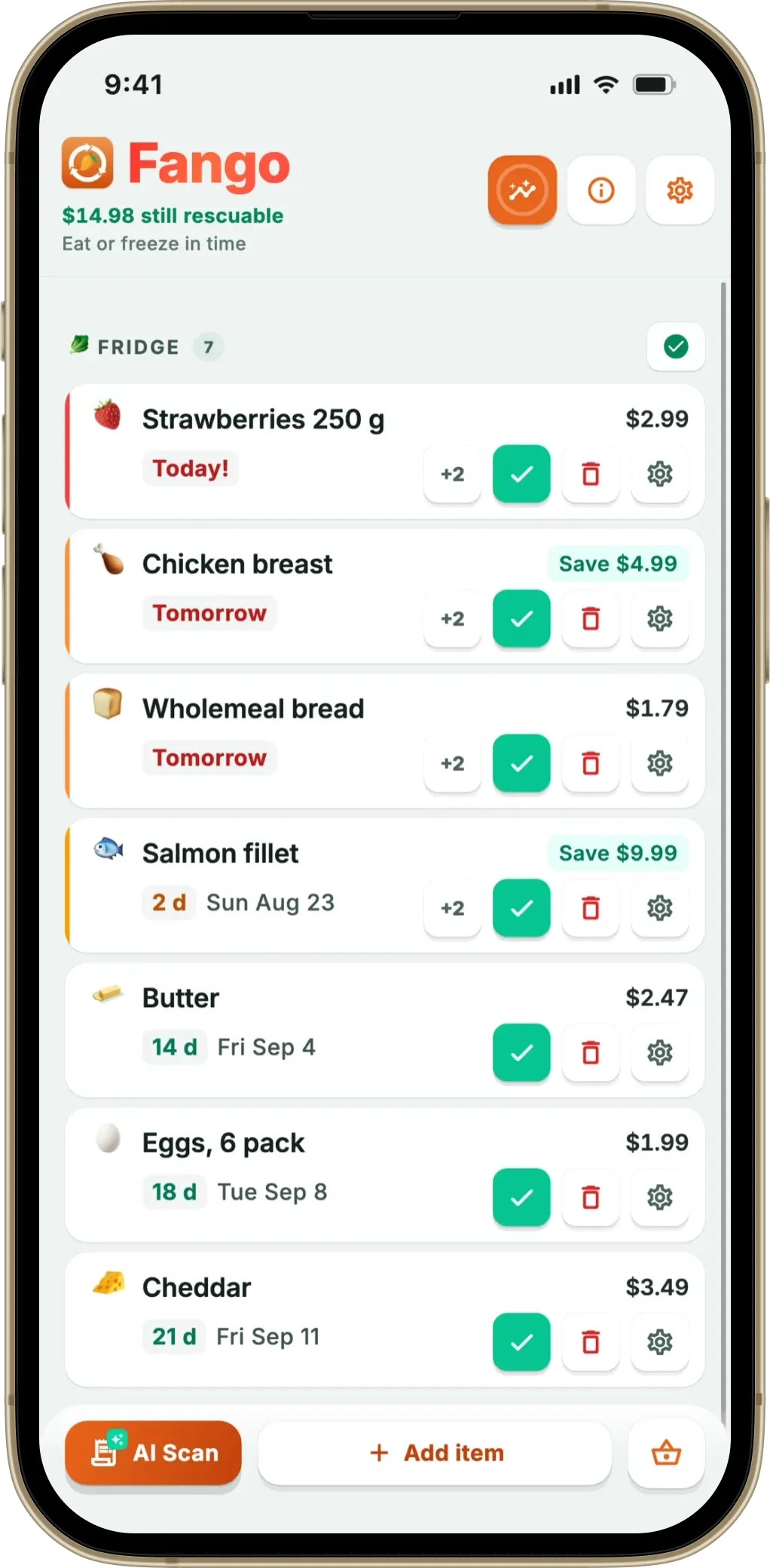
Mark each item eaten or wasted as it leaves your fridge, and Fango keeps a running tally of the money you’ve saved versus thrown away. Scan a receipt to fill your list — no typing, no account.
Download on the App Store Get it on Google PlayFree for a month · No sign-up · iOS and Android
- Track for two weeks first — record every item you bin and roughly what it cost, to see your real baseline.
- Measure cost and item count, not just weight — the money figure is what actually changes behaviour.
- The average UK household wastes around 70 kg of edible food per person a year, worth about £1,000 for a family (WRAP).
- An app makes it effortless: in Fango you tap each item as eaten or wasted, and it keeps a running tally of money saved versus binned.
Why tracking is the step that actually works
The reason food waste is so hard to fix is that it’s invisible by design. Each loss is tiny and instantly forgotten, so there’s no moment where the scale of it lands. Tracking creates that moment. When you write down or tap “wasted: half a cucumber, £0.40” five times in a week, the total stops being abstract — and a number you can see is a number you can shrink.
If you are choosing between apps, our guide to picking an expiry date tracker lists the features that decide whether you are still using it a month later.
This is why measurement beats willpower. WRAP puts UK household food waste at around 70 kg of edible food per person a year — roughly £1,000 for an average family and about £17 billion nationally — and UNEP estimates a fifth of the food available to consumers globally goes to waste. Those numbers feel like someone else’s problem until you watch your own version of them build up over a fortnight. For the full breakdown of what it costs, see how much money food waste costs.
What to measure: cost, count or weight
You can track food waste three ways, and the one you pick changes how motivating it feels. For a household, cost and item count win — weight is what big studies use, but money is what moves people. Here’s how they compare:
A fridge tracker app keeps this for every item in the fridge at once and reminds you before the day runs out.
| What you measure | How motivating | Effort |
|---|---|---|
| Cost (£ binned) | ✓ Hits hardest | Low — note the price |
| Item count (things wasted) | ✓ Clear trend | Lowest — just tap |
| Weight (kg) | Abstract at home | High — need scales |
← scroll →
The sweet spot for most people is cost plus item count: “I wasted 4 items worth about £6 this week.” It takes seconds, it’s specific enough to spot patterns (always salad? always bread?), and the running total is the thing that makes you change what you buy. Don’t get hung up on precision — a rough price is fine, because the trend matters far more than any single figure.
The two-week notebook method
Before reaching for an app, you can prove the value to yourself with nothing but a pen. Keep a small list on the kitchen counter and, every time you bin food, jot one line. After two weeks you’ll have your baseline — and almost certainly a surprise. Here’s the minimal version:
- One line per item binned — what it was and a rough price. “Yoghurt, £0.60.” Don’t overthink it.
- Note why, in one word — “mouldy”, “forgot”, “too much”. The reason is where the fix hides.
- Total it each Sunday — add up the week’s cost and count, and write the number at the bottom.
- Look for the repeat offender — the one item or one reason that shows up again and again is your highest-value thing to change.
The notebook works, and it’s free. Its weakness is the same as every manual habit: you forget to write things down, and within a week the list has gaps. That’s exactly the gap an app closes — by being the place you’re already looking when food leaves your fridge.
How an app makes tracking automatic
The whole trick to tracking food waste long-term is removing the effort, and an app does that by folding the measurement into something you’d do anyway. In Fango, the items are already in the app — you put them there by scanning your grocery receipt, so AI reads every product and adds it with an estimated expiry date. When something leaves the fridge, you tap it as eaten or wasted. That single tap is the entire logging step.
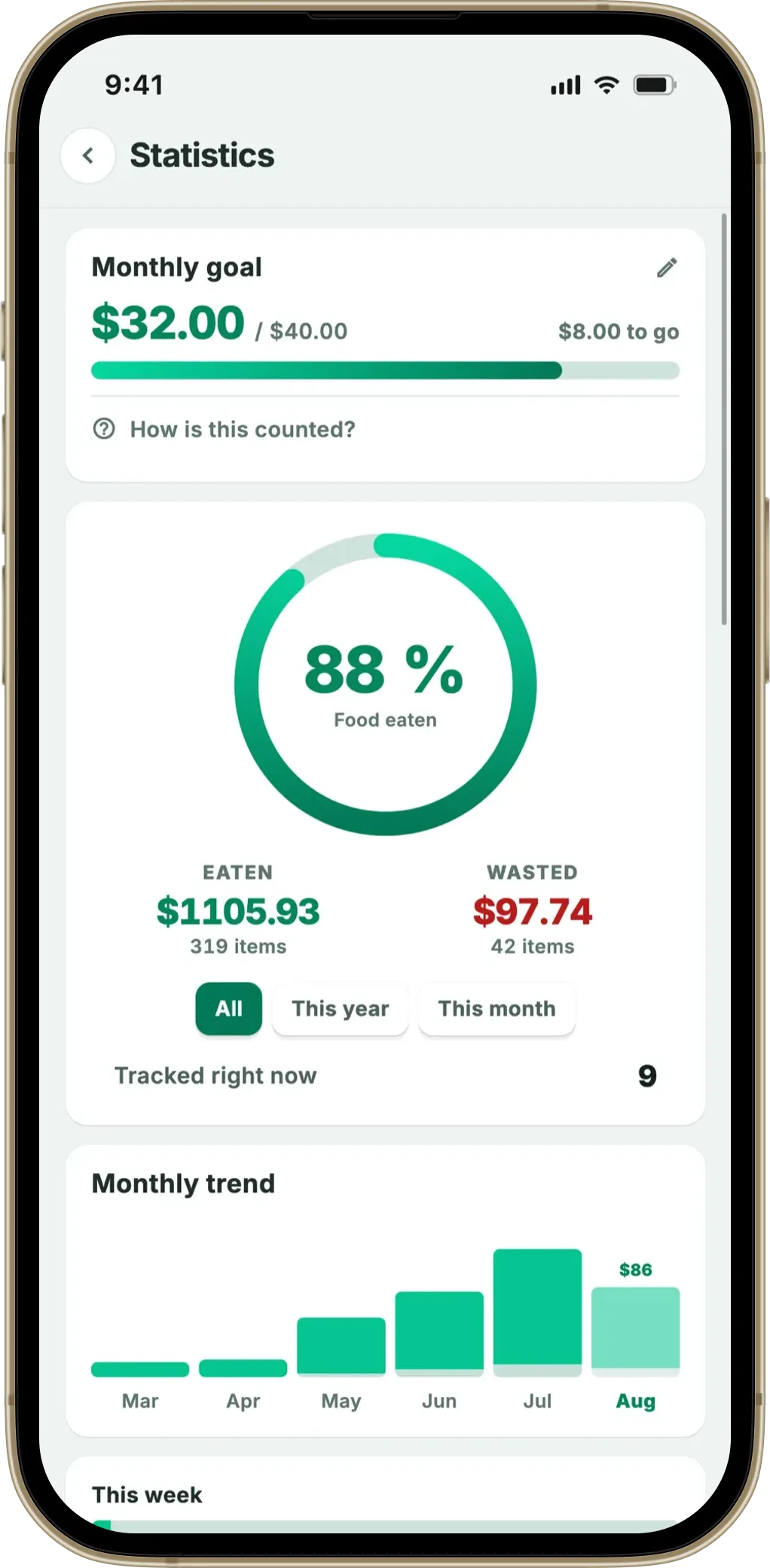
From those taps, Fango builds your statistics: how many items you used in time versus binned, and the money saved versus wasted over weeks and months. Because you’re not maintaining a separate list, the data stays complete instead of trailing off after the first enthusiastic week. And it all stays on your phone by default — no account, no cloud — so you get the insight without handing your eating habits to anyone. The mechanics of getting items in are covered in the grocery receipt scanner app guide.
Turning numbers into less waste
Tracking is only step one — the point is to act on what it shows. Once you can see the pattern, the fixes are usually small and obvious. Buy less of whatever you keep binning. Move the items closest to expiry to the front. And catch things before they turn, which is where reminders earn their keep: an app that reminds you in time turns “I forgot it was there” into “I’ll use it tonight”, and when something is genuinely on the edge, our guide on what to do when food is about to expire has eight ways to rescue it.
Give it a month and the running total becomes its own motivation — watching the “wasted” figure shrink and the “saved” figure climb is oddly satisfying, and far more durable than guilt. For where a tracking app fits among the alternatives, see the best food waste tracker app roundup.
Take the number to the shop as well. Once you know which items keep reappearing in your waste, you know what to buy less of — and a shopping list that reads the fridge and your receipt history makes that call for you: it suggests only what is genuinely running low.
Mark each item eaten or wasted as it leaves your fridge, and Fango keeps a running tally of the money you’ve saved versus thrown away. Scan a receipt to fill your list — no typing, no account.
Download on the App Store Get it on Google PlayFree for a month · No sign-up · iOS and Android
Frequently Asked Questions
How do I track how much food I waste?
Start by recording, for one or two weeks, every item you throw away — what it was and roughly what it cost. A kitchen-counter notebook works, but it’s easy to forget. An app makes it stick: in Fango you tap each item as eaten or wasted when it leaves your fridge, and it keeps a running count and value of what you’ve saved versus binned, so the picture builds itself.
What should I measure — weight, cost or number of items?
Cost and item count are the most motivating for a household. Weight is what national studies use, but at home the money figure hits harder — seeing that you binned about £15 of food this week changes behaviour faster than grams do. Counting items (“I wasted 4 things”) is the simplest to keep up and still shows the trend.
How much food does the average household waste?
UK households throw away around 70 kg of edible food per person each year, worth roughly £1,000 for an average family and about £17 billion nationally, according to WRAP. Globally, UNEP estimates roughly a fifth of the food available to consumers is wasted. Most of it is small, daily losses — a forgotten yoghurt, wilted salad — rather than one big event, which is why tracking reveals it.
Does Fango track what I waste?
Yes. When an item leaves your fridge you mark it eaten or wasted, and Fango keeps statistics on both — including the money saved versus thrown away over time. All of it is stored on your phone by default, with no account, so you get the insight without handing your habits to anyone.