The Christmas food shopping list that wastes the least is planned by plates, not by guests, and bought in three trips instead of one. Count how many people eat each meal from Christmas Eve to New Year’s Day, buy the baking and pantry items in early December, order the ham or prime rib ahead, and leave everything fresh until one or two days before. Then decide on December 25 what happens to the leftovers, because the clock on them starts that evening.
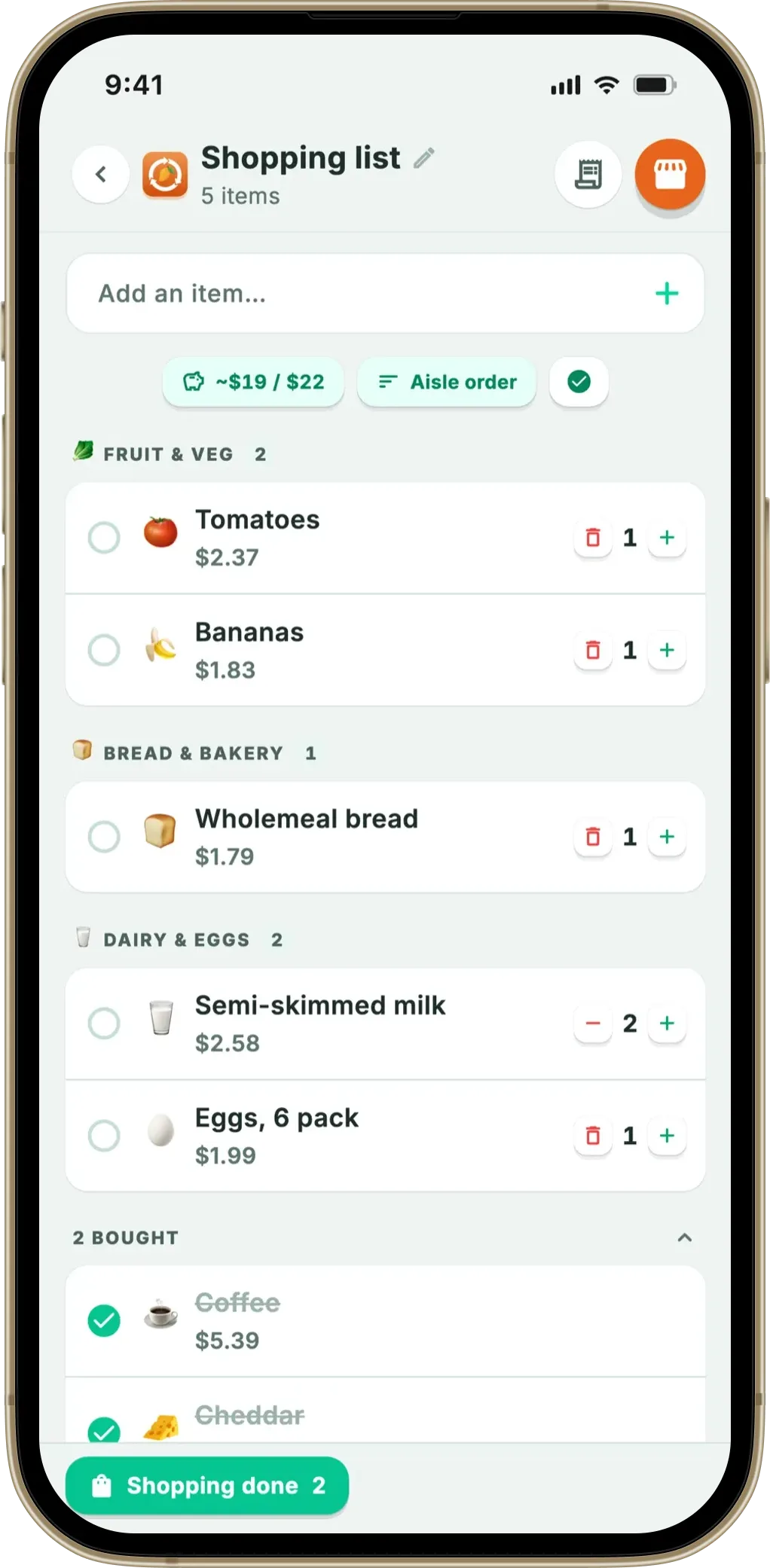
Everyone adds to the same list and sees changes in seconds, sorted by store section. Scan the receipt afterwards and Fango reminds you in time to eat what you bought.
Download on the App Store Get it on Google PlayFree for a month · No sign-up · iOS and Android
Why bother? The EPA’s 2025 estimate of the cost of food waste puts the bill for an ordinary household of four at $2,913 a year, or about $56 a week, and that is before anyone buys a twelve-pound ham. December makes it worse: ReFED, citing the EPA, notes that household garbage can rise by 25 percent between Thanksgiving and New Year’s Day.
- Plan by plates: count who eats each meal from December 24 to January 1, not how many people are visiting
- Shop in three phases: pantry and baking early, the roast ordered ahead, fresh food 1–2 days before
- One shared list for everyone who shops, so nobody buys the butter twice
- Leftovers last 3–4 days in the fridge (USDA): freeze what you won’t finish by December 28–29
Step 1: Count plates, not guests
Christmas overbuying usually starts with one number: “we’re twelve this year.” But twelve people rarely eat twelve of every meal. Your sister arrives on the 24th and leaves on the 26th, the in-laws only come for dinner, and the teenagers sleep through breakfast. A plate grid fixes that in five minutes. Write the days across the top, the meals down the side, and put the real number of people in each box.
| Meal | Dec 24 | Dec 25 | Dec 26 | Dec 27–31 |
|---|---|---|---|---|
| Breakfast | 4 | 8 (the big one) | 8 | 4 |
| Lunch | 4 | grazing | leftovers | leftovers, then normal |
| Dinner | 8 (Christmas Eve) | 12 (Christmas dinner) | 8, leftovers | 4, New Year’s Eve 6 |
← scroll →
Two things jump out of a grid like this. First, the main roast only has to feed one dinner at full strength; the rest of the week it is leftovers by design. Second, the days after the 26th are a normal household week again, which means they need very little shopping if the leftovers plan works. This year Christmas falls on a Friday, so the leftovers week runs straight into the weekend and the following Monday and Tuesday.
Step 2: Shop in three phases
The trick is to match each item’s shelf life to its buying date. Things that cannot spoil go early, when you have time and the store is quiet. Things that spoil fast go last.
Phase 1, early December: baking, pantry and drinks
Flour, sugar, brown sugar, chocolate chips, vanilla, spices, nuts, canned pumpkin and cranberry sauce, stock, coffee, sodas and anything bottled. None of this can go bad before Christmas, so buying it early spreads the cost and keeps the final trip short. The same rounding-up and running-total method from our guide to a grocery list that saves money works here. Cookie baking is where the pantry quietly doubles: before you buy, check the cupboard for the half bag of flour and the sprinkles from last year, and only add what the recipes actually need. Butter bought on a December promotion can go straight into the freezer until baking day.
Phase 2, two to three weeks ahead: order the roast
Ham, prime rib or a turkey from the butcher counter often has to be ordered, and ordering is where portion size gets decided. Order for the Christmas dinner number in your grid, plus a planned amount of leftovers, not “in case.” If you are buying a frozen turkey, it needs time in the fridge: the USDA Food Safety and Inspection Service recommends about 24 hours of thawing for every 4 to 5 pounds, so a 16-pound bird goes into the fridge on the 21st for Christmas Day. A fresh beef roast keeps 3 to 5 days in a fridge at 40°F or below, according to FSIS guidance on beef, so pick up the prime rib no earlier than the 22nd.
Phase 3, December 22–23: everything fresh
Salad greens, herbs, berries, cream, sour cream, soft cheese, bread and rolls, and the vegetables for the sides. These are the items with the shortest life, and buying them two days out instead of a week out is the single biggest waste saving on the list. It is also the trip where duplicates happen, because several people tend to “just pick something up” on the way home.
Step 3: One list for everyone who shops
At Christmas a household shops like a small team: one person does the baking run, another picks up the roast, a third grabs bread at the gas station. Without a shared list, each of them works from memory or a private note, and the result is three tubs of sour cream and no cream. Before each trip, take one look in the fridge; it catches the things already bought, a habit covered in our guide to shopping your fridge first.
Fango’s shopping list is built for this. You can make a separate Christmas list next to the everyday one and share it with your household, up to four people in all; joining takes an eight-character invite code and no account. A line added or ticked off on one phone shows up on the others in seconds, so whoever is in the store sees what has already been bought. The list sorts itself into 13 store sections, takes a budget, and after the holiday you can clear the ticks and keep the list for next year. If you want to compare it with general list apps, see our roundup of the shopping list app that reduces food waste. The same plan works a month earlier, too: see our Thanksgiving grocery list that doesn’t end in the trash.
Step 4: The leftovers week
Here is where the money is won or lost. The USDA’s leftovers guidance gives three rules that are easy to plan around: get cooked food into the fridge within two hours, eat refrigerated leftovers within 3 to 4 days, and freeze what you won’t finish, where it is best used within 3 to 4 months. Reheat leftovers to 165°F. For a dinner on Friday the 25th, the fridge window closes on Monday the 28th or Tuesday the 29th.
Ham deserves its own line, because it is usually the biggest leftover. According to the FSIS page on hams and food safety, a whole, store-wrapped cooked ham keeps about 7 days in the fridge, but once it is sliced, halved or spiral-cut, or if it is the leftover of a ham you cooked, the window is 3 to 5 days. Cooked ham can be frozen for 1 to 2 months. A ham from a USDA-inspected plant can be reheated to 140°F, but leftover or repackaged ham should reach 165°F. More detail is in our guides to how long ham lasts in the fridge and freezing ham.
A simple plan that fits those windows:
- December 25, before bed. Carve what is left off the bone, portion it into shallow containers and get it in the fridge within two hours of the meal. Label each with the date.
- December 26. Freeze half of the ham and roast right away, in meal-sized portions. The freezer half is January’s easy dinners; the fridge half is this week’s.
- December 26–28. Eat the fridge half: sandwiches, hash, soup from the bone, ham and potato bake. Our list of ideas for using up leftovers helps here.
- December 29. Anything still in the fridge from Christmas dinner goes. Past the 3 to 4 days, look and smell can’t tell you whether bacteria have grown, so throw it out.
- December 30–31. A small New Year’s Eve shop for one meal, not a second Christmas.
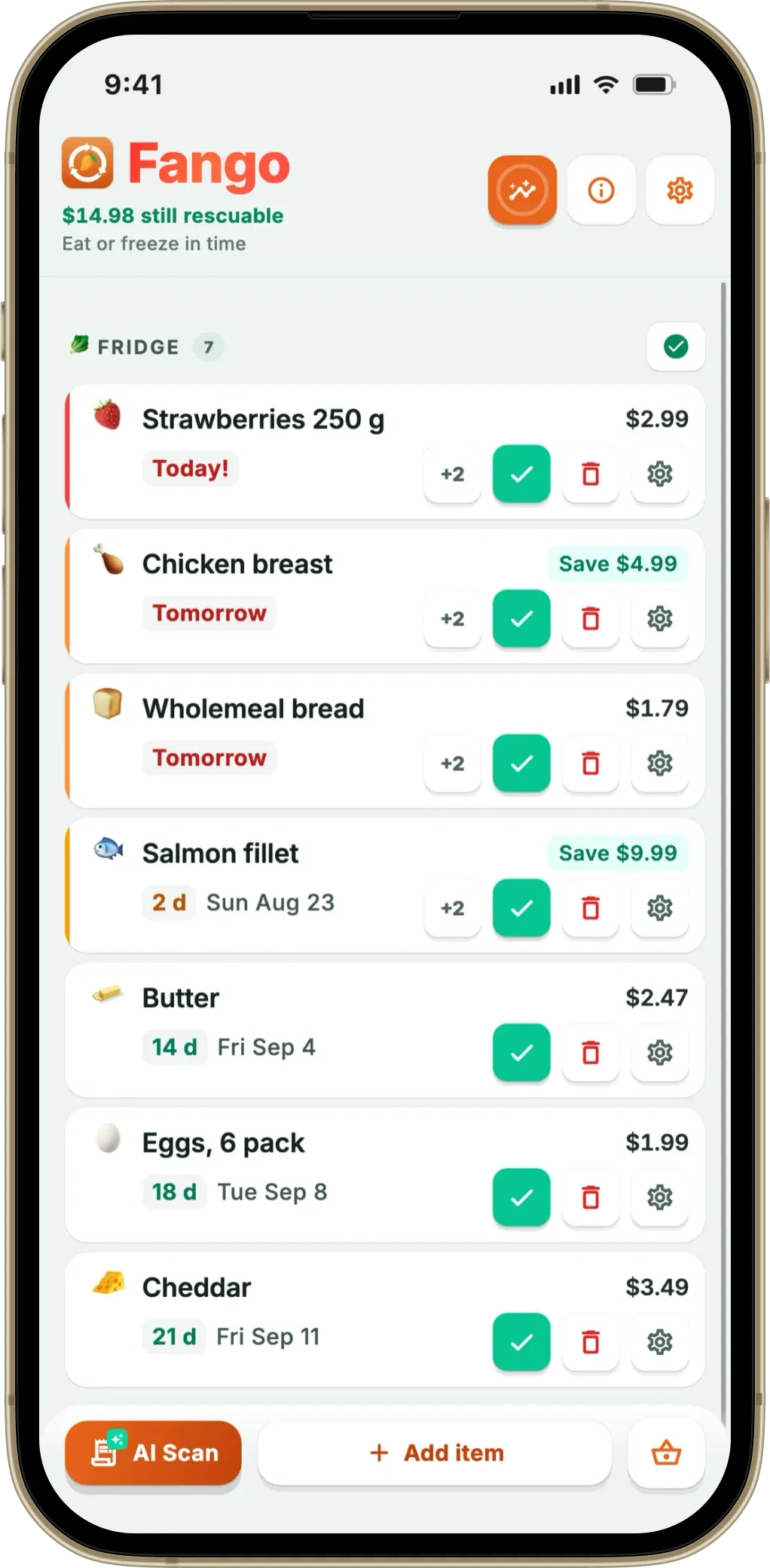
Scan the holiday receipts, get a reminder in time for the cream and the leftovers, and mark what you ate. Fango counts it in dollars against a monthly goal.
Download on the App Store Get it on Google PlayFree for a month · No sign-up · iOS and Android
Where Fango fits: the receipt is the proof
A plan on paper fails on December 27, when nobody remembers whether the cream was opened on the 23rd or the 25th. That is the gap Fango closes. Scan the receipt from each Christmas trip, or share a digital receipt to the app, and every item lands in one list with an estimated shelf life. You can add the leftover ham by hand too, and set it to the fridge or the freezer. Fango then reminds you in time, on the day or up to 14 days ahead depending on your settings, and a reminder can be answered with Eaten or Wasted, or for food that freezes well, Freeze, straight from the notification.
Because the whole household shares the same fridge list, whoever opens the door sees what needs eating first. And because everything you ate in time is counted in dollars, you see at the end of the month what the Christmas plan actually saved, rather than guessing. That’s the link between the list and the money: the list stops the double purchase, the reminders stop the forgotten leftovers, and the statistics show the result. For the bigger picture, see our guide to the best food waste app for US households.
Frequently asked questions
How far ahead should I do my Christmas food shopping?
In three phases rather than one big trip. Buy baking supplies, pantry staples and drinks in the first week of December, because none of them can spoil before the holiday. Order the ham or prime rib two to three weeks ahead and pick it up in the last few days. Leave salad, herbs, cream, bread and other fresh food until one or two days before Christmas Eve, so that the short-lived items start their clock as late as possible.
How long do Christmas leftovers last in the fridge?
Three to four days, according to the USDA Food Safety and Inspection Service, provided they went into the fridge within two hours of cooking. For dinner on December 25, that means Monday the 28th or Tuesday the 29th at the latest. Anything you will not eat by then should go into the freezer, where leftovers are best used within three to four months. If the window has passed, throw the food out; how it looks or smells cannot tell you whether bacteria have grown.
How long does leftover Christmas ham last?
It depends on how far the ham has been cut. USDA guidance puts a whole, store-wrapped cooked ham at about seven days in the fridge, while slices, half hams, spiral-cut hams and leftovers from a ham you cooked yourself last three to five days. Cooked ham can be frozen for one to two months. When you reheat leftover or repackaged ham, take it to 165°F.
How do I stop buying duplicates when several people shop for Christmas?
Keep one list that everyone in the household writes to and shops from, and tick items off in the store rather than afterwards. Duplicates happen when two people each work from their own note: both buy the butter, nobody buys the cream. A shared list that updates on every phone while you are still in the aisle removes the guesswork, and a quick look in the fridge before each trip catches the rest.