A shopping list is the cheapest financial tool in a household, and most people use maybe a third of it. Writing down eight things stops you forgetting the milk. Writing them down properly — in shop order, with rounded-up prices, checked against what’s already in the fridge — attacks four separate leaks in a food bill at once, and takes about five minutes more.
Sorted into 13 supermarket sections, prices remembered from your own receipts, a budget target that counts down as you tick items off — and a reminder before the food goes off at home.
Download on the App Store Get it on Google PlayFree for a month · No sign-up · iOS and Android
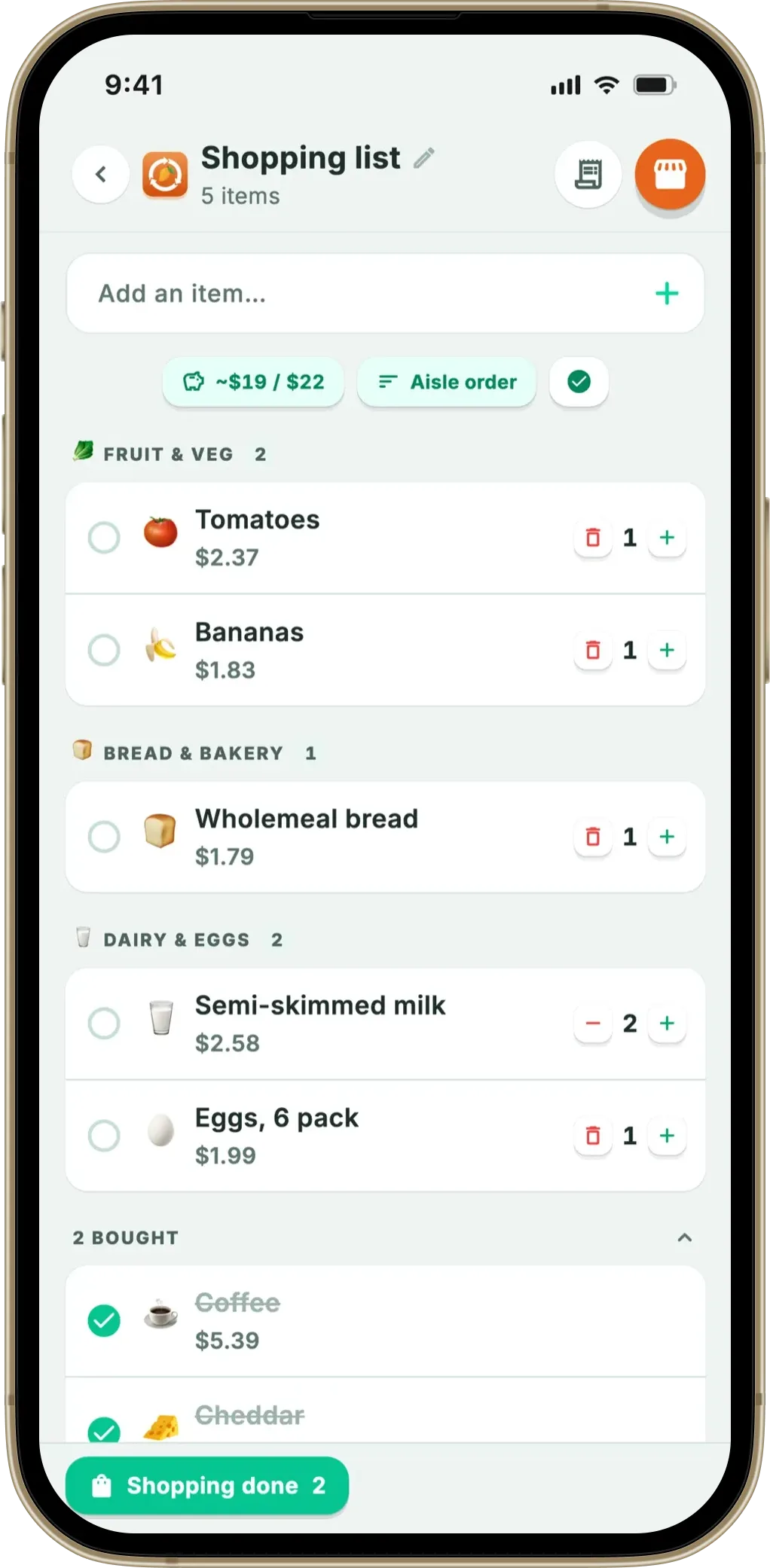
Below: where the money actually goes, a seven-step method, and an honest account of which part of this is worth the most.
- Four leaks: extra laps of the shop, duplicate buying, no running total, and food binned at home
- The bin is the big one. WRAP puts UK household food waste at £1,000 a year for a household of four
- Round prices up, not down — the cushion is what makes the total useful
- Check the fridge before writing, not after. Most people find two or three lines they already own
Where a grocery bill actually leaks
Four places, in roughly ascending order of how much they cost you.
If the same problem shows up on the shopping side — buying what you already have — our best shopping list app comparison covers apps that read your inventory.
- Extra laps of the shop. A list in the order you thought of it — milk, bananas, toilet roll, yoghurt — sends you across the building three times. Every return lap is another pass through the end-caps and the promotions, which is where unplanned items get into the trolley.
- No total until the till. If you don’t know what the list costs, you can’t decide anything about it while you can still put something back. The correction happens at the checkout, where nobody makes it.
- Duplicate buying. The third jar of mustard, the second bag of spinach. This is a memory problem, and it costs the full price of the item plus, usually, the price of the one that then goes off.
- Food binned at home. The largest by a distance. WRAP’s 2022 report puts UK household food waste at £1,000 a year for the average household of four, with fresh produce the most wasted category by weight of edible parts, and UNEP’s Food Waste Index Report 2024 estimates around a fifth of the food available to consumers is thrown away.
Notice the shape of that list. The first three happen in the shop and are worth tens of pounds a month. The fourth happens at home and is worth hundreds a year. Any advice that only addresses the aisle is working on the small end of the problem.
The seven-step method
- Open the fridge first. Two minutes, before you write a word. Anything that has to be eaten this week decides a meal for you, and anything you were about to buy again comes off the list before it goes on. This step alone usually finds two or three lines.
- Start from last week’s list, not a blank page. Your staples don’t change. Clear the ticks, edit the five lines that moved. The blank page is what makes people give up on lists after a fortnight.
- Add only meals you’ve actually decided on. Not the aspirational ones. The salad bag bought for a week you were going to be a different person is the single most reliable item in the bin.
- Group it by section. Fruit and veg, bakery, chilled, meat, frozen, cupboard, household. Four lines of grouping buys you one lap instead of three. If your app does it automatically, better — our aisle-by-aisle guide covers the standard order.
- Write a rounded-up price beside each line. £1.20 becomes £1.50. The rounding is the point: it absorbs the ones you guessed wrong, so being under budget is the normal result rather than a fluke.
- Add it up before you leave the house. If the total is already over what you meant to spend, the edit happens at the kitchen table, where cutting two items is easy and unemotional.
- Subtract as you shop. The number that changes behaviour is what’s left to buy, not what the whole list cost. A static figure at the top stops registering after ten minutes.
Steps five to seven are the ones people abandon first, because the arithmetic by hand is dull. That’s precisely the part worth automating — and the wider habits around the shop are in how to save money on groceries.
Putting prices on the list — and who charges for it
Surprisingly few apps will do the adding up. AnyList’s help pages state that AnyList Complete is required to add prices to items, describing the paid tier as what lets you enter prices and calculates a running total; its feature comparison prices Complete at $9.99 a year for an individual or $14.99 for a household. Cozi’s plan comparison doesn’t offer a total at any tier — its paid Gold plan buys an ad-free experience and a full-screen Shopping Mode. OurGroceries and Bring! don’t document one either.
Whatever tool you use, the same two caveats apply. No consumer app has live shelf prices for the shop you’re standing in, so every total is an estimate built from what you or the app remembered. And an estimate is fine — the job of the number is to tell you you’re £20 over while you can still act on it, not to predict the receipt. Our comparison of which apps actually show a shop total goes through the options.
The leak nobody puts on a list
Steps one to seven get the shop right. They do nothing about the yoghurt that goes off on Thursday, and that’s where the £1,000 lives.
WRAP’s people-focused research associates lower household food waste with a cluster of behaviours: meal planning, making shopping lists, using leftovers, storing food properly and portioning rice and pasta. The list is genuinely in there — but so is everything that happens after you unpack the bags. Two practical additions that pair with the method above:
- Freeze on arrival. Half the loaf, the second pack of mince, the spare chicken breasts. Ninety seconds, and it converts a deadline into no deadline. Cooked food keeps only 2–4 days in the fridge according to the UK Food Standards Agency, which also puts the fridge at 0–5°C.
- Keep an eat-me-first shelf. One shelf for anything on its last two days, checked before you decide what to cook. The full method is here, and it costs nothing.
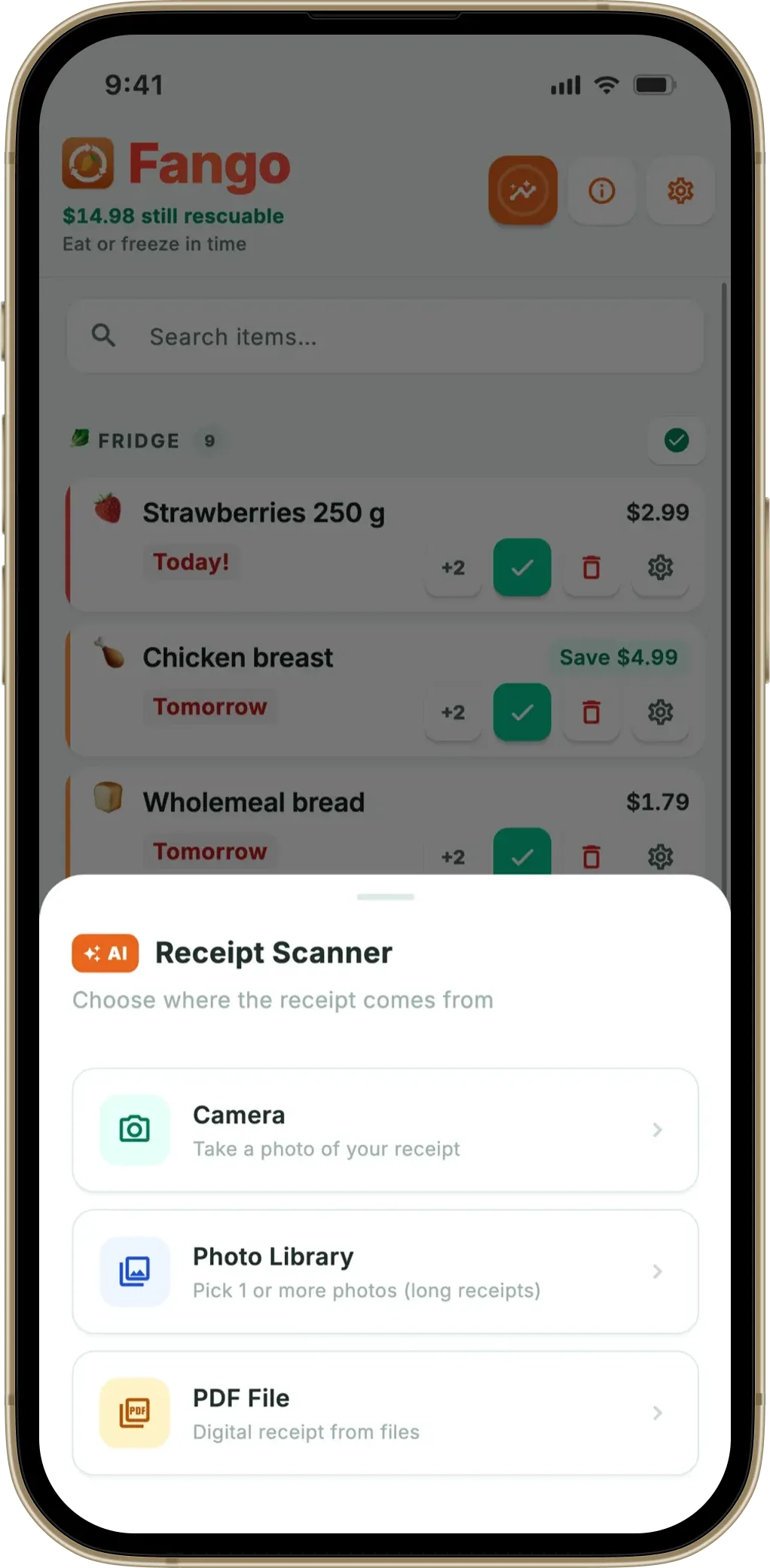
The app version of the same idea is to let a scanned receipt build the list of what’s at home, with a reminder before each item’s date — which is what Fango does, and why its shopping list sits inside a food waste app rather than a budgeting one. Buying well and eating what you bought are two halves of one bill.
What’s this actually worth? Work out your own number
We’re not going to tell you a percentage, because the honest answer depends entirely on how much you currently waste. What you can do is measure it, in one week, without any app:
- Keep the receipt from your next shop.
- Put a jar or a note by the bin. Every time something food-shaped goes in, write down roughly what it cost.
- Add it up on Sunday and multiply by 52.
Most households are surprised, in one direction or the other, and either answer is useful. If the number is small, your shop is the place to work and the seven steps above are the whole job — plus the layout of the store itself, which is designed to add items you did not plan, as we cover in supermarket psychology tricks. If it’s large, the list is only half your problem and the fridge is the other half — which is what tracking how much food you waste is for.
Sorted into 13 supermarket sections, prices remembered from your own receipts, a budget target that counts down as you tick items off — and a reminder before the food goes off at home.
Download on the App Store Get it on Google PlayFree for a month · No sign-up · iOS and Android
Frequently asked questions
Does writing a shopping list actually save money?
The evidence points that way, though the honest version is that lists are part of a cluster rather than a magic trick on their own. WRAP’s people-focused research associates lower household food waste with a group of habits that includes meal planning, making shopping lists, using leftovers, storing food properly and portioning rice and pasta. A list mainly works by removing decisions from the aisle, where every decision is made under time pressure and next to a promotion.
What is the biggest money leak in a food shop?
Not the shop itself — the bin. WRAP puts UK household food waste at £1,000 a year for the average household of four, and UNEP estimates around a fifth of the food available to consumers is thrown away. Shaving ten per cent off the till total takes concentration every single week; not throwing away a fifth of what you already bought is the same money and most of that work happens at home, after the shopping is done.
Should I put prices on my shopping list?
Yes, rounded up, and mainly so you know the total before the till does. Rounding up rather than down builds in a cushion for the items you priced wrong, which means being under budget is the normal outcome instead of a surprise. Few apps do this for you: AnyList’s own help pages state that its paid tier is required to add prices to items, and Cozi, OurGroceries and Bring! do not document a running total at all.
How do I stop impulse buying at the supermarket?
Reduce the number of times you walk past the same shelf. A list written in the order of your own head sends you back and forth across the shop, and every return lap is another pass through the promotions and the end-caps. A list grouped by section means one lap in one direction. Add a total you can see while you shop and the two together do more than any amount of willpower at the checkout.