A shopping list and expiry tracker in one app exists, and the combination does something neither half manages alone: the list can read your fridge, and the fridge can clean up your list. Fango does both. Here’s why the usual arrangement — a list app on one screen, expiry dates tracked in your head — quietly falls apart, and where a combined app still loses to a specialist.
Most people don’t run two apps on purpose. They run a list app because shopping demands one, and no tracker at all, because typing dates into a second app feels like homework. So the real comparison isn’t app A versus app B — it’s one app versus a list plus a vague memory of the back of the fridge.
- One product, typed twice — the list and the fridge never talk to each other
- In the aisle, neither helps — nothing tells you what’s already at home
- One app closes the loop — suggestions read your fridge, the receipt cleans the list
- Honest limits — no recipes, no barcode scanning
Why the two-app setup breaks down
A dedicated list app — Listonic, Bring, AnyList, a note in Google Keep — is good at the twenty minutes you spend in a supermarket, and blank about everything either side of that. Three failures follow.
If the same problem shows up on the shopping side — buying what you already have — our best shopping list app comparison covers apps that read your inventory.
You enter the same product twice. Milk goes on the list on Thursday and into the trolley on Friday. To track it, you type “milk” again into a second app, with a guessed date. Almost nobody keeps that up past week two — which is why so many pantry trackers sit unopened.
Nothing tells you what’s at home while you’re shopping. This is the expensive one. The list says “yoghurt” because you wrote it on Monday; it can’t tell you there are already four tubs in the fridge, two dated for tomorrow. In the aisle, a list app and a memory are the same tool. WRAP puts UK household food waste at roughly six million tonnes a year, costing an average family of four in the region of £1,000 — much of it bought while an identical item sat at home.
Neither half learns anything. A list app forgets each list when you clear it; a tracker knows what you had but not what you keep buying. Between them they hold everything needed to say “you buy oat milk about every nine days, and yours runs out tomorrow” — and neither says it, because the halves never meet.
What one app can do that two can’t
Put both behind the same product memory and receipt history, and things become possible that a standalone list cannot offer.
-
1
Suggestions that read the fridge. Items expiring within about three days appear as a “running low” suggestion — the yoghurt you’re about to finish, offered before you shop rather than after you’ve forgotten it.
-
2
Suggestions that read your receipts. Past receipts show what you buy regularly and how often, so the repeat basket proposes itself instead of being retyped weekly.
-
3
Suggestions filtered by what you already own. Anything on your fridge list, or already on the list, is filtered out. No app proposes four more tubs of yoghurt if it can see the first four.
-
4
The receipt tidies the list for you. After a scan, the app matches your list against the new receipt: “5 items from your list were on your last receipt — remove the bought ones?” One tap and it’s clean.
-
5
One product memory, two uses. Autocomplete offers the product with a price estimate from your own receipts — which is what makes a budget target useful rather than decorative.
None of it involves AI: suggestions and aisle sorting are local frequency and keyword calculations on your phone; the AI appears only in the receipt scan. Same principle as turning a grocery receipt into a digital list — the data you already generate at the till beats anything you’d type by hand.
Fango’s shopping list suggests what you’re running low on, sorts itself into 13 supermarket aisles and tracks a budget target. Scan the receipt afterwards and the same products land in your fridge list with expiry reminders. No account, all on your device.
Download on the App Store Get it on Google PlayFree for a month · No sign-up · iOS and Android
The loop in a normal week
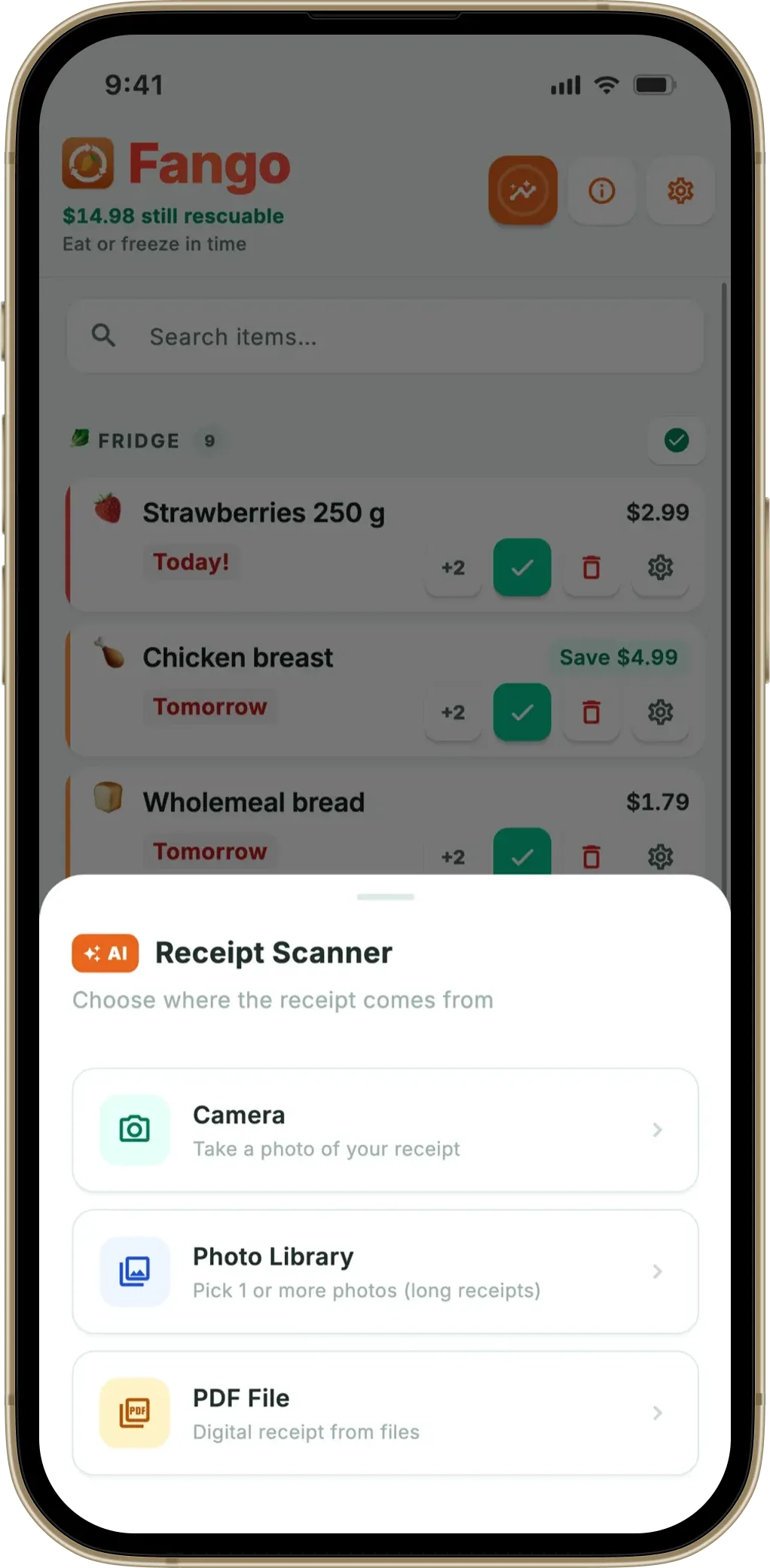
It’s not a system, just four connected moments. You finish the cheese on Tuesday and mark it eaten in the fridge list; the confirmation offers an “add to shopping list” button, so it’s on the list in one tap with its quantity and price. On Saturday the list is already half-written by the suggestions. In the shop you switch to full-screen shop mode: big rows grouped by aisle in the order you walk the store, a progress bar, and a budget pill that shrinks as you tick things off. At the till you photograph the receipt, the products land in the fridge list with expiry estimates, and the app offers to clear the bought rows for you. “Shop done” clears the ticks but keeps the rows, so next week starts from the same skeleton rather than a blank page.
A list you rebuild from nothing every week is one you abandon. The full waste-reduction case for the loop is in our piece on a shopping list app that reduces food waste.
Where a dedicated list app still wins
No combined app beats a specialist on its own ground. If any of these matter to you, use a dedicated list app.
| Feature | Fango | Dedicated list apps |
|---|---|---|
| Shared household list, live sync | ✓ up to 4 people | ✓ |
| Recipes and meal planning | ✗ | ✓ |
| Barcode scanning | ✗ | ✓ |
| Aisle sections, quantities, notes | ✓ | ✓ |
| Budget target for the list | ✓ | Often a paid extra |
| Full-screen shop mode | ✓ | Often a paid extra |
| Expiry dates and reminders | ✓ | ✗ |
| Suggestions from fridge + receipts | ✓ | ✗ |
| No account, no ads, data on device | ✓ | Varies |
← scroll →
The top three rows are the honest gaps. Sharing stops at four people in one household, and there is no personal sync between your own devices — an account-free design buys you the first without the second, as set out in our piece on food inventory apps with no account. There are no recipes, by choice (food tracking without recipes), and no barcode scanning, because the receipt does that job faster for a whole shop — the trade-off in receipt scanning versus barcodes. If you cook from recipes with a partner editing the same list, no amount of fridge-aware cleverness makes up for it.
The flip side is what the specialists can’t reach. A budget target sits behind AnyList’s paid tier, and Cozi’s full-screen shop mode is a paid feature; in Fango both are simply part of the app. Listonic’s free version is heavy on advertising, and Bring’s data handling has drawn questions. And none of them can flag something because it’s about to expire — none of them knows.
Fango sorts everything by reminder date and colour-codes the urgent items in red. The home screen widget shows what to use next without opening the app.
Download on the App Store Get it on Google PlayFree for a month · No sign-up · iOS and Android
The one thing to be clear about: ticked off ≠ in your fridge
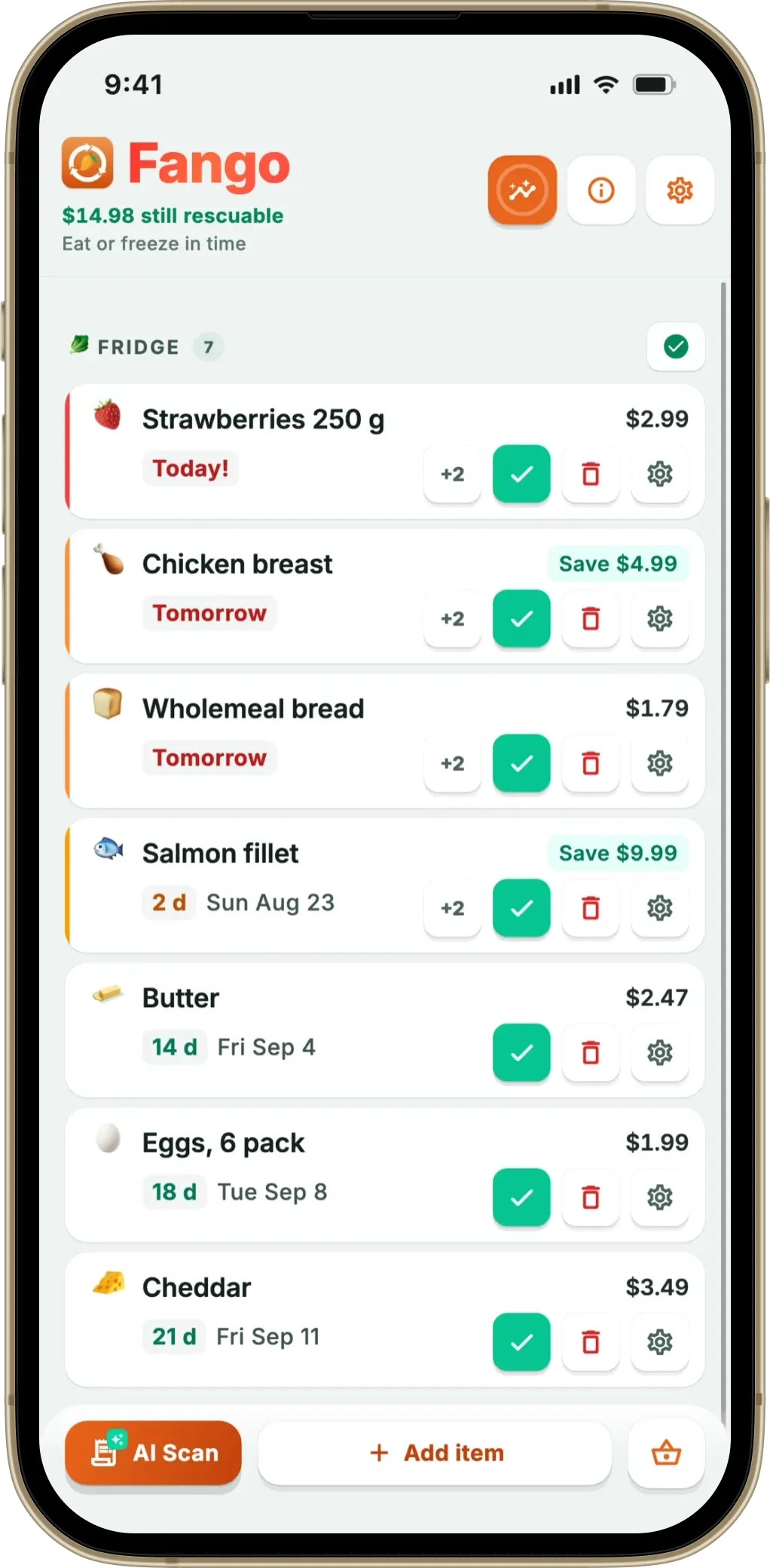
This is the limitation people assume away, so plainly: ticking an item off does not add it to your fridge list. Scanning the receipt is what does that, or adding the item by hand.
That’s a design decision, not a missing feature. An expiry estimate is only worth having if it’s based on the actual product — brand, pack size, shop and purchase date — which is what a receipt line contains and a word you typed on Monday does not. Auto-filling from ticked rows would produce a tracker full of plausible-looking dates that are quietly wrong, and wrong dates are worse than none: they teach you to ignore the reminders. So the scan stays the gate — a photograph, a few seconds, receipt formats from around 34 countries. The mechanics are covered in scanning a receipt to track food.
Privacy, languages and price
Both halves are local. The shopping list, the fridge list, your product memory, price estimates and receipt history all live on the device, with no account and no sign-up. The only moment anything touches the network is the receipt scan, where the image is processed briefly and not stored — which is also why the list works with no signal in a supermarket basement.
The app runs in eight languages, with the aisle keywords written natively in each rather than translated. Reminders arrive one to fourteen days before a date, depending on how perishable the item is. Fango is free to try for one month, then from $2.99/month or $22.99/year, on iOS and Android — the shopping list is part of the app, not a separate purchase.
Frequently asked questions
Can one app be both a shopping list and an expiry tracker?
Yes. Fango does both in one app: the shopping list and the fridge list share the same product memory and receipt history. The list side has aisle sections, quantities, notes, a budget target and a full-screen shop mode; the tracker side handles expiry estimates and reminders before a date.
Do items I tick off the shopping list get added to my fridge automatically?
No, and that is deliberate. Ticking an item only marks it bought on the list. Products reach your fridge list by scanning the receipt, because a realistic expiry estimate needs the real product line — brand, pack, shop and date — not a word you typed days earlier.
How does the shopping list know what I already have at home?
Suggestions are filtered against your fridge list and against what is already on the list, so the app stops proposing something you bought yesterday. It works the other way too: items expiring within about three days appear as a running-low suggestion before you shop.
Is a combined app better than a dedicated shopping list app?
Not for everything. Dedicated list apps such as AnyList, Bring or Listonic win on shared household lists and recipes, and Fango has neither, nor barcode scanning. A combined app wins when the goal is buying less and wasting less: only an app that knows your expiry dates and receipt history can tell you what you actually need.
Worth it?
If your household runs on a shared list and a weekly meal plan, keep the specialist. If you’re the one buying a second jar of pesto because the first was hiding behind the milk, the split is what’s costing you — the everyday duplication behind the fifth of consumer-available food that UNEP’s Food Waste Index Report 2024 finds is thrown away. One app that writes half your list from your own fridge and receipts, then puts the shopping back with dates attached, is a smaller change than it sounds — and a much harder one to abandon.
Adding a price to each line turns the same list into a running total before the till — we compared which apps allow it in grocery list apps with prices.