Food waste apps are easy to download and easy to abandon. The category has a reputation for sounding useful in week one and disappearing by week three. So the honest question — do they actually reduce waste in real households — deserves an honest answer, not a marketing one.
Photograph a receipt, AI builds the fridge list, your phone reminds you 1–14 days in time. The friction story is the survival story — fast in, fast forgotten, fast worth it.
Download on the App Store Get it on Google PlayFree for a month · No sign-up · iOS and Android
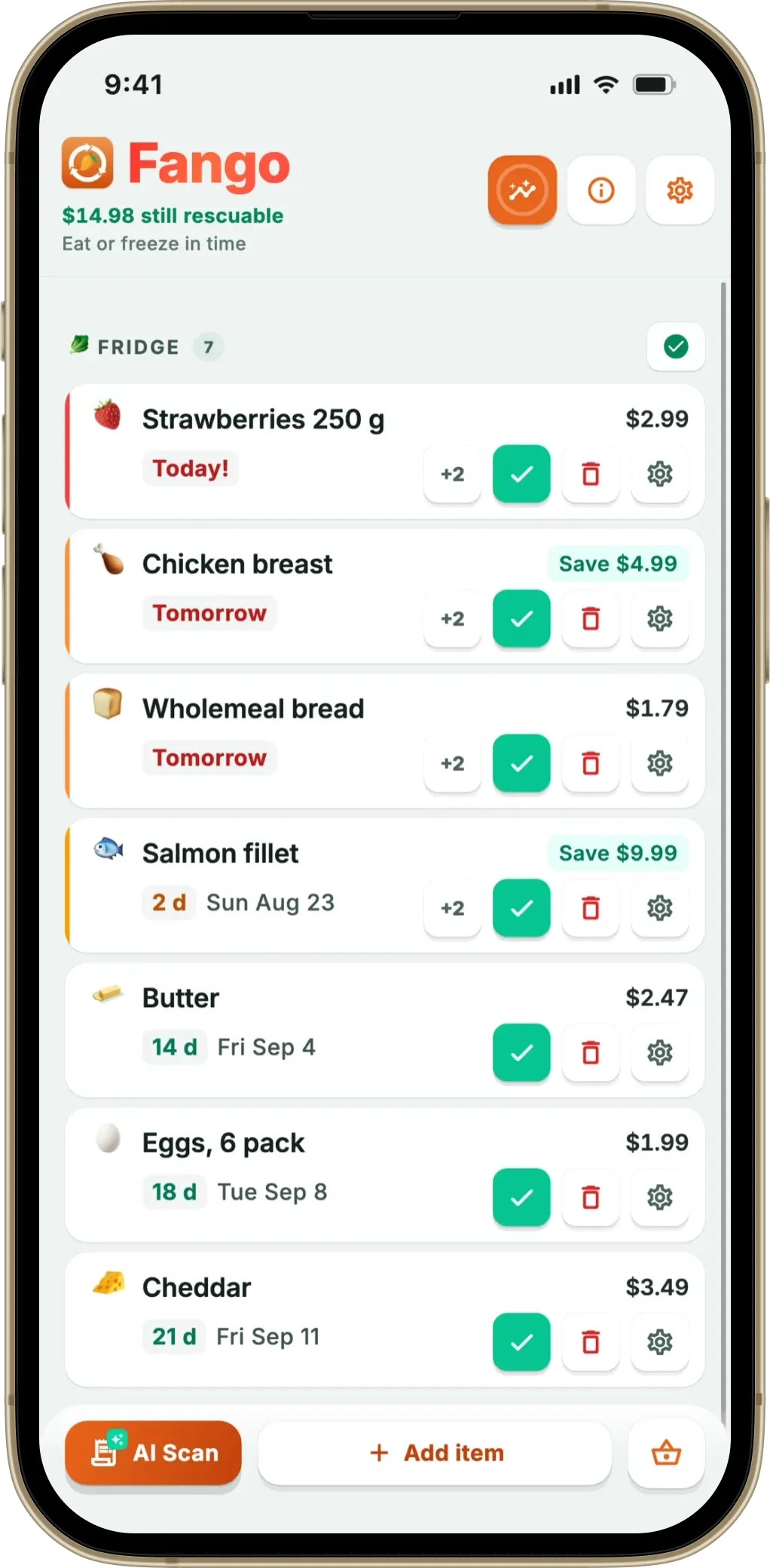
This article looks at what determines whether an app survives past month two, which households see the biggest reduction in waste, and where the category genuinely doesn’t help. Fango shows up as a worked example throughout, but most of the patterns hold across receipt-scan trackers in general.
- Yes, for users who stick with it — the gain comes from expiry reminders, and it builds over the first few months
- Most don’t stick with it — manual-entry apps lose users in week 2–3, mostly to friction
- Receipt-scan apps survive longer — adding a shop takes seconds, not minutes
- Biggest gains for weekly-shop households of 2+ already wasting three or more items a week
- Low break-even — the subscription costs less than a few items of wasted food a month
The honest week-by-week pattern
Across the receipt-scan-tracker category, a typical user trajectory looks like this:
If you are choosing between apps, our guide to picking an expiry date tracker lists the features that decide whether you are still using it a month later.
| Phase | What happens | Where apps lose users |
|---|---|---|
| Week 1–2 | Habit-building. First shops scanned, first reminders fire, fridge gets organised. | Manual-entry apps: the first 20-item shop typed by hand. Users decide it’s not worth it. |
| Week 3–6 | List gets out of sync. A skipped shop or a top-up shop unscanned, and the inventory drifts. | Apps without quick top-up scanning: the broken list erodes trust, then abandonment. |
| Month 2–3 | Concrete waste reduction shows up. Repeat-offender items get caught in time. | Mostly retention here; users either disengaged in month one or stuck around. |
| Month 3+ | Statistics become useful. Recurring waste patterns visible. Habit becomes invisible. | Few users churn at this point; the app is now part of the kitchen routine. |
← scroll →
The interesting part is week 3–6. That’s where most apps lose half their installs — not because they don’t work, but because the maintenance cost beats the benefit. The apps that survive past that window almost all have one thing in common: very low per-shop friction.
Why receipt-scan apps survive month two
The friction story is unflattering for manual-entry tracker apps. A 20-item weekly shop typed into a list is 3–6 minutes; a 20-item receipt scanned in Fango is under 30 seconds. Multiply that by 50 shops a year and the difference is the gap between a habit and a chore.
This is why the receipt-scan category specifically tends to outperform the manual-entry category on retention. It’s not that the apps are better at reminding — the notification logic is similar across the board. It’s that the weekly maintenance step is fast enough to actually happen.
Within receipt-scan apps, the survival pattern is similar but not identical:
- Apps that require a sign-up for the receipt scan lose roughly half their installs at the sign-up step.
- Apps that work offline (manual fridge adjustments without internet) survive better than online-only ones.
- Apps that support both camera and PDF (for online grocery) survive better with hybrid online/offline households.
- Apps that flag low-confidence items rather than silently mis-categorising them keep more trust.
What “actually works” looks like at month three
The visible signs that an app is working — for the user, not just for the app’s marketing:
- Fewer “oh no, this expired” moments. The most direct, most immediate signal.
- The same item stops being thrown away repeatedly. The yoghurt that always died in the back of the fridge gets caught.
- Less impulse re-buying. A glance at the list before shopping prevents the “I think we’re out of butter” buy when there’s still half a block.
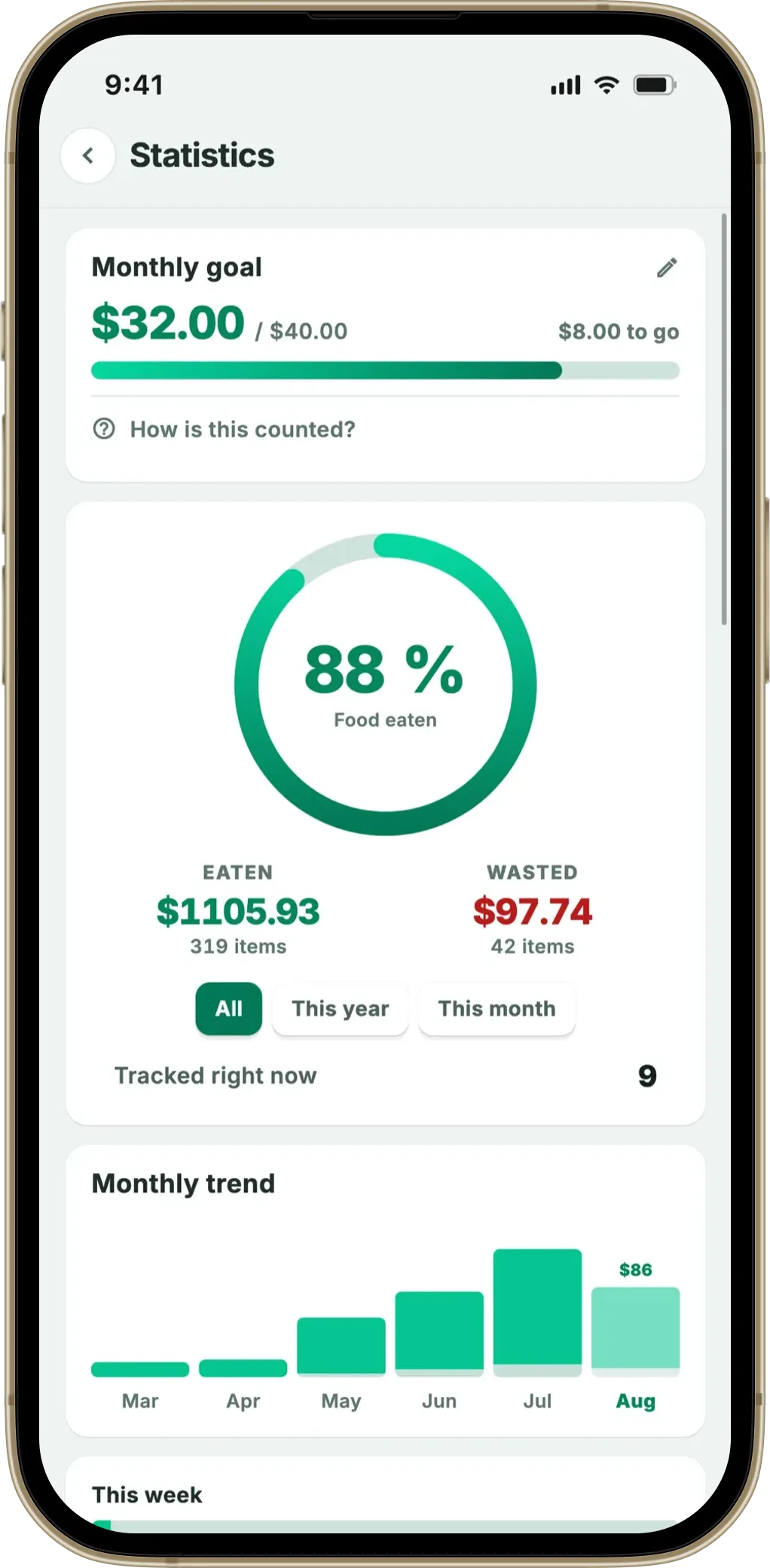
- The weekly statistics number stops surprising you. Wasted-vs-eaten ratios become predictable rather than embarrassing.
The negative signs — when the app isn’t working:
- The list is more than a few days out of sync with reality.
- Reminders are getting dismissed without action.
- The fridge still has unexpected expired items.
- Weekly waste statistics aren’t trending down by month three.
If month three rolls around and none of the positive signs are present, the app isn’t working for that household — and continuing wouldn’t change that.
Which households see the biggest reduction
Not every household has the same ceiling. Three patterns dominate:
- Weekly shoppers of two or more. The combination of “lots of items at once” and “more than one person opening the fridge” is where forgotten items accumulate. Receipt-scan apps win this hard.
- Daily-shop single-person households. Smaller upside — the fridge has fewer items to forget — but the workflow advantage is also smaller. App still helps; benefit is more modest.
- Online-grocery-heavy households. Big PDFs scan cleaner than paper receipts. Online order PDFs from Ocado, Tesco delivery and Wolt are usually one of the highest-savings cases.
Conversely, two groups should be honest about smaller expected returns:
- Households that already waste less than one item a week. The marginal value of an app is small; existing habits are doing the work.
- Households that don’t have a regular shopping pattern. Frequent ad-hoc top-ups make the list-vs-reality drift hard to keep up with.
What “doesn’t work” is usually doing instead
When an app doesn’t work for a household, the failure mode is rarely “feature missing”. It’s usually one of:
- Habit didn’t form. The user remembered to scan the first two shops, then forgot. The app is fine; the trigger isn’t.
- Fridge geography doesn’t suit the list. If items get pushed to the back of a deep fridge with no rotation, even a perfect reminder fires too late — the chicken is found, on day 1 of 2, but behind a Tupperware tower.
- Wrong household member is the user. The person who scans isn’t the person who cooks, so the list-to-fridge gap stays open.
- Reminders muted. Push notifications are routinely silenced and never seen.
These are real causes, and an app can do a limited amount about them — a widget for “fridge at a glance”, quieter reminder timing, a smaller default list. Forgetful-user-friendly design is more than a marketing line, but the underlying habits matter more than any feature.
The honest verdict
Food waste apps work for the households that stick with them past month two, and the deciding factor is whether the weekly add step is fast enough. Receipt-scan apps survive that test more often than barcode or manual-entry ones, and within receipt-scan, friction in the sign-up step and the review step are the next decision points.
If you’re considering one, the realistic expectation is: month one is habit-building; concrete waste reduction shows up in month two; statistics get meaningful at month three. The subscription pays for itself once it saves a few items of food a month — a low enough bar that the question is rarely “is it worth it” and more often “will I actually use it for three months”. For most households that try the free month honestly, the answer to both is the same.
Related reading: are food tracking apps worth it, app vs pen and paper, best app for forgetful people, best food waste tracker app 2026, grocery receipt scanner app overview, food tracking apps without recipes.
There is a link most apps skip. Part of the waste is created before the food is even home: you buy again what is already in the fridge. Shopping your fridge first breaks exactly that link, and an app that keeps the fridge list and the shopping list together makes the check easy — a pure tracking list never reaches it.
Photograph a receipt, AI builds the fridge list, your phone reminds you 1–14 days in time. The friction story is the survival story — fast in, fast forgotten, fast worth it.
Download on the App Store Get it on Google PlayFree for a month · No sign-up · iOS and Android
Frequently Asked Questions
Do food waste apps actually reduce household waste?
For households that stick with one for at least three months, the answer is yes — typically a meaningful reduction in what gets thrown away, mostly because expiry reminders catch forgotten items in time. For households that drop the app within a fortnight, the answer is no — and the dropout rate is high. The deciding factor isn’t the app’s feature list; it’s whether the weekly add step is fast enough to keep up with shopping. Receipt-scan apps like Fango stick longer than manual-entry ones because the add step takes seconds rather than minutes.
Why do most people stop using food tracker apps?
The single biggest reason is the input cost. Typing 15–25 items into a list after every shop adds up to 5–10 minutes per week, plus the friction of remembering to do it. After two or three skipped shops, the list stops reflecting the fridge and gets abandoned. The second reason is feature creep: shared lists, meal planning and recipe suggestions sound useful but multiply the per-shop maintenance. Apps that strip back to receipt-scan + reminders survive month two; apps that load on extras don’t.
Which households see the most benefit from a food waste app?
Three groups consistently see the biggest reductions in waste: households that already shop weekly (rather than daily top-ups), households with two or more people sharing a fridge, and households that throw away more than three items a week. For single-person households shopping daily, the savings can still be real but the workflow advantage is smaller. For households that already track expiry by memory and waste under one item a week, the marginal benefit is too small to justify the workflow change.
How long does it take to see results?
Month one is mostly habit-building — the fridge list catches up with reality, reminders start firing on the right items. Month two shows the first concrete waste reduction as repeat-offender items (the same yoghurt forgotten every fortnight) start getting eaten in time. Month three onwards is when the statistics view becomes useful — you can see what’s actually saved versus wasted, and adjust shopping accordingly. The honest expectation: don’t judge the app on week one.
Is the savings claim realistic?
The often-quoted figure is £1,000 of household food waste a year per the WRAP 2022 study. A successful tracker app captures perhaps 30–50% of that — call it £300–500 a year for an average UK household. That’s a realistic ceiling, not a guarantee. Households that don’t waste much to start with see less; households that throw away more see more. The Fango subscription costs less than a few items of wasted food a month, so it breaks even quickly — a low bar for almost any household.