You open the fridge, scan it for ten seconds, see nothing for dinner, and order takeaway — then three days later find the chicken and the spinach you forgot were in there, both past saving. Forgetting what you own is the single biggest driver of food waste at home, and it’s not a memory failure so much as a visibility one. The good news: a handful of simple systems take the remembering off your shoulders entirely. Here are six, from no-tech to fully automatic, with Fango as the hands-off option.
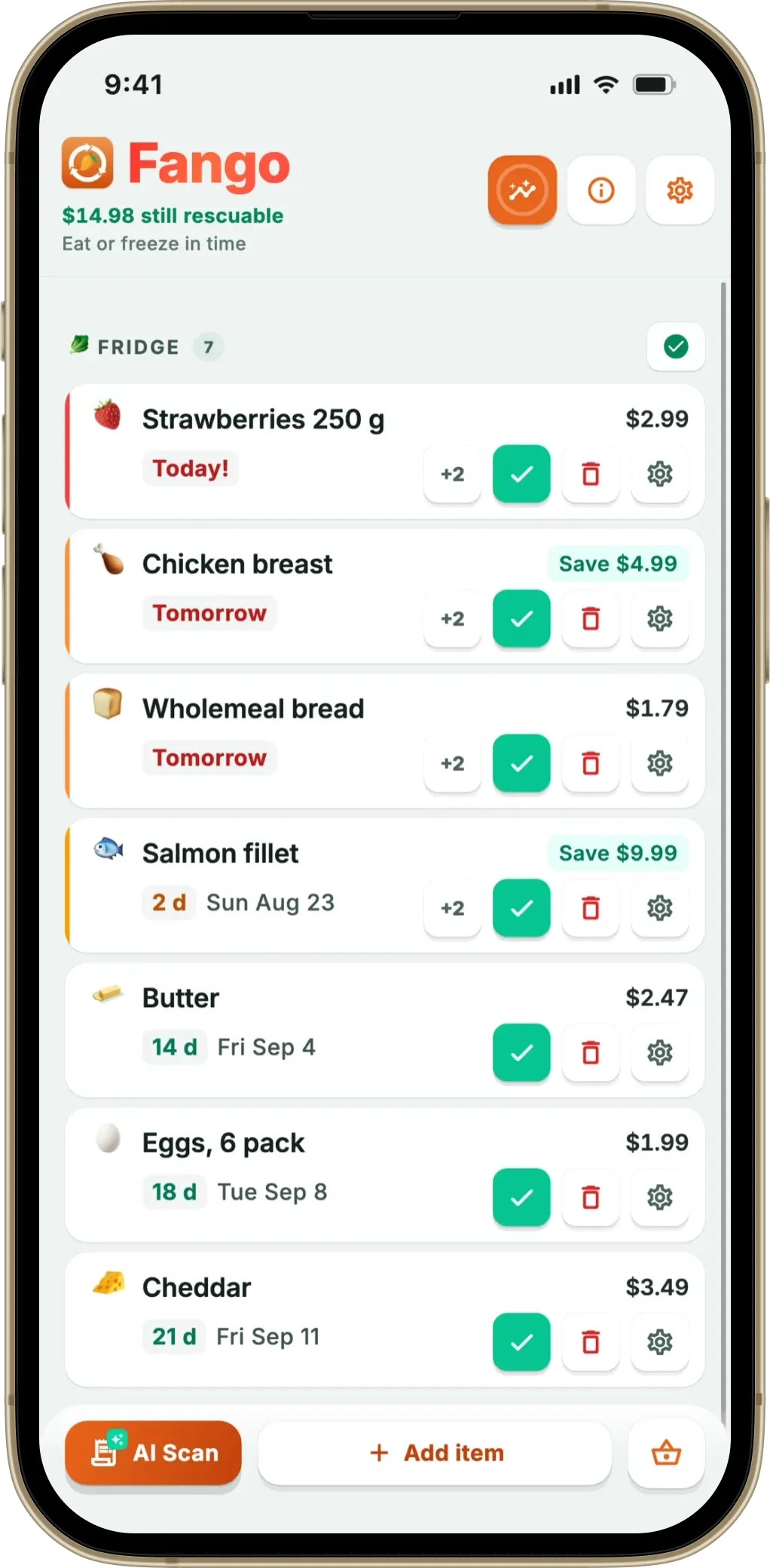
Scan your receipt and Fango lists everything with an estimated reminder date, shows what’s next on a home-screen widget, and reminds you in time. No more “I forgot that was in there.” No account, all on your phone.
Download on the App Store Get it on Google PlayFree for a month · No sign-up · iOS and Android
- You forget food because it’s out of sight, not because your memory is bad — so the fix is making it visible.
- Low-tech: an eat-me-first shelf and a door whiteboard put what you have in plain view.
- Hands-off: an app keeps the list and reminds you in time, so you don’t have to remember at all.
- Fango builds the list from your receipt and shows what’s next on a home-screen widget.
Why you forget in the first place
It helps to know what you’re fighting. The problem is structural: a fridge stacks items behind one another, so anything not at the front is invisible, and you can’t remember what you can’t see. Add a busy week and a full shop, and whole purchases vanish to the back. This is why “just try to remember” never works — you’re asking memory to do a job that sight should be doing. For the deeper reasons, see why you keep forgetting food in your fridge.
A fridge tracker app handles this for every item at once — here is what separates a good one from a spreadsheet.
The scale is real: WRAP estimates UK households waste around 70 kg of edible food per person a year, much of it forgotten rather than genuinely spoiled. So every system below has the same goal — turn “I can’t remember” into “I can see it.”
Six ways to remember what you have
These range from a sticky note to a self-updating app. Pick the level of effort you’ll actually keep up — the best system is the one you don’t abandon in week two:
- The eat-me-first shelf. Designate one visible shelf or box for everything close to its date. It’s the simplest fix and it works — see the eat-me-first shelf guide.
- A whiteboard on the door. Jot what’s inside and wipe items as you use them. Cheap and visible, but only as current as your last update.
- Shop your fridge first. Before writing a shopping list, look inside and plan meals around what’s already there. Stops you double-buying what you’ll then forget.
- Don’t overfill it. A packed fridge hides food and blocks cold air. Leaving room means you can actually see what’s there — and it keeps better too (how to organise your fridge).
- Photograph the inside. A quick photo before you shop is a surprisingly good memory aid at the supermarket. Low effort, no app needed.
- Use a tracking app. The hands-off option: it keeps the list and reminds you in time, so remembering isn’t your job at all.
The first five rely on you keeping them up; the sixth does the upkeep for you. Most people end up combining one physical habit (the shelf) with the app as a safety net.
Why an app is the most reliable system
The honest weakness of every low-tech method is that it depends on you remembering to keep it current — which is the exact thing you’re bad at, or you wouldn’t be reading this. An app removes that dependency. Once your food is in it, the list stays accurate without further effort, and instead of you scanning the fridge and hoping to notice what’s urgent, the app tells you: a home-screen widget shows what to use next, and a reminder in time nudges you a day or two ahead.
The reason most people never keep a fridge list is the typing, and that’s where Fango differs: you don’t type. Photograph your grocery receipt and AI reads every item, assigns an estimated expiry date, and adds it all at once (see the grocery receipt scanner app guide). The list builds itself the moment you get home, so the “remembering” is handled before you’ve even unpacked. For the wider toolkit, see the best food waste tracker app roundup.
Scan your receipt and Fango lists everything with an estimated reminder date, shows what’s next on a home-screen widget, and reminds you in time. No more “I forgot that was in there.” No account, all on your phone.
Download on the App Store Get it on Google PlayFree for a month · No sign-up · iOS and Android
Frequently Asked Questions
How can I remember what’s in my fridge?
Use a system rather than memory. The simplest is an eat-me-first shelf where everything close to its date sits in one visible spot. A whiteboard list on the door works too. The most reliable option is an app that keeps the list for you and reminds you in time — like Fango, which builds the list from your receipt and nudges you in time.
Why do I keep forgetting food in my fridge?
Because food at the back goes out of sight, and out of sight is out of mind. You can’t remember what you can’t see, and a full fridge hides items behind one another. The fix isn’t trying harder to remember — it’s making what you have visible, either physically with a shelf system or digitally with a tracked list and reminders.
What’s the best way to keep track of fridge contents?
For most people, an app that lists your food with expiry dates and reminds you before things go off. It removes the memory part entirely. A physical eat-me-first shelf is a great low-tech companion, but it can’t tell you when something is due — an app can, with a nudge a day or two ahead.
Does Fango help you remember what’s in your fridge?
Yes. Scan your receipt and Fango lists every item with an estimated reminder date, shows what to use next on a home-screen widget, and reminds you before anything goes off. You don’t have to remember — the app keeps the list and surfaces the urgent items for you, all stored on your phone with no account.