Ask anyone what their household spends on food in a month and you will get a guess, usually on the low side. The ONS Family Spending survey puts food and non-alcoholic drinks at £70.50 a week for the average UK household in the year to March 2024, and the following year’s release adds another £3.20 on top, most of it prices. Call it £74 a week, or around £320 a month. The trouble with tracking food spending is not the arithmetic. It is that the numbers live in three places: some in your banking app, some in a pile of receipts, and the biggest chunk in the bin, where nobody counts anything. Fango starts from the receipt, because that is the only place the product-level truth about where the money went actually exists.
This article gives you a benchmark first, then four ways to track food spending, and ends with the number that is missing from every household budget.
- The average is about £74 a week — roughly 11% of household spending, and well above that for a family with children
- Your bank sees the total, the receipt sees the products — £45 at Tesco does not tell you what was food and what was washing-up liquid
- A spreadsheet is the most accurate and lasts three weeks — typing in every line is the step where tracking dies
- The second number is missing for everyone — WRAP puts binned food at around £250 per person a year, and neither your bank nor your spreadsheet sees it
How much does a household spend on food a month?
The ONS asks thousands of households to keep a spending diary every year, and the Family Spending bulletin for the year to March 2024 puts average weekly expenditure at £623.30, with £70.50 of that going on food and non-alcoholic drinks — about 11%. The year to March 2025 added £3.20 a week (5%), and the ONS notes that most of that increase reflected higher prices rather than more food in the trolley. Around £74 a week, then, or roughly £320 a month for the average household.
Read the average with three caveats. First, it is an average across all households: a single person spends less and a family with two children considerably more, because the number is per household, not per head. Second, the figures lag reality by more than a year, and food prices have not stood still since. Third, the survey records what was bought, not what was eaten. That is the subject of the last section.
A practical rule of thumb: on these figures, a family of four spending £600–800 a month on food is ordinary, not extravagant. If you cannot name your own figure to within a hundred pounds, that is a reason to start tracking, not a reason to worry.
Four ways to track food spending
The methods differ on two things: how much manual work they need and how deep they see. A monthly total is easy to get, product-level detail takes effort, and only the second one tells you where the money is going.
-
1
Your bank’s spending categories. Most banking apps categorise card payments automatically, and “groceries” is already there. Zero effort and a monthly total every month. The limit is that the bank sees the transaction, not the basket: £45 at Tesco on a Saturday includes the washing-up liquid, the cat litter and the block of cheese that went off on Thursday. Cash and supermarket pay-by-app purchases can slip past it too.
-
2
A spreadsheet or notebook. The most accurate method, because you record what you bought and what it cost. It is also the method that stops in week three, because every line has to be typed in by hand. It works best as a time-limited experiment: one month a year gives you a personal benchmark to hold the bank’s total against.
-
3
Keeping the receipts. Photograph the receipt or ask for a digital one. The product level is preserved, but a photo does not add anything up: at the end of the month you have a folder of images and the same manual work as the spreadsheet. This is a halfway house, not a method.
-
4
Scanning receipts with an app. AI reads the products, quantities and prices off the receipt, so the product level appears without any typing. Fango does this and keeps every receipt as a card showing the shop, the number of items and the total. Prices are remembered per product, so your next shopping list arrives with estimates already on it. What receipt scanning alone does not do is the monthly sum: your bank gives you that, and the receipt gives you what the bank cannot see.
In practice the combination is best: the bank gives you the monthly total for free, the receipt tells you what was in it. Neither, though, answers the question that decides whether you save anything — how much of the food you bought was actually eaten.
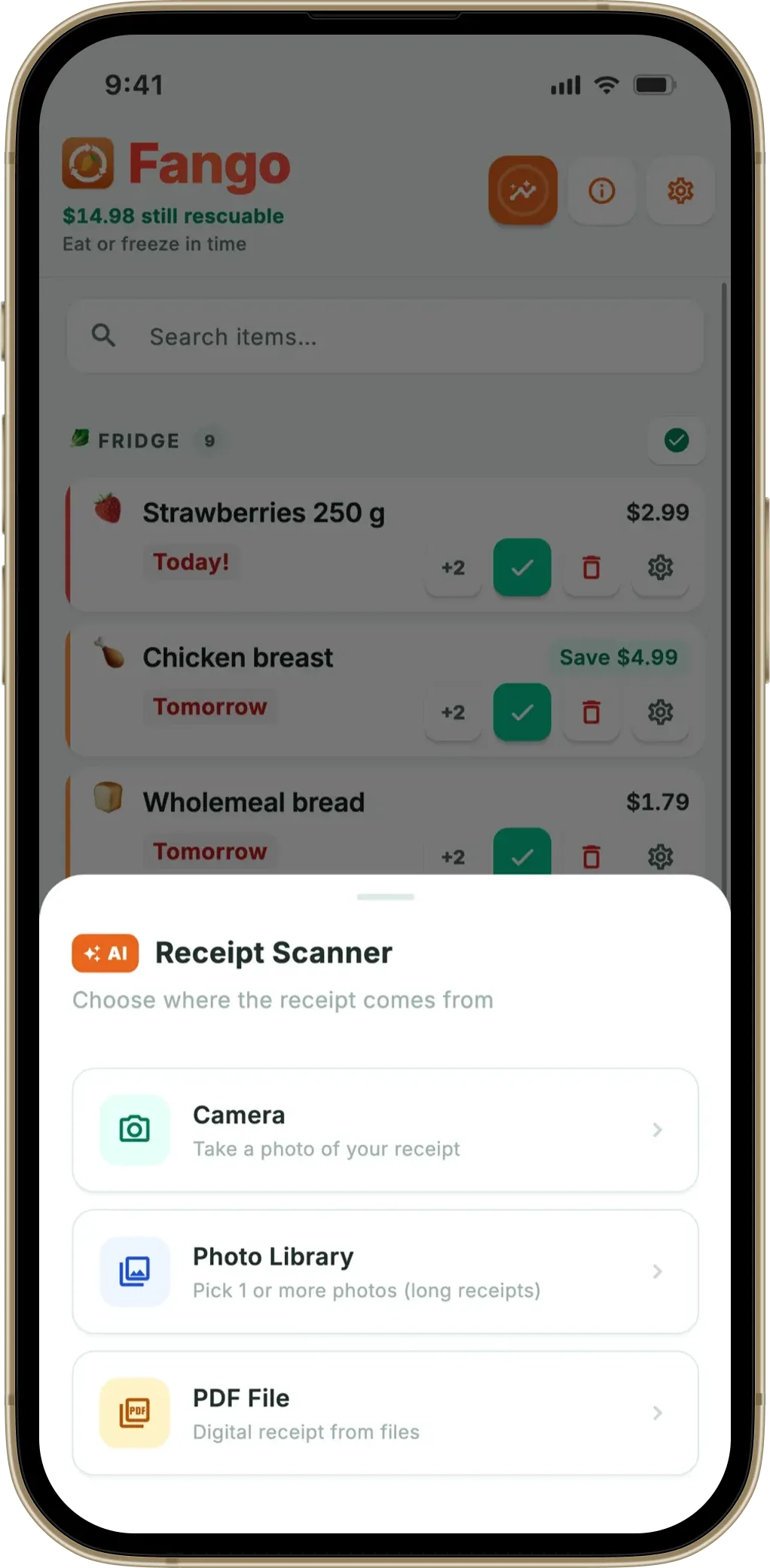
Scan your grocery receipt — AI reads the products and prices, puts the food on your fridge list with reminders and saves the receipt as a card. The stats show the value of food that went in the bin, in pounds. No account, no bank connection.
Download on the App Store Get it on Google PlayTry free for a month.
The second number nobody tracks
Every household budget has a line for food. None has a line for food that was thrown away — even though that is money that has already left the first line. WRAP estimates that UK households bin around 70 kg of edible food per person a year, worth about £250 per person, or £1,000 for a family of four; across the country it comes to £17 billion a year.
For a family of four, that is several weeks’ worth of shopping carried home and then carried out to the bin. None of the four methods above can see this number, because the bank and the receipt both stop at the checkout. Waste happens later, in the fridge, often days after the shop, and tracking it means knowing what is in the fridge and when it needs using. How big this line is in pounds for different households is worked through in how much food waste costs.
This is also where tracking actually pays off. The food total is hard to shrink, because you do not eat less. The binned share is a cost that does not need replacing with anything: halve it and the saving comes straight off the food bill, and for an ordinary family that is tens of pounds a month. How to save money on groceries covers the other levers, but this is the only one that does not ask you to buy cheaper or buy less.
How Fango tracks food spending
Fango is a food waste app, not a budgeting app, so its tracking starts exactly where the others stop. Here is how it works in practice:
- The receipt is read once. Photograph the receipt or share it to the app as a PDF. AI reads the products, quantities and prices, and the food lands on your fridge list with shelf-life estimates. Photographing is the only input step; nothing is typed. How the reading copes with different supermarkets is covered in scanning receipts to track food.
- Receipts are kept as cards. Past purchases appear on the shopping-list side as cards with the shop name, the number of items and the total. You can pull products from a card straight onto the next list.
- Prices are remembered per product. Add butter to the list and an estimate of what it cost last time comes with it. You can set a budget target for the list and the estimate sits against it: green under, red over. More in how to make a grocery list that saves money.
- Waste and rescues in pounds. When you mark an item as eaten or binned, the stats total both by month. “Wasted” shows the value of food that went in the bin, and the rescued total shows what you used in time, close to its date. That is the line the budget is missing.
- The whole household in one fridge. With family sharing, up to four people share the same fridge list and shopping list on one subscription. The invite is an eight-character code, no account is needed, and changes show up on everyone’s phone within seconds.
And the limits, so the number stays useful: Fango does not add up the month’s shopping total automatically, does not connect to your bank and does not compare prices between supermarkets. A price estimate is what you paid last time, not what is on the shelf today. The monthly total still comes from your bank — Fango tells you how much of it got eaten.
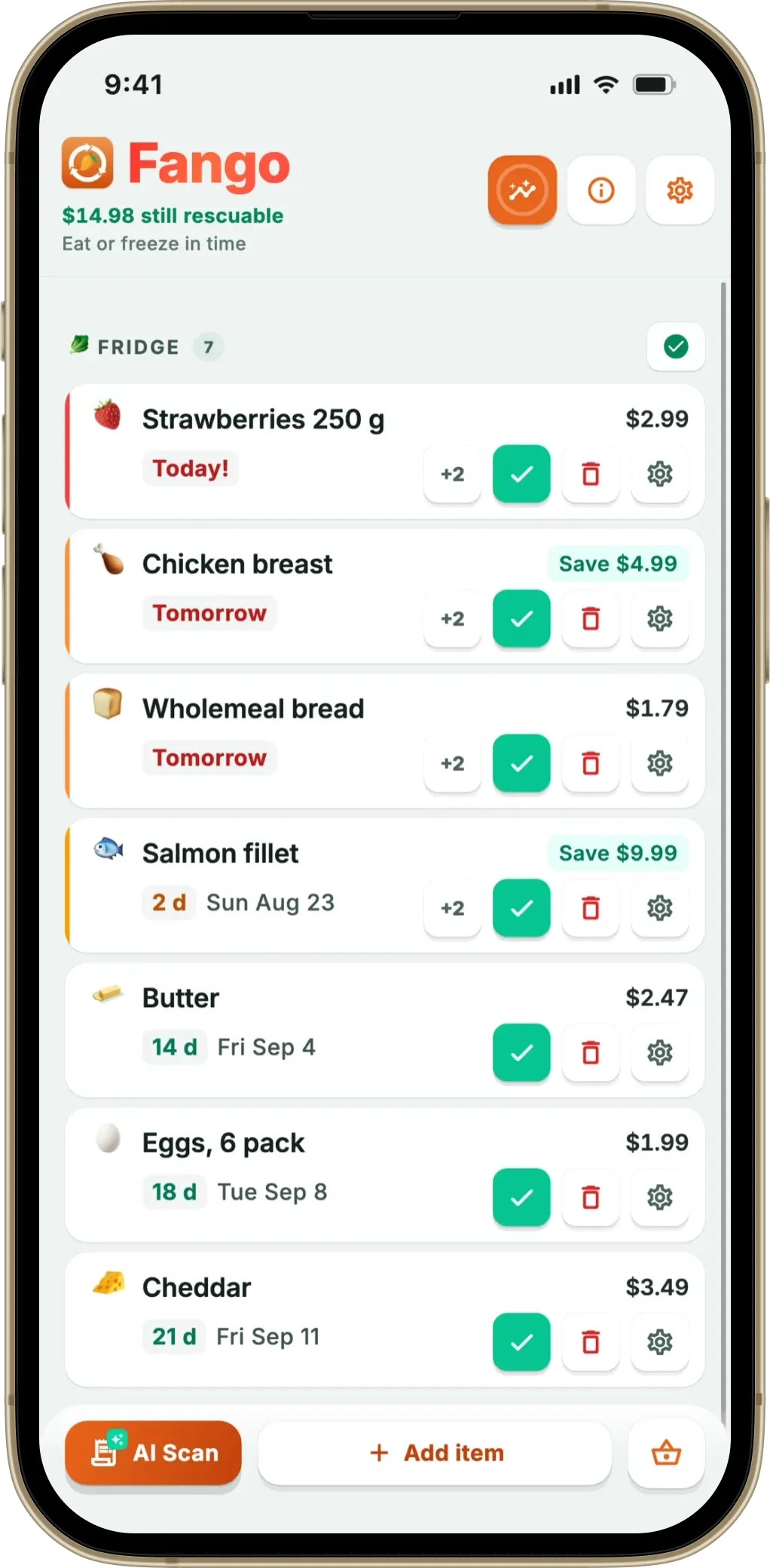
Fango sorts everything by reminder date and colour-codes the urgent items in red. The home screen widget shows what to use next without opening the app.
Download on the App Store Get it on Google PlayTry free for a month.
A tracking routine that outlasts week three
Tracking only survives if it takes less time than it saves. This routine takes a few minutes a week.
-
1
Take a three-month average from your bank. A single month swings with birthdays and big stock-up shops. The three-month average is your personal benchmark, and the ONS’s £74 a week is what to set it against.
-
2
Scan the receipt as soon as you get home. At the kitchen table it takes a moment, and the products are on the fridge list with reminders at the same time. A receipt that sits in a wallet for a week never gets scanned.
-
3
Mark binned food honestly. The waste figure is only useful if it is true. After a few weeks you can see which products end up in the bin repeatedly — and that is a list you shrink on the shopping list, not in the fridge.
-
4
Compare two numbers at the end of the month. The bank total tells you how much you bought. Fango’s stats tell you how much of it was thrown away. When the second number falls, the first can follow it down — as far as what you actually eat.
Most of the saving happens at step three. Tracking food spending is not bookkeeping; it is finding out what share of what you buy goes uneaten, and for that it is enough to have the contents of the fridge and their dates in one place. Shopping once a week collects the other ways to bring the bill down, and if you want a tool for this, food waste app explains what to expect from one.
Frequently asked questions
How much does the average UK household spend on food a month?
According to the ONS Family Spending survey, the average UK household spent £70.50 a week on food and non-alcoholic drinks in the year to March 2024, and the following year added £3.20 (5%), most of it higher prices. That is around £74 a week or roughly £320 a month, about 11% of total household spending. It is an average per household: a single person spends less and a family with children considerably more.
Is my bank’s spending category enough to track food spending?
It is enough to track the total, but it does not tell you where the money went. The bank sees the transaction: £45 at Tesco on a Saturday. It does not see that £10 of that was washing-up liquid and £4 was a block of cheese that went in the bin on Thursday. If you want to know what your food spending is made of and how much of it is waste, you need product-level detail, and that only exists on the receipt.
Does Fango add up my monthly food spending automatically?
Not as a monthly total. Fango keeps every scanned receipt as a card with the shop name, the number of items and the total, and remembers per-product prices for your next shopping list. What it does total automatically is the other side: the value of food that went in the bin and the value of food used in time, by month, in the stats view. The month’s shopping total is a job for your bank, or for adding up the receipt cards.
How much food goes in the bin, in money?
WRAP estimates that UK households throw away around 70 kg of edible food per person a year, worth about £250 per person or £1,000 for a family of four, and £17 billion a year across the country. For a family of four that is several weeks’ worth of shopping.