If you’ve ever cleaned out the crisper drawer and found a bag of spinach you forgot about, you’re not alone. The average Australian household throws away roughly $2,500 worth of food a year, according to figures cited by Foodbank Australia and the Department of Climate Change, Energy, the Environment and Water. Nationally, Australia wastes around 7.6 million tonnes of food each year — more than a third of it from our own kitchens — at an estimated cost of $36.6 billion to the economy.
A food waste app won’t fix that on its own, but it does the one thing willpower can’t: it remembers what’s in your fridge and tells you before it goes off. Fango was built for exactly that, but it’s one of several options you can download in Australia. Here’s an honest look at what’s available in 2026, and which app suits which kind of shopper.
- Best overall for most Aussie households → Fango (scan your Woolies/Coles/Aldi receipt, no account)
- Shared fridge across two phones → Fango (no account) or NoWaste (cloud sync)
- Barcode-first tracking → NoWaste or BEEP (the original Fridgely is no longer in the app stores)
- Simple barcode reminder tool → BEEP
What to look for in a food waste app
Most food tracking apps do the same core job — a list of what you own and a reminder in time. The differences that actually matter day to day are:
The feature that matters most in any of these apps is the reminder — see what a good expiry date tracker app does differently.
- How fast it is to add food. If logging a weekly shop takes ten minutes, you’ll stop doing it. Receipt scanning adds a whole shop in seconds; barcode scanning means one product at a time; manual entry is the slowest.
- Does it work with Australian receipts? Plenty of apps are built around UK or US supermarkets. An app that reads a Woolworths, Coles or Aldi docket saves you re-typing everything.
- Account or no account. Some apps make you register with an email before you can track a single item. Others keep everything on your phone.
- Where your data lives. Cloud sync is handy for sharing a fridge across devices — but it means your grocery history sits on someone’s server.
- Reminders you can actually act on. Notifications a day or two out, ideally with a quick “eaten” or “binned” button, so the list stays honest.
If you want to dig into any one of these, our best food waste tracker app guide breaks them down in more detail, and how much money food waste really costs puts the household numbers in context.
The apps at a glance
| Feature | Fango | NoWaste | Fridgely | BEEP |
|---|---|---|---|---|
| Reads Australian receipts | ✓ | Not verified | — | ✗ |
| No sign-up required | ✓ | Check listing | — | ✗ |
| Data stays on device by default | ✓ | ✗ | — | ✗ |
| AI receipt scanning | ✓ | Receipt scan (iOS) | — | ✗ |
| Barcode scanning | ✗ | ✓ | — | ✓ |
| Push notifications | ✓ | ✓ | — | ✓ |
| Multi-device sync | ✓ in household sharing | ✓ | — | ✓ team invite |
| iOS | ✓ | ✓ | ✗ removed | ✓ |
| Android | ✓ | ✓ | ✗ removed | ✓ |
| Free tier | ✓ 1-month free trial | 6 lists / 500 items | No longer available | Limited (paid Premium) |
← scroll →
Fango — best for the big weekly shop
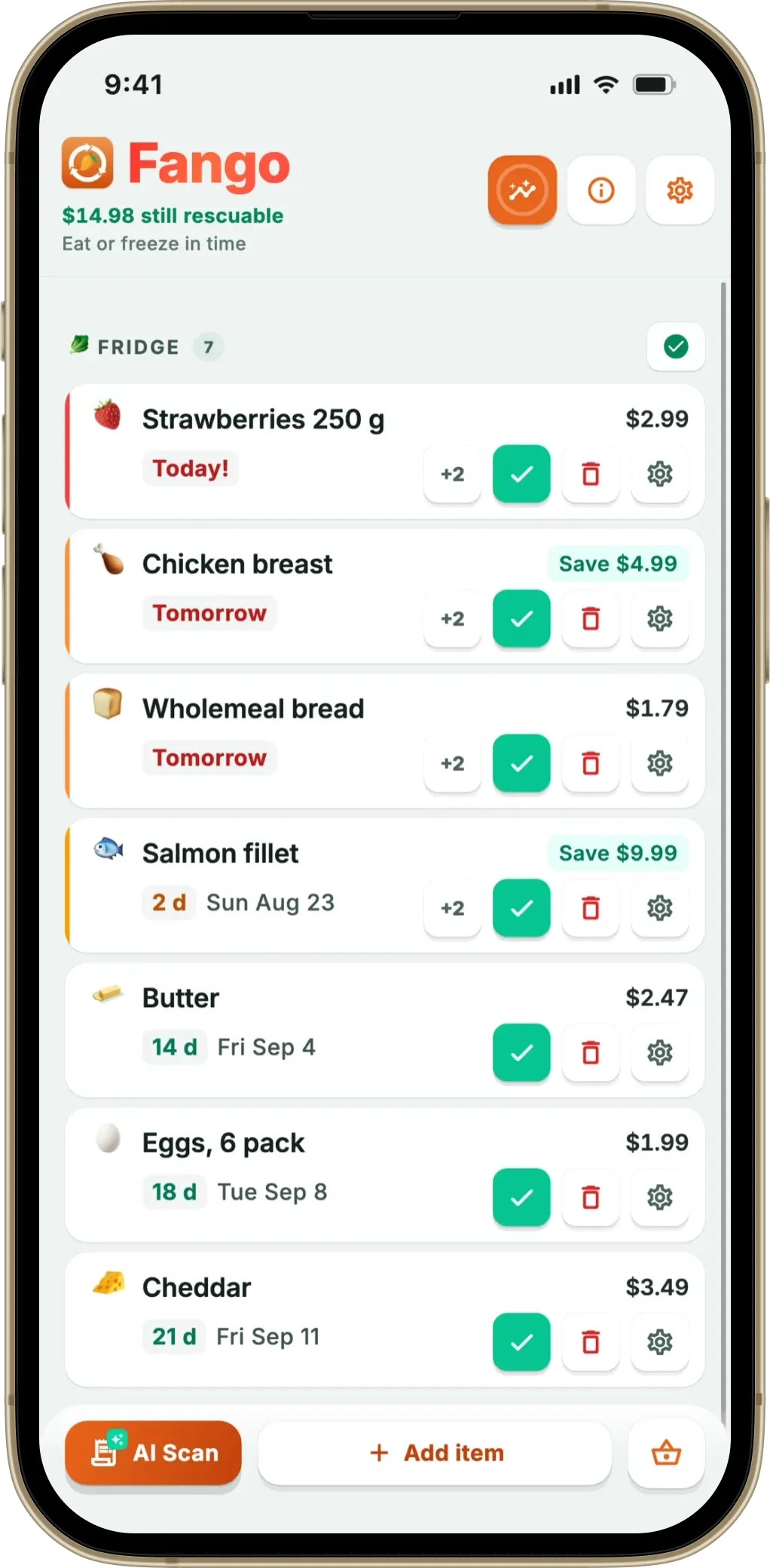
Fango is built around one idea: adding your food should take seconds, not minutes. After a shop at Woolworths, Coles, Aldi or IGA, you photograph the receipt and Fango’s AI reads every product, estimating a use-by date for each based on item type. A full trolley is logged in under a minute — no barcode-by-barcode scanning, no typing. It handles Australian dockets natively, and if you have a digital receipt as a PDF it can read that too.
From there, Fango sends push notifications in time — anywhere from one to fourteen days out, set per item — with quick action buttons to mark something eaten or binned. There’s a home-screen widget, running waste stats so you can see what you’re saving, and support for prices in Australian dollars. There’s no account to create: you open the app and start straight away, and your fridge list stays on your phone by default. Unless you share it with your household, the only thing that leaves the device is the optional receipt scan itself, which is processed momentarily and then discarded.
- Reads Australian supermarket receipts (Woolworths, Coles, Aldi, IGA)
- No account or sign-up required
- Fridge data stays on your device by default — no cloud account by default
- Configurable reminders with quick action buttons
- Free to try for a month, then subscription (price in app)
- Household sharing: the same view for up to four people, one subscription
- No barcode scanning
- No multi-device sync by default
- No recipe suggestions or meal planning
Photograph the docket and Fango’s AI adds every item with an estimated reminder date. Get a reminder in time. No account, no cloud sync by default, fridge data stays on your phone by default.
Download on the App Store Get it on Google PlayFree for a month · No sign-up · iOS and Android
If receipt scanning is the feature you care about most, our grocery receipt scanner app guide goes deeper on how it works and where it helps.
NoWaste — best for multi-device households
NoWaste is one of the most established apps in the category and is available on the Australian App Store and Google Play. Its standout feature is cloud sync across your devices, with a web app alongside the phone apps. It includes barcode scanning, manual entry and separate lists, and on iPhone also receipt, photo and AI-assistant input.
The Google Play listing mentions only barcode scanning, so check what the Android version offers. The free tier covers 6 lists and 500 items; NoWaste Pro costs $6.99 a year or $29.99 lifetime in the US App Store (Australian prices may differ).
- Multi-device sync, plus a web app
- Barcode scanning and separate lists
- Receipt and photo input on iPhone
- Available on iOS and Android in Australia
- Data stored in the cloud
- Receipt scanning is mentioned for iOS only
- Free tier capped at 6 lists and 500 items
Fridgely — no longer available
Fridgely was built around barcode scanning, with expiry tracking, a fridge inventory and reminders. The original app is no longer in the App Store or on Google Play (checked September 2026), so it can’t be installed in Australia any more. The app now listed as “Fridgely” on Google Play is a different, newer app from another developer.
If you want barcode scanning, NoWaste and BEEP still offer it. Barcode databases skew toward large international brands, so some Australian home-brand items may not be recognised in any barcode app.
- Was a simple barcode-based fridge tracker
- Supported inviting family members or housemates
- No longer available on iOS or Android
- Same name now used by an unrelated Android app
BEEP — best for simple barcode tracking
BEEP takes a stripped-back approach. It focuses on barcode scanning and expiry reminders without the extra features that can make other apps feel cluttered. If you just want a simple tool that reminds you in time, BEEP is worth a look. It needs an account, keeps your data on its servers and lets you invite others to a team; Premium costs $7.99 a month or $59.99 a year in the US App Store.
It doesn’t have receipt scanning, so a full shop means scanning each item. The feature set is intentionally focused, which makes it quick to use but limited compared with Fango or NoWaste.
- Simple and fast to use
- Available on iOS and Android
- Team invites for a shared kitchen
- No receipt scanning
- Premium is a paid subscription
- Account required
Which app is right for you?
Want the version without an email step at all? Our guide to a food waste app with no registration covers why that matters. And if you’re comparing notes with mates overseas, the best food waste app in the UK runs the same test for British supermarkets.
Related reading: Best Food Waste App in Canada and Best Food Waste App in Ireland.
Frequently asked questions
What is the best food waste app in Australia?
It depends on how you shop. If you do a big weekly shop at Woolworths, Coles or Aldi and want to add everything in one go, Fango is the strongest pick — you photograph the receipt and its AI adds every item with an estimated expiry date, with no account and your fridge data kept on your device by default. If you want your inventory synced across devices, NoWaste is a long-running option with a web app. For barcode-first tracking, BEEP is worth a look; the original Fridgely is no longer in the App Store or on Google Play.
Does Fango read Australian supermarket receipts?
Yes. Fango’s AI receipt scanning is built to handle receipts from more than 60 countries, including Australia. Woolworths, Coles, Aldi, IGA and similar dockets are read the same way — photograph the receipt and the products are added automatically with estimated use-by dates. Prices and dates are shown in Australian formatting.
How much does food waste cost an Australian household?
The average Australian household throws away roughly $2,500 worth of food each year, according to figures cited by Foodbank Australia and the Department of Climate Change, Energy, the Environment and Water. Nationally, Australia wastes around 7.6 million tonnes of food annually, with more than a third of that coming from homes.
How much does a food waste app cost in Australia?
Fango is free to try for one month. After that it’s a monthly or yearly subscription billed through the App Store or Google Play in Australian dollars, with the price for your country shown in the app. There is no account to create and no card details are shared with Fango.