In the past couple of years, three well-known food-waste apps have gone dark: CozZo shut down its servers and left the App Store, Kitche was bought and then disappeared from the app stores, and Fridgely vanished from both Google Play and the App Store. If you’ve had to find a replacement more than once, you’ve felt it — this is one of the highest-churn corners of the app world. Fango is our own take on the problem, and part of why we built it the way we did is precisely to avoid the failure mode below.
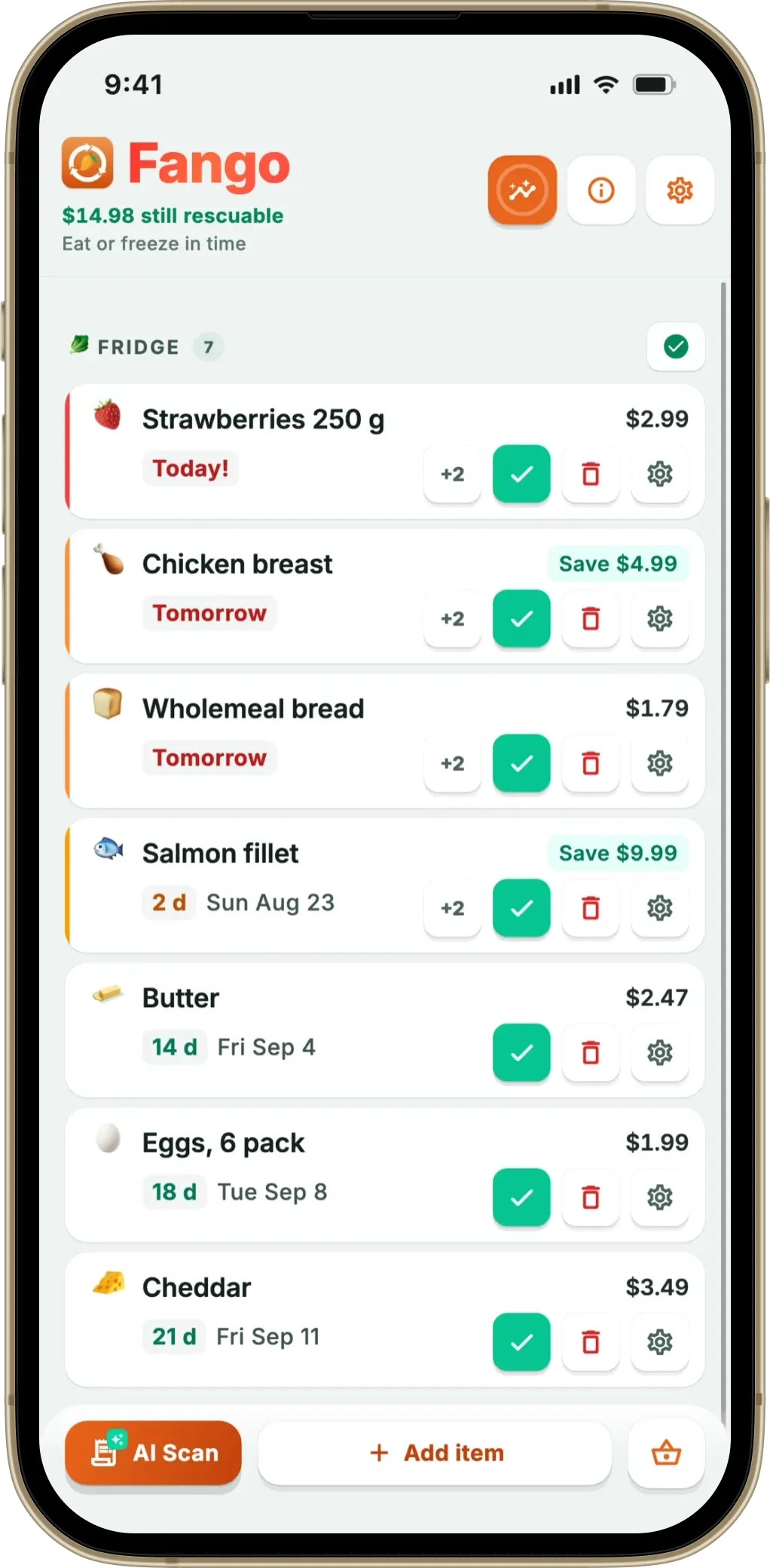
Fango stores your inventory on your own device — no account, no cloud sync by default. Scan a receipt, AI adds the items, get reminders in time. Even in the worst case, your list and reminders stay on your phone by default.
Download on the App Store Get it on Google PlayFree for a month · No sign-up · iOS and Android
According to UNEP’s Food Waste Index Report 2024, households throw away around a fifth of the food available to them — so the demand for these apps is real and growing. The problem isn’t interest. It’s that the economics of running one are quietly brutal. Here’s what keeps killing them, and how to choose one that won’t leave you stranded.
- Three exits in two years — CozZo, Kitche and Fridgely
- Cloud costs kill them — sync and AI features cost money every month
- Free-with-VC has no floor — no revenue means no survival
- Pick local-first — data on your phone can’t be switched off remotely
The graveyard: three apps in two years
These weren’t obscure failures. All three had real users and, in some cases, excellent features.
The feature that matters most in any of these apps is the reminder — see what a good expiry date tracker app does differently.
CozZo — killed by its own cloud
CozZo was arguably one of the most feature-complete apps in the category: a shared household account, barcode scanning and a receipt reader. It announced that the cloud infrastructure behind all of that was being shut down, released a final free version with premium unlocked (supported until 30 December 2025), and then went — the cozzo.app site now carries the end-of-life notice. By 2026 it was gone from the App Store. It wasn’t short of features; its own notice points to the cloud infrastructure that all those features ran on being shut down. We covered the details in our CozZo shutdown write-up.
Kitche — bought, then gone from the stores
Kitche was a well-regarded free UK app that scanned your receipts to build a fridge list. In February 2025 it was acquired by Remy (see Remy’s acquisition announcement), and the Kitche app is no longer in the App Store or Google Play — Remy itself is a very different, recipe-first product. It was free to use, and a free app without a clear revenue model has its own kind of fragility. See our Kitche alternatives guide for where its users landed.
Fridgely — a quiet disappearance
Fridgely, a long-running barcode-first tracker, is no longer in either store: its Google Play listing returns a 404, and the iOS app has been removed from the App Store too (both rechecked September 2026). A quiet disappearance rather than a dramatic shutdown, but the effect on users was the same. (An app now listed as “Fridgely” on Google Play is a different, newer app from another developer.) Our Fridgely alternatives comparison has more, and the same quiet-disappearance pattern hit shopping list apps too — we could not find Out of Milk’s iPhone listing in the UK, Irish, German or Finnish App Store when we checked, which is why we wrote up the Out of Milk alternatives.
Why this category is so hard
Put the three cases together and the pattern is clear. Food-tracking apps face a squeeze that most apps don’t:
- Cloud features cost money forever. Sync across devices, shared households, AI recipe generation and AI scanning all run on servers. Every active user adds a recurring cost. When you’re charging £2 a month — or nothing at all — the maths gets tight fast.
- Free-with-venture-money has no floor. An app kept free by investors looks great until the funding runs out. There’s no revenue to fall back on, so the app either gets sold (like Kitche) or closes.
- The audience is price-sensitive. People tracking food to save money are, understandably, reluctant to pay much for the privilege. That caps how much revenue the category can generate.
- One developer, one point of failure. Several of these apps were tiny teams or solo projects. If attention drifts elsewhere, an app can quietly disappear — as Fridgely did.
None of this means you should give up on tracking your food. It means you should choose with survivability in mind.
How to pick a food app that lasts
You can’t guarantee any company’s survival. But you can pick an app whose death — if it ever comes — doesn’t take your data with it. Look for these:
-
1
Data stored on your device. The single most important factor. If your list lives on your phone rather than someone’s server, no shutdown can erase it. Ask: where does my inventory actually live?
-
2
No forced account. An app that doesn’t require sign-up usually isn’t holding your data hostage in the cloud — and there’s no login to lose access to when the servers go.
-
3
A sustainable, honest price. A small subscription that actually covers costs is more reassuring than “free forever” with no visible way of paying the bills. Free is lovely right up until it isn’t.
-
4
Light infrastructure. The fewer always-on server features an app depends on, the lower its running costs — and the less likely it is to hit the wall CozZo did.
-
5
Export, or at least local persistence. Being able to get your data out, or knowing it never left your phone in the first place, is your insurance policy.
Fango stores your inventory on your own device — no account, no cloud sync by default. Scan a receipt, AI adds the items, get reminders in time. Even in the worst case, your list and reminders stay on your phone by default.
Download on the App Store Get it on Google PlayFree for a month · No sign-up · iOS and Android
Where Fango fits
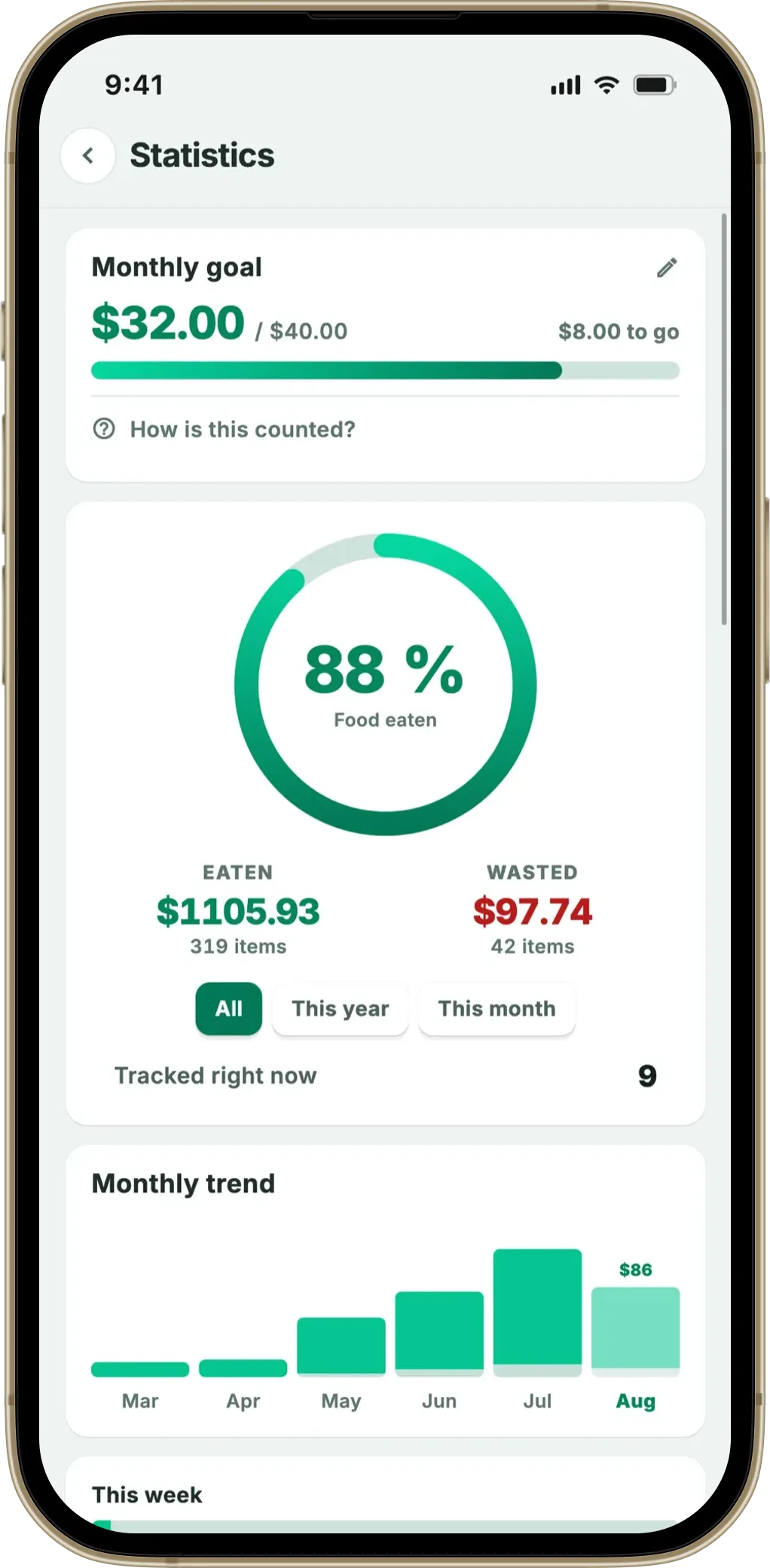
We built Fango around that checklist, because we’d seen the pattern. There’s no account and no sign-up, and your fridge inventory is stored locally on your device — not on our servers, unless you choose to share it with your household. That’s the key difference: by default your data itself is never sitting on a server that could be switched off. You scan a receipt, the AI reads the products (without household sharing, that scanning step is the one moment anything touches the network, and the image isn’t kept), and from then on your list, expiry dates and reminders live entirely on your phone.
We’re honest about the flip side. The receipt-scanning feature does rely on a backend, so if Fango’s developer ever disappeared, that one convenience would stop working. But — and this is the part that matters — your existing list, your reminders and manual adding would carry on, because none of that depends on us keeping a server alive. That’s a fundamentally more durable position than an app where the inventory itself lives in the cloud. If the no-account angle is what draws you, our guide to food waste apps with no sign-up goes further, and our best food waste tracker app roundup puts the surviving options side by side. It’s also worth reading how Remy compares, since it acquired Kitche.
Frequently asked questions
Which food waste apps have shut down?
In the space of about two years, CozZo shut down its cloud servers and left the App Store, Kitche disappeared from the app stores after Remy acquired it in February 2025, and the original Fridgely is no longer available in either the App Store or Google Play. Several smaller apps have quietly disappeared too. It’s one of the highest-churn categories in mobile apps.
Why do food tracking apps keep closing?
Two reasons dominate. First, heavy cloud features — sync, shared households, AI recipes — cost money every month to run, and a £2-a-month app with a small subscriber base struggles to cover that. Second, apps that stayed free on venture funding never built a revenue floor, so when the money ran out, so did the app. Both patterns leave users stranded.
What happens to my data when a food app shuts down?
If your inventory lived on the app’s cloud servers behind an account, it usually disappears when those servers are switched off — there’s often no way to export it afterwards. That’s the core risk of account-based tracking. An app that stores your list locally on your phone keeps that data even if the company vanishes.
How do I pick a food waste app that will last?
Favour apps whose data lives on your device, that don’t force an account, that charge a fair, sustainable price rather than relying on free-with-venture-money, and that keep their infrastructure light. A local-first app like Fango means that even in the worst case, your list and reminders keep working on your phone — nobody can switch them off remotely.