Out of Milk has been a fixture of this category for over a decade: free, shared, barcode scanning, a shopping history and — unusually — a pantry list for what you already own. Most people searching for an alternative in 2026 aren’t looking because it got worse. They’re looking because it isn’t there any more.
When we checked in August 2026, the Out of Milk iPhone listing loaded in the US and Canadian App Stores and returned a not-found error in the UK, Irish, German, Finnish and Australian ones. An App Store search run from a UK account didn’t return the app at all. The Android listing was still published in every one of those countries on the same day, and the US iPhone listing had been updated at the end of July — so this reads as a storefront availability change, not a dead app. Either way, if you’re on an iPhone in Europe, you need something else.
- iPhone, Europe: we found no App Store listing in the UK, Ireland, Germany or Finland — Android was unaffected
- Closest swap: OurGroceries — free, shared, barcodes, aisle grouping, web version
- Best-built list: AnyList, though prices and unlimited recipe imports need the paid tier
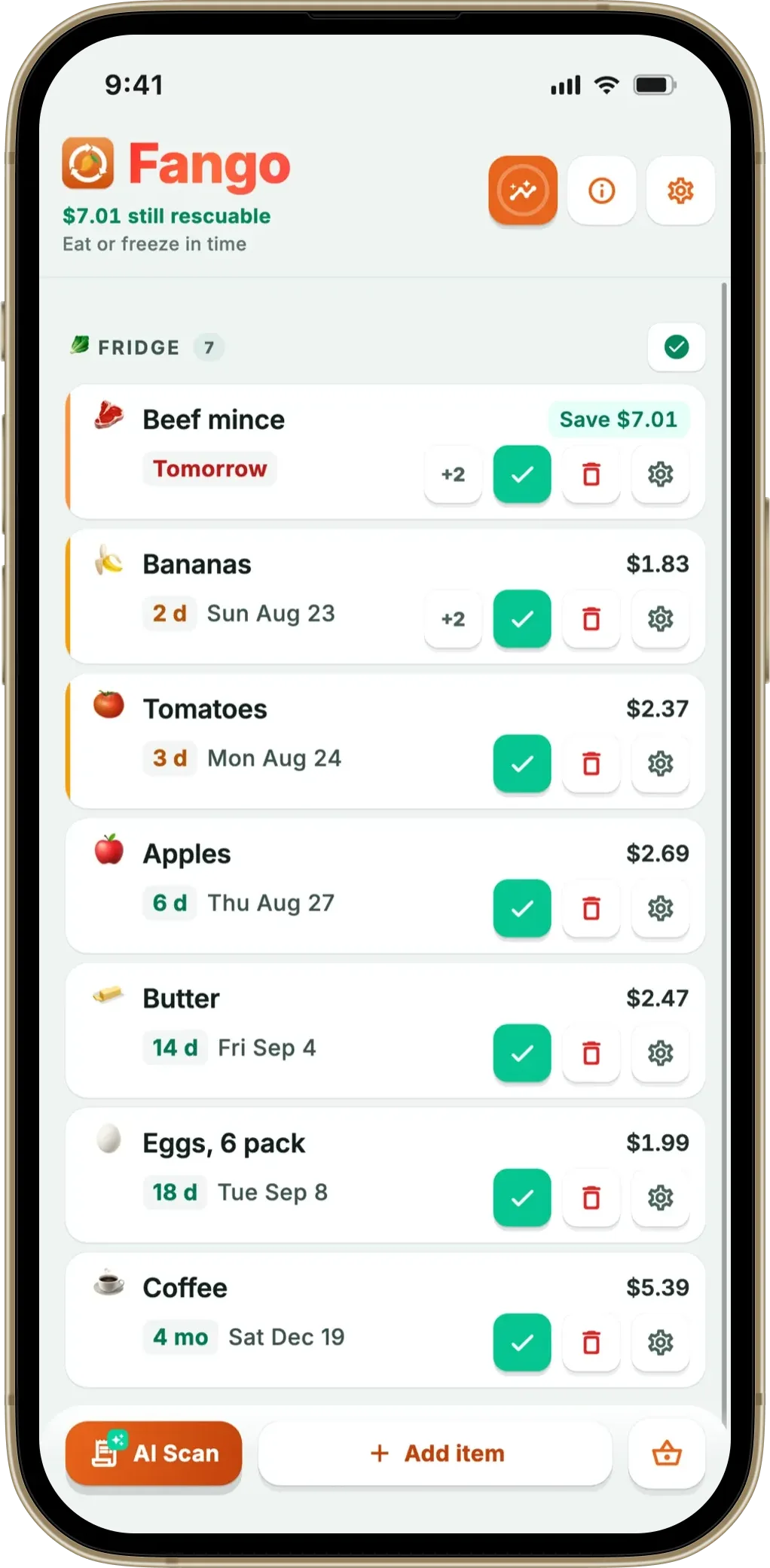
- For the pantry list: Fango replaces it with a tracked fridge, freezer and cupboard list that warns you in time
What we actually checked
Availability claims are easy to get wrong, so here is the method rather than just the conclusion. In August 2026 we requested the Out of Milk App Store page in seven storefronts and recorded the response, then ran the same check against Google Play.
If you are choosing between apps, our guide to picking an expiry date tracker lists the features that decide whether you are still using it a month later.
Out of Milk’s own website still describes the app as free across Android and iOS with shared lists, a barcode scanner, a pantry inventory, shopping history, photos and a web version, and carries no announcement about any market. So: don’t panic if you’re in North America, and don’t wait for an explanation if you’re not.
What you’re actually replacing
Out of Milk does three jobs, and most alternatives only do two of them.
- The shared shopping list. Multiple lists, categories, priorities, barcode scanning, syncing between phones through an account. Every app below covers this.
- The shopping history. Past items come back so you’re not retyping the weekly staples. Most alternatives do a version of this.
- The pantry list. A running record of what you already own, so you check before you buy. Almost no shopping list app has this — it’s the feature that’s hardest to replace, and the reason a straight list app can feel like a downgrade.
That third one is worth more than it looks. WRAP puts UK household food waste at £1,000 a year for the average household of four, and UNEP’s Food Waste Index Report 2024 estimates around a fifth of the food available to consumers is thrown away. Knowing what’s already in the cupboard is the only part of a shopping app that touches that number.
The four alternatives, compared
OurGroceries — the closest like-for-like
If you want to feel the smallest possible difference, this is it. Free, shared across a household through an account, with automatic category suggestions, barcode scanning, item photos, recipes that fill the list in one tap, an Apple Watch app and a web version. Its own FAQ confirms the app is free with banner ads and sells an upgrade to remove them, and warns that its barcode product database is “rather U.S.-centric” — relevant if you were scanning British shelves.
AnyList — the best-built list of the group
The most polished option, and the only one with a proper running total. AnyList’s own feature comparison puts lists, sharing, meal planning, a web app and up to five recipe imports in the free tier, with AnyList Complete at $9.99 a year for an individual or $14.99 for a household. Its help pages state that AnyList Complete is required to add prices to items, so the total is paid.
Bring! — the shared list that looks good
Design-led, built around a household sharing one list, and available across Europe on both platforms — which matters here. Its help centre documents a Group by Categories setting under List View, so items arrange themselves into shop sections. Free with advertising; a Premium tier removes ads and adds extras such as a dark theme.
Fango — the pantry list, rebuilt around expiry dates
The only app here that answers the pantry half. Fango holds one tracked list of what’s in your fridge, freezer and cupboard, with a shelf-life estimate per item and a push reminder up to 14 days before the date — and it fills that list by scanning a receipt rather than by typing, so the inventory doesn’t rot from neglect the way manual pantry lists do. The shopping list side sorts into 13 aisles in walking order, autocompletes from names you’ve used, takes non-food items by hand, and has a full-screen shopping mode and a budget target.
Out of Milk vs the alternatives, side by side
| What you want | Out of Milk | OurGroceries | AnyList | Bring! | Fango |
|---|---|---|---|---|---|
| On iPhone in the UK / EU | ✗ not listed | ✓ | ✓ | ✓ | ✓ |
| Shared list | ✓ | ✓ | ✓ | ✓ | ✓ up to 4 people |
| Barcode scanning | ✓ | ✓ US-centric database | ✓ | Varies by region | ✗ receipts instead |
| Groups items by aisle | Manual categories | ✓ | ✓ | ✓ | ✓ 13 aisles |
| Pantry / what you already own | ✓ manual | ✗ | ✗ | ✗ | ✓ from receipts |
| Warns in time | ✗ | ✗ | ✗ | ✗ | ✓ |
| Works with no account | ✗ | ✗ | ✗ | ✗ | ✓ |
| What it costs | Free | Free with ads; paid upgrade | Free; Complete $9.99–$14.99/yr | Free with ads; paid Premium | Free for a month, then from $2.99/mo |
← scroll →
Why a manual pantry list always dies
If you used Out of Milk’s pantry feature for a while and then quietly stopped, you’re the rule rather than the exception. A manual inventory has to be updated twice per item — once when it comes in and once when it’s used — and the second update never happens. Within a fortnight the list is describing a cupboard that no longer exists, and an inventory you don’t trust is worse than none, because you stop checking it.
The only version of this that survives contact with a real household is one where the “in” half is automatic. That’s the design behind scanning the receipt: one photo after the shop enters twenty items at once, with dates attached, and the “out” half is a single tap when you eat something. Our piece on how to remember what’s in your fridge goes through the failure modes, and app vs pen and paper covers why the notebook version dies the same death.
What Fango adds — and what it gives up
What it adds. Scan a receipt and the AI reads the products, estimates how long each keeps, and puts them into a fridge, freezer or cupboard list with reminders before the date. That history also feeds the shopping list: things you buy on a regular cadence come back as one-tap suggestions, and anything about to go off is flagged before you buy a duplicate — the loop behind shopping your fridge first and a list that knows what you’re about to run out of. By default it all stays on the device: no account, no cloud copy of your shopping.
What it gives up. Unlimited sharing — a Fango household stops at four people, which is the clearest reason to pick OurGroceries or Bring! instead. No barcode scanning, no recipes or meal planning, no web version and no shopping-list widget. Ticking an item off the shopping list doesn’t move it into fridge tracking either; things get there by scanning a receipt or adding them by hand. It’s free for a month, then from $2.99 a month or $22.99 a year, against free forever for Out of Milk.
Scan the receipt and the whole shop lands in your fridge, freezer and cupboard list with dates attached — plus an aisle-sorted shopping list for next time. No account, no ads.
Download on the App Store Get it on Google PlayFree for a month · No sign-up · iOS and Android
Which one should you move to?
One practical note before you switch: export or screenshot your Out of Milk lists first. None of these apps import from it, so the move is a one-off retype of your regular shop — which is quick, because every app worth switching to starts suggesting your staples after two or three shops. For the wider field, our roundup of the best shopping list apps by use case covers the shared-list and recipe-led options, and the account-free options are here if the login was always the part you disliked.
Frequently asked questions
Why can’t I find Out of Milk in the App Store?
Because the iPhone listing is not published in every country. When we checked in August 2026, the Out of Milk App Store page loaded in the United States and Canada and returned a not-found error in the United Kingdom, Ireland, Germany, Finland and Australia, and an App Store search from a UK account did not return the app at all. The Android app was still listed in all of those countries on the same day. Out of Milk has not published a notice about this on its own website, so treat it as a storefront availability change rather than a shutdown.
Is Out of Milk shutting down?
There is no sign of that. The US App Store listing was updated at the end of July 2026, which is recent maintenance rather than an abandoned app, and the Android version is still published across Europe. What has changed is where you can install the iPhone version. If you are in the United States or Canada, nothing about your setup is at risk today; if you are in Europe and on an iPhone, you need a different app whether or not the company ever explains why.
What is the closest alternative to Out of Milk?
OurGroceries, by some distance. It is free, it shares lists across a household, it scans barcodes, it groups items into aisles automatically and it has a web version — which covers almost everything Out of Milk is used for. The one thing it does not replicate is the pantry inventory. If that was the feature you actually valued, an app built around what is in your kitchen and when it expires is a closer match than another list app.
Which app replaces the Out of Milk pantry list?
No plain shopping list app does, because a pantry list is inventory rather than a list. The closest replacements are apps built around what you already own. Fango is one: it holds a tracked list of what is in your fridge, freezer and cupboard, with a shelf-life estimate and a reminder before each item goes off, and it fills that list from a scanned receipt rather than from typing. The trade is that it has no barcode scanner.