You buy the spinach with good intentions. You forget it. A week later you find it liquefying at the back of the fridge and tip it into the bin — along with the money you paid for it. If that cycle sounds familiar, you’re not careless and you’re not alone. Throwing away food is mostly a system problem, not a willpower problem, and systems can be fixed.
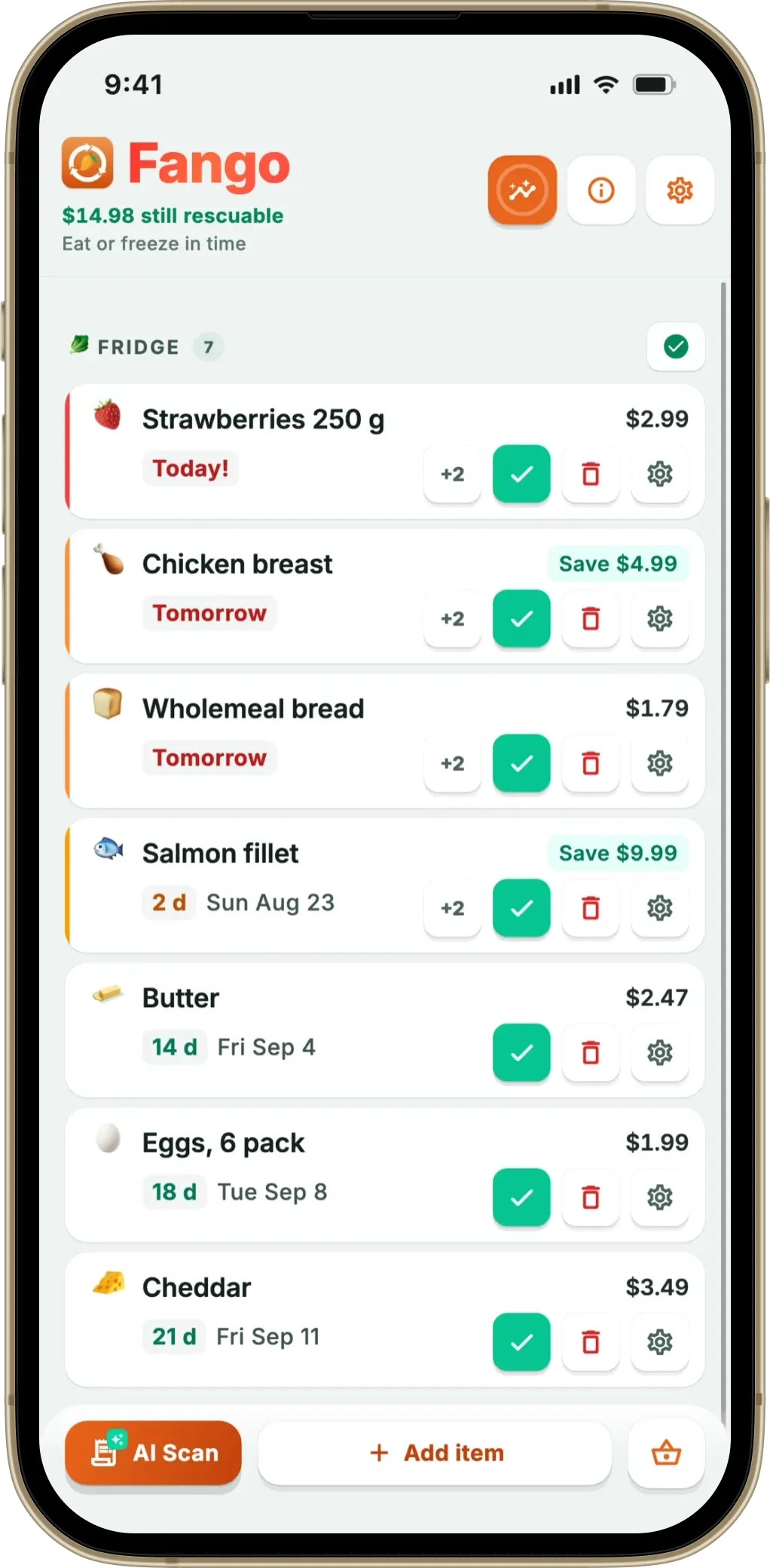
Scan your grocery receipt and Fango’s AI adds every item with an estimated reminder date. It sends a reminder one to fourteen days ahead, so nothing hides at the back of the fridge. No account, and your fridge data stays on your device by default.
Download on the App Store Get it on Google PlayFree for a month · No sign-up · iOS and Android
The scale is genuinely large. UNEP’s Food Waste Index Report 2024 estimates that around a fifth of all food available to consumers is thrown away, and that households — not shops or restaurants — cause roughly 60% of it. In the UK, WRAP puts household food waste at roughly six million tonnes a year, costing the average family of four in the region of £1,000. The good news hiding inside those numbers: because most waste happens in ordinary kitchens, small changes at home add up fast. Here’s how to actually stop.
- Shop to a plan — buy for meals you’ll genuinely cook, not for the fantasy week
- Store food properly — the right shelf and container can double how long things last
- Run an “eat me first” shelf — a first-in-first-out zone for anything close to turning
- Track expiry dates — so nothing hides at the back until it’s too late
- Freeze before it turns — the freeze button is the ultimate undo
- Check the fridge before you shop — stop re-buying what you already own
Why we throw away food
Before the fixes, it helps to name the causes — because each strategy below targets a specific one. Household waste almost always comes down to a short list:
The feature that matters most in any of these apps is the reminder — see what a good expiry date tracker app does differently.
- Forgetting. This is the big one. Food gets buried behind other items, drops out of sight, and is only rediscovered once it’s spoiled. If you’ve ever wondered why you keep forgetting food in your fridge, the honest answer is that a fridge is a terrible memory device — out of sight really is out of mind.
- Over-buying. Multi-buy offers, big weekend shops and shopping while hungry all lead to more food than you can realistically eat before it goes off.
- Confusing date labels. “Best before” is about quality, not safety — plenty of edible food gets binned the day the label ticks over, when it’s often perfectly fine.
- Poor storage. Bread in the wrong spot, herbs left loose, leftovers forgotten in an opaque tub — small storage mistakes shorten shelf life dramatically.
Notice that none of these require you to be a better or more disciplined person. They’re habits and blind spots, and the six strategies below are designed to remove them one at a time.
1. Shop to a plan
Waste starts in the shop, not the bin. The single highest-leverage change is to buy for meals you’ll actually cook, rather than for an idealised week where you make salad every day. Before you go, sketch three or four dinners you genuinely intend to eat, write a list from those meals, and — this is the hard part — mostly stick to it.
If the fridge is where food gets lost, a fridge tracker app puts everything in it on one list with dates.
Two rules make a disproportionate difference. First, never shop hungry; a full stomach quietly cuts impulse buys. Second, be sceptical of multi-buy offers on perishables. “Three for two” on bagged salad is only a saving if you eat all three, which most people don’t. Buying loose, in the quantity you need, usually wastes less money than a discount you end up binning.
2. Store food so it lasts
How long food survives depends heavily on where and how you keep it, and most of us store things on autopilot. A few evidence-based tweaks go a long way. Keep your fridge at or below 5°C — a surprising number run too warm, which shortens the life of everything inside. Move milk and other perishables off the door (the warmest part) and onto a middle shelf. Store most fruit and veg in the drawers, but keep bananas, onions and potatoes out of the fridge entirely.
Little habits compound: pop a paper towel in the bag of salad leaves to absorb moisture, keep herbs in a jar of water like cut flowers, and decant leftovers into clear containers so you can see what’s in them. Our full food storage tips guide goes item by item, and the UK Food Standards Agency has solid, cautious guidance on fridge temperatures and safe chilling.
3. Run a “first in, first out” shelf
Supermarkets rotate stock so the oldest items sell first. You can borrow the trick at home. Designate one shelf — or just one corner of a shelf — as your “eat me first” shelf. Anything approaching its use-by date, any leftovers, and any half-used jar goes there, front and centre. When you’re deciding what to cook, you look there first.
It sounds almost too simple, but it works because it converts an invisible problem into a visible one. Instead of relying on memory, you build a physical prompt into the fridge itself. The rule is easy to teach a whole household, too: if it’s on that shelf, it needs eating soon.
4. Track expiry dates so nothing hides
Here’s the uncomfortable truth about the strategies so far: they all lean on you remembering. And remembering is exactly the thing that fails. You can shop perfectly, store perfectly and keep a beautiful eat-me-first shelf, and still lose the yoghurt at the back that you genuinely forgot existed.
This is where a tracker earns its place. Instead of trusting yourself to notice, you keep a running list of what you own and when each thing expires, and something reminds you before the deadline — not after. It’s the same reason we use calendars for appointments: important things shouldn’t depend on happening to glance in the right place at the right moment. If you want to see the pattern in your own kitchen first, it’s worth tracking how much food you waste for a couple of weeks — the total is usually a wake-up call.
A tracker won’t cook dinner for you, and it isn’t magic — but it does remove the one job humans are worst at. Log an item once (Fango reads a whole receipt in seconds), and the reminder shows up on the right day whether you were paying attention or not.
5. Freeze before it turns
The freezer is the most underused tool in most kitchens. Think of it as an undo button: the moment you realise you won’t get through something in time, freeze it and reset the clock. Bread freezes beautifully and toasts straight from frozen. Milk, cheese, cooked rice, ripe bananas, herbs in oil, and almost all leftovers freeze well too.
The trick is to act early — freeze while food is still good, not the night before it goes off, when quality has already dropped. Portion things out before freezing so you defrost only what you need, and label bags with a date. If you’re facing a fridge full of things all reaching the edge at once, our guide on what to do when food is about to expire walks through freezing, cooking and quick rescue meals.
6. Check the fridge before you shop
The final strategy closes the loop back to strategy one. A huge amount of waste is simply re-buying what you already have — a third jar of mustard, a second bag of carrots — because you couldn’t remember what was in the fridge while standing in the aisle. A two-minute check before you leave, or a glance at your tracker’s list on your phone, prevents the duplicate purchase entirely.
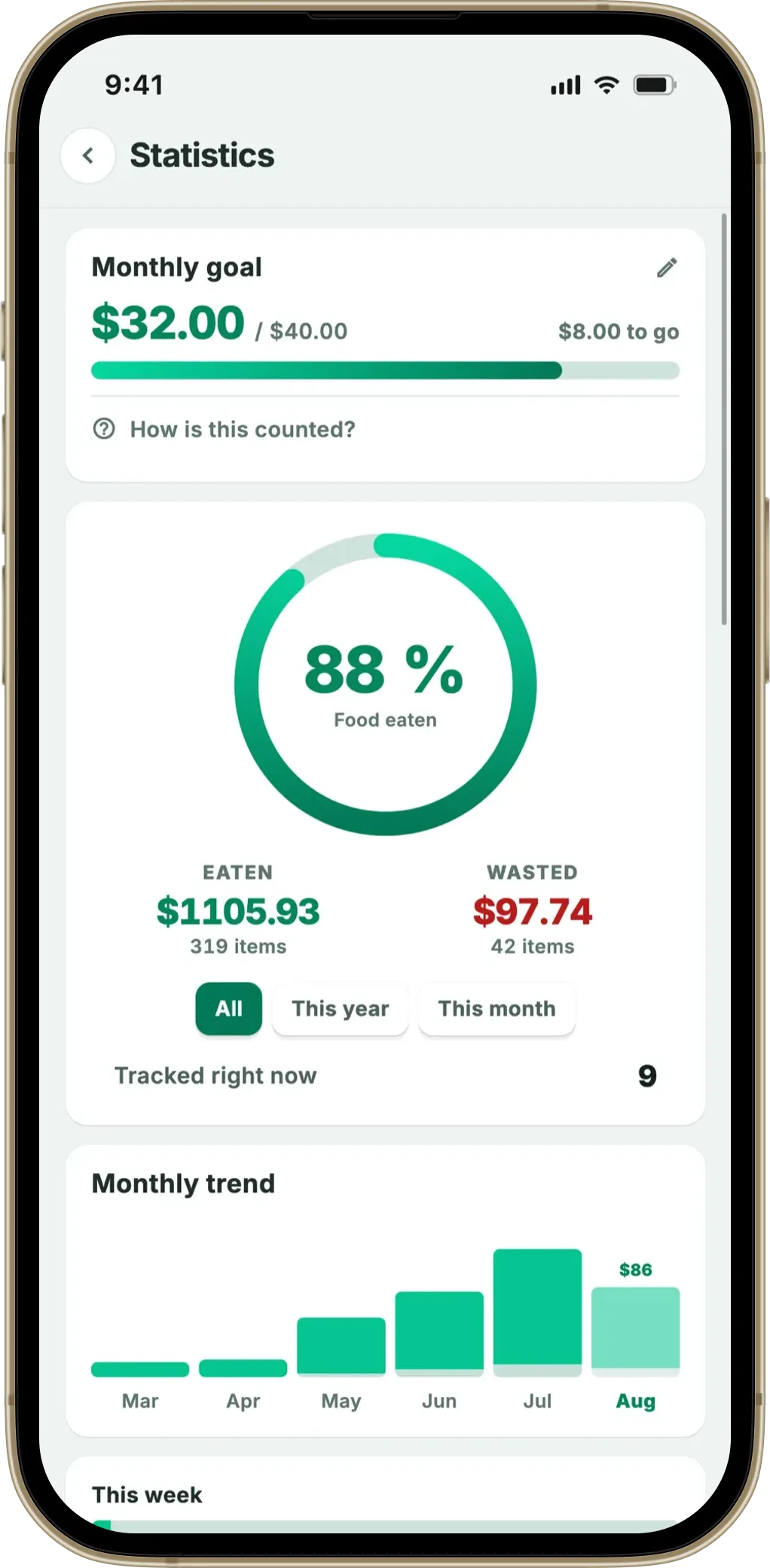
This is where an on-device list quietly pays off: your fridge inventory is in your pocket, so “do we still have eggs?” is answered from the shop instead of guessed. Buy around what you already own, eat that down first, and the whole cycle tightens. Once you see the running total of what you’ve saved, it stops feeling like effort and starts feeling like a game you’re winning — and the money food waste really costs makes the case on its own.
Scan your grocery receipt and Fango’s AI adds every item with an estimated reminder date. It sends a reminder one to fourteen days ahead, so nothing hides at the back of the fridge. No account, and your fridge data stays on your device by default.
Download on the App Store Get it on Google PlayFree for a month · No sign-up · iOS and Android
Start with one change
You don’t need to adopt all six strategies this week. Pick the one that matches your biggest failure point. If you forget things, start tracking. If you over-buy, plan your shop. If food spoils fast, fix your storage. Each change is small and each one compounds — a planned shop feeds an eat-me-first shelf, which feeds a freezer habit, which feeds a leaner next shop. Stop throwing away food and you’re not eating less or spending more; you’re just keeping the money you were already binning.
That attention is worth taking to the shop too. Fango’s shopping list reads the same fridge list and your scanned receipts: it suggests what is running low and recognises your buying cadence — the mustard bought three times in three months is only suggested when it is due. The duplicate you avoid would have become waste however good the reminders were.
Frequently asked questions
What is the number one cause of food waste at home?
For most households it is simply forgetting what you have. Food gets pushed to the back of the fridge, hidden behind other items, and is only rediscovered once it has gone off. Over-buying and cooking too much are close behind. The fix is visibility: keep an accurate view of what you own and when it needs eating, so nothing disappears until it is too late.
How much money does throwing away food actually cost?
WRAP estimates the average UK family of four throws away roughly £1,000 of edible food a year — food that was bought, paid for, and binned. Even a smaller household typically loses several hundred pounds. Cutting waste is one of the few grocery savings that does not require buying anything cheaper or eating anything different.
Do I need an app to stop wasting food?
No — a planned shop, sensible storage and a first-in-first-out shelf will take you most of the way, and cost nothing. An app helps with the one part that willpower cannot fix: remembering. A tracker like Fango logs what you have and reminds you one to fourteen days in time, so the memory work happens automatically instead of relying on you to check.
How does Fango help reduce food waste?
Fango is a food-expiry tracker for iOS and Android. You scan your grocery receipt and its AI adds the items automatically, estimating each expiry date, then it sends a push reminder in time. It also shows how much you have saved over time. There is no account and your fridge data stays on your device by default. Fango is free to try for one month, then a monthly or yearly subscription, with the price for your country shown in the app.