Most weekly grocery list templates fail for the same reason: they’re someone else’s list. You print it, buy the four things on it you’d never normally eat, and go back to the note on your phone. A weekly list is only useful when it’s built from what your household actually gets through — and when it’s laid out in the order you walk the shop rather than the order the ideas arrived.
Sorted into 13 supermarket sections, suggesting the staples you buy on a cadence, and warning you when something’s already in the fridge. Clear the ticks and the list is ready for next week.
Download on the App Store Get it on Google PlayFree for a month · No sign-up · iOS and Android
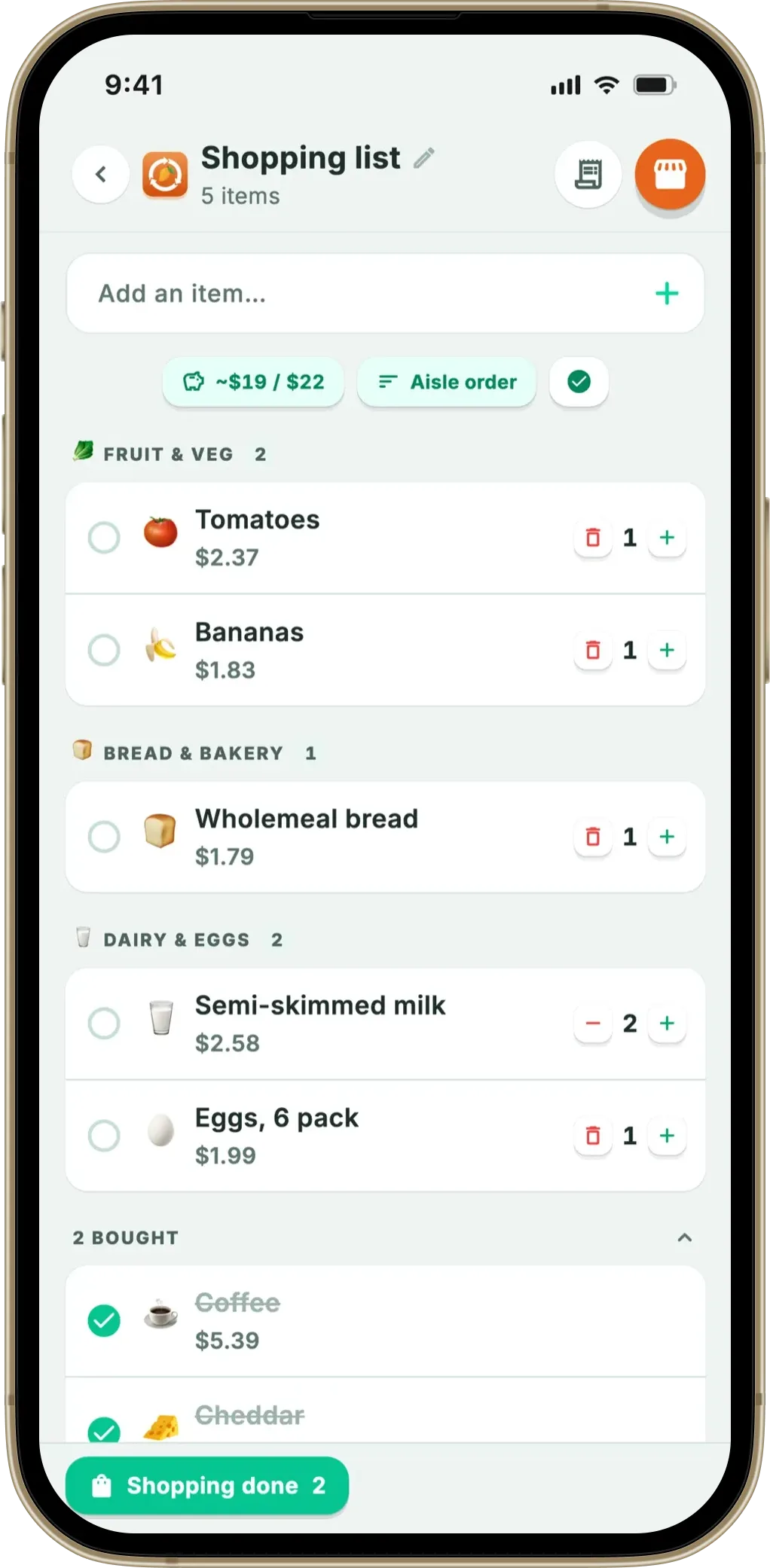
Below: a weekly list template arranged by supermarket section, how to size it for one person or five, the categories that reliably end up in the bin, and the two-minute method for building your own from your last three receipts.
- Two layers: the staples you buy almost every week, plus the few items this week’s meals need
- Order it by aisle, not by thought — one lap of the shop instead of three
- Fresh produce is the most wasted category in UK households by weight of edible parts (WRAP)
- Build layer one from receipts, not memory — anything on two of your last three is a staple
The weekly grocery list, in supermarket order
Use this as a checklist to prompt your own items, not as a shopping list to copy wholesale. The section order is the one most supermarkets are laid out in, so working down it means one lap.
If the same problem shows up on the shopping side — buying what you already have — our best shopping list app comparison covers apps that read your inventory.
| Section | Typical weekly items | Buy for |
|---|---|---|
| 1. Fruit and veg | Salad, tomatoes, cucumber, onions, carrots, potatoes, bananas, apples, lemons | Salad leaves 3–4 days; roots and apples 2+ weeks |
| 2. Bakery | Bread, wraps, rolls | 3–5 days, or the freezer |
| 3. Dairy and eggs | Milk, butter, cheese, yoghurt, eggs, cream | Most of the week; eggs several weeks |
| 4. Meat and fish | Chicken, mince, bacon, fish for one or two meals | 1–2 days fresh; freeze the rest on the day of purchase |
| 5. Frozen | Peas, sweetcorn, spinach, berries, fish fillets, chips | Months — the backstop for the end of the week |
| 6. Dry goods and tins | Pasta, rice, noodles, tinned tomatoes, beans, stock, oil, sauces | Months; top up rather than rebuy |
| 7. Snacks and sweets | Crisps, biscuits, chocolate, nuts | As long as you like — decide the quantity at home |
| 8. Drinks | Coffee, tea, juice, squash, water | Weeks to months |
| 9. Household | Washing-up liquid, laundry, bin bags, kitchen roll, foil | Top-up only |
| 10. Health and beauty | Shampoo, toothpaste, soap, razors | Top-up only |
| 11–13. Baby · Pets · Other | Nappies, wipes, formula, dog and cat food, batteries, light bulbs | Top-up only |
← scroll →
Sections 9 to 13 are the ones people forget to put on a food list and then remember at the checkout. Keeping them on the same list — rather than in a second note — is the whole reason a list app should accept non-food items, which our guide to a grocery list organised by aisle goes into in more detail.
Sizing it for your household
The quantities are where most weekly lists go wrong, and the error is almost always in the same direction. Some rough starting points, to adjust after two or three weeks of actually watching what’s left on Sunday:
- One person. Half a loaf, not a loaf, unless the freezer takes the rest. One bag of salad, not two. Meat and fish in single portions, frozen on the day you buy them. People living alone waste more per person than larger households, according to WRAP’s people-focused food waste research, and the reason it gives is food going off or passing a date label rather than leftovers piling up — see food waste when you live alone.
- Two people. The classic trap is buying for four because the multipack is better value. It isn’t, if half of it is binned.
- Family of four or five. Bulk works here, on the dry and frozen sections. It still doesn’t work on salad, herbs or soft fruit, which have the same shelf life no matter how many of you there are.
One rule that survives every household size: buy the fresh food for the first three days and let the second half of the week run on frozen, tinned and dried. Nothing in sections 5 and 6 can go off while you change your mind about Thursday.
The lines that reliably end up in the bin
This isn’t guesswork. WRAP’s 2022 household food waste report ranks the categories: by weight of edible parts, fresh produce is the most wasted, followed by meals (homemade and pre-prepared), bakery, and dairy and eggs. The same report puts the bill at £1,000 a year for the average UK household of four, and UNEP’s Food Waste Index Report 2024 estimates around a fifth of the food available to consumers is thrown away worldwide.
Read that ranking next to the template above and the pattern is obvious: the top of your list, sections one to four, is where the money leaks. So spend your planning effort there and stop agonising over the tins.
- Fresh produce. The bag of spinach bought for a salad you didn’t make. Buy the loose amount, not the pack, wherever the shop allows it.
- Bakery. Bread has a short life and a big volume. Half the loaf into the freezer on the day you buy it solves this entirely — freezing bread works better than people expect.
- Dairy. Yoghurt multipacks and cream bought “for something”. Cream in particular is a single-recipe purchase; if the recipe isn’t in the diary, leave it.
- Leftovers and prepared meals. Cooked food keeps 2–4 days in the fridge according to the UK Food Standards Agency, which also puts the fridge at 0–5°C. Anything you won’t eat inside that window is a freezer job, not a fridge one.
Build your list from receipts, not memory
Here’s the two-minute version of finding your real staples. Take your last three grocery receipts. Anything appearing on two of them is layer one of your weekly list — that’s your template, and it’s more accurate than anything you’d write from memory, because memory over-reports the healthy items and under-reports the coffee.
WRAP’s people-focused research associates lower household food waste with a cluster of habits including meal planning, making shopping lists and using leftovers. The list is doing real work there — but only the list you actually shop from, which is why it has to be built out of your own buying rather than an idealised one.
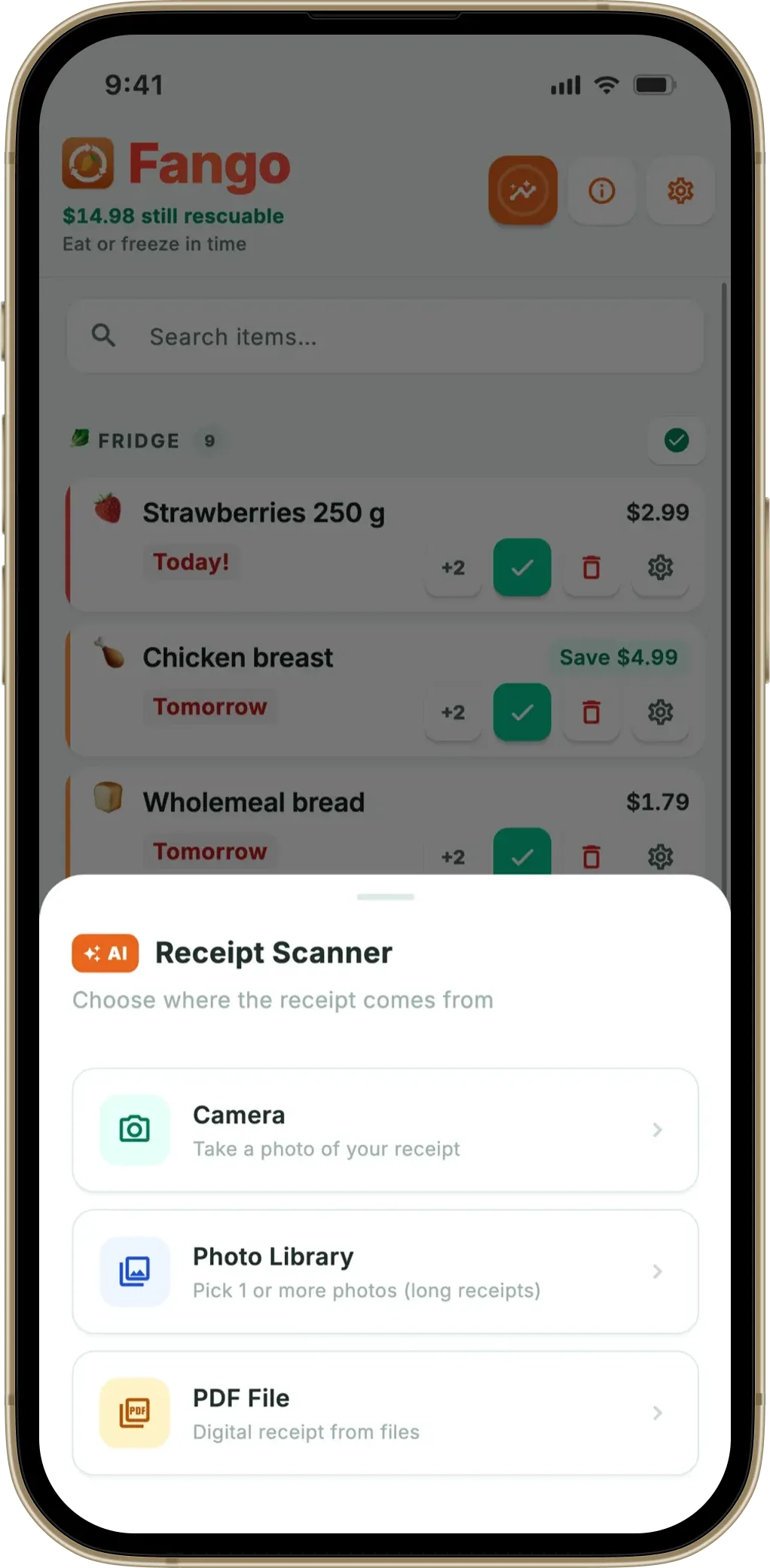
Doing this by hand once is easy. Doing it every week is the part nobody sustains, which is where an app earns its place: Fango reads scanned receipts and works out which items you buy on a regular cadence, then offers them back as one-tap chips with an estimate of how often you rebuy them. Our piece on a grocery list that learns what you buy regularly explains the mechanism.
A weekly list that gets reused, not rewritten
The last piece is what happens after the shop. Most people either delete the list — losing the template they just built — or leave it to silt up with crossed-out lines until it’s unreadable.
The pattern that works is two separate actions: clear the ticks after each shop, keeping the lines themselves, and delete the list only when you want a genuinely different one. That way last week’s list is next week’s starting point, and the weekly rewrite becomes a five-line edit. It’s the reason Fango separates “shopping finished” from “empty the list”, and it’s worth checking whether whatever app you use does the same — if the only option is delete everything, you’ll rebuild the same list 52 times a year.
The other half is knowing what you already have before you start writing. That’s a different problem from the list, and the one that decides whether the week’s food gets eaten — shopping your fridge first covers the method, and the eat-me-first shelf is the no-app version.
Sorted into 13 supermarket sections, suggesting the staples you buy on a cadence, and warning you when something’s already in the fridge. Clear the ticks and the list is ready for next week.
Download on the App Store Get it on Google PlayFree for a month · No sign-up · iOS and Android
The weekly routine, in five steps
- Look in the fridge first. Two minutes, before you write anything. Note what has to be eaten this week — that decides two of your meals for free.
- Start from last week’s list. Clear the ticks rather than deleting; edit the five lines that changed.
- Add the meals you’ve actually decided on. Not the meals you’d like to be the kind of person who cooks.
- Check it’s in aisle order. Either the app does it or you group it yourself in four lines: veg, chilled, frozen, cupboard.
- Freeze on arrival. Half the bread, the second pack of mince, the spare chicken. It takes ninety seconds and it’s the single highest-return habit on this page.
Two companion pieces if you want to push this further: how to make a grocery list that actually saves money adds rounded-up prices and a running total to the routine above, and how to grocery shop once a week deals with the harder half — making a single shop stretch to Sunday without the fresh section turning. And because the list is only as good as your ability to stick to it in the aisle, supermarket psychology tricks to save money covers what the store does to it.
Frequently asked questions
What should be on a weekly grocery list?
Your own staples, in the order of the shop, plus whatever the week’s meals need on top. A useful weekly list has two layers: the dozen or so things you buy almost every week regardless, and the handful of items that change. Copying a stranger’s template gives you their staples rather than yours, which is why most printable lists get used once. The fastest way to find your real layer one is to read your last three receipts and write down everything that appears on two of them.
How do I stop buying too much fresh food every week?
Buy fresh produce for the first half of the week and plan the second half around things that keep. Fresh produce is the most wasted food category in UK households by weight of edible parts, according to WRAP, and the reason is almost always optimism at the shelf rather than a bad recipe. Splitting the week means a Thursday plan that leans on frozen, tinned and dried food, which cannot go off while you change your mind.
Is a weekly shop cheaper than shopping every few days?
Usually, but only if you eat what you buy. One trip means fewer passes through the promotions and less impulse buying, which is where a food budget normally leaks. The catch is that a week’s fresh food has to survive a week, and if a third of it goes off on Friday the savings are gone. A weekly shop plus a way of tracking what needs eating first beats both a weekly shop alone and daily top-up trips.
How long should a weekly grocery list be?
Long enough to cover the meals you have actually decided on, and no longer. A list that runs past about 40 items usually means you are shopping for an imagined week rather than the one in your diary. If it keeps growing, the fix is not a longer list but checking what is already at home before you write it — most people find three or four lines they were about to buy for the second time.