Almost every shopping list app claims to learn your habits, and almost every one means autocomplete: type “mi” and it offers “milk”, because you typed “milk” before. That isn’t learning what you buy — it’s learning what you type. Fango takes the record from somewhere more honest: your scanned receipts. Because the app already reads receipts to track expiry dates, it knows which products genuinely came home, on which days, and how many days usually pass before you buy them again — so recurring items surface on the list by themselves, roughly when they’re due.
Scan your receipts and Fango works out what you buy regularly and how often — the ones due again surface on your list as one-tap chips. No account and, by default, no cloud — nothing calculated off your phone.
Download on the App Store Get it on Google PlayFree for a month · No sign-up · iOS and Android
Below: how the frequency and cadence estimate works, what it needs from you, and what it doesn’t do.
- Most lists learn your typing — Fango learns from receipts you’ve already scanned
- Frequency plus cadence — how consistently you buy something, and roughly how many days between shops
- Items that are due again rise to the top — chips carry the cadence in days
- All on your phone — no account, no server, no AI in the list logic
What “learns what you buy” usually means
In a typical list app, the learning is two features wearing a trench coat:
If the same problem shows up on the shopping side — buying what you already have — our best shopping list app comparison covers apps that read your inventory.
- Autocomplete from your typing. A dictionary of words you’ve entered, sorted by how often — handy, but it only fires once you start typing, so you had to remember the item first.
- A “frequent” or “favourites” screen. A tally of how often something was added to a list. Anything you wrote down and didn’t buy still counts; anything you grabbed on autopilot without listing it never appears.
Both run off list history, and list history is a record of intentions. It can’t tell you that you buy oat milk every nine days, because it never saw a purchase — only a piece of typing.
Fango learns from receipts, because it’s already reading them
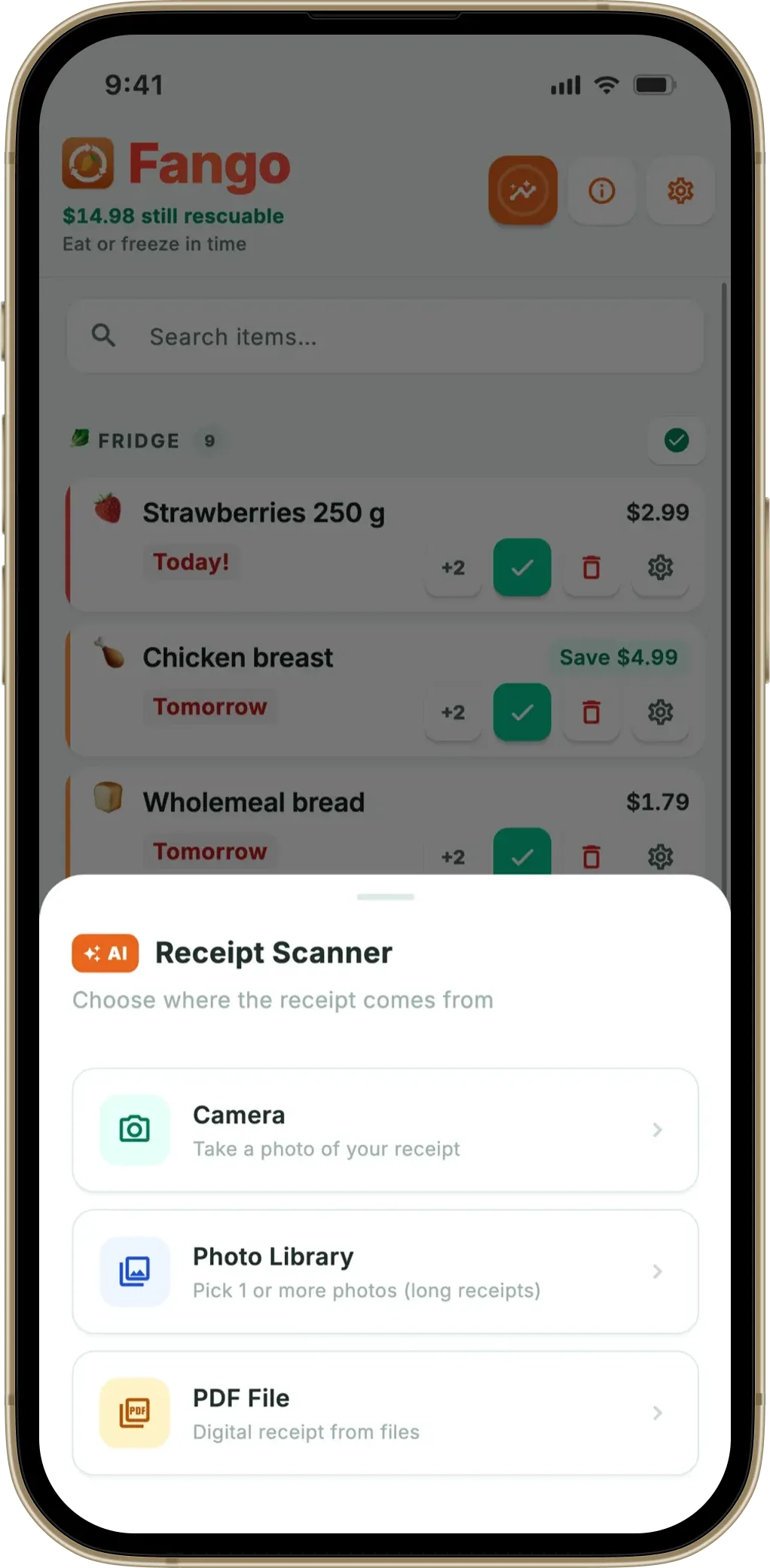
Fango’s day job is reducing food waste: scan a grocery receipt, AI reads the product lines and estimates a shelf life for each, the items land in your fridge inventory, and push notifications warn you up to 14 days before something turns — the mechanics are in our piece on scanning a receipt to track food.
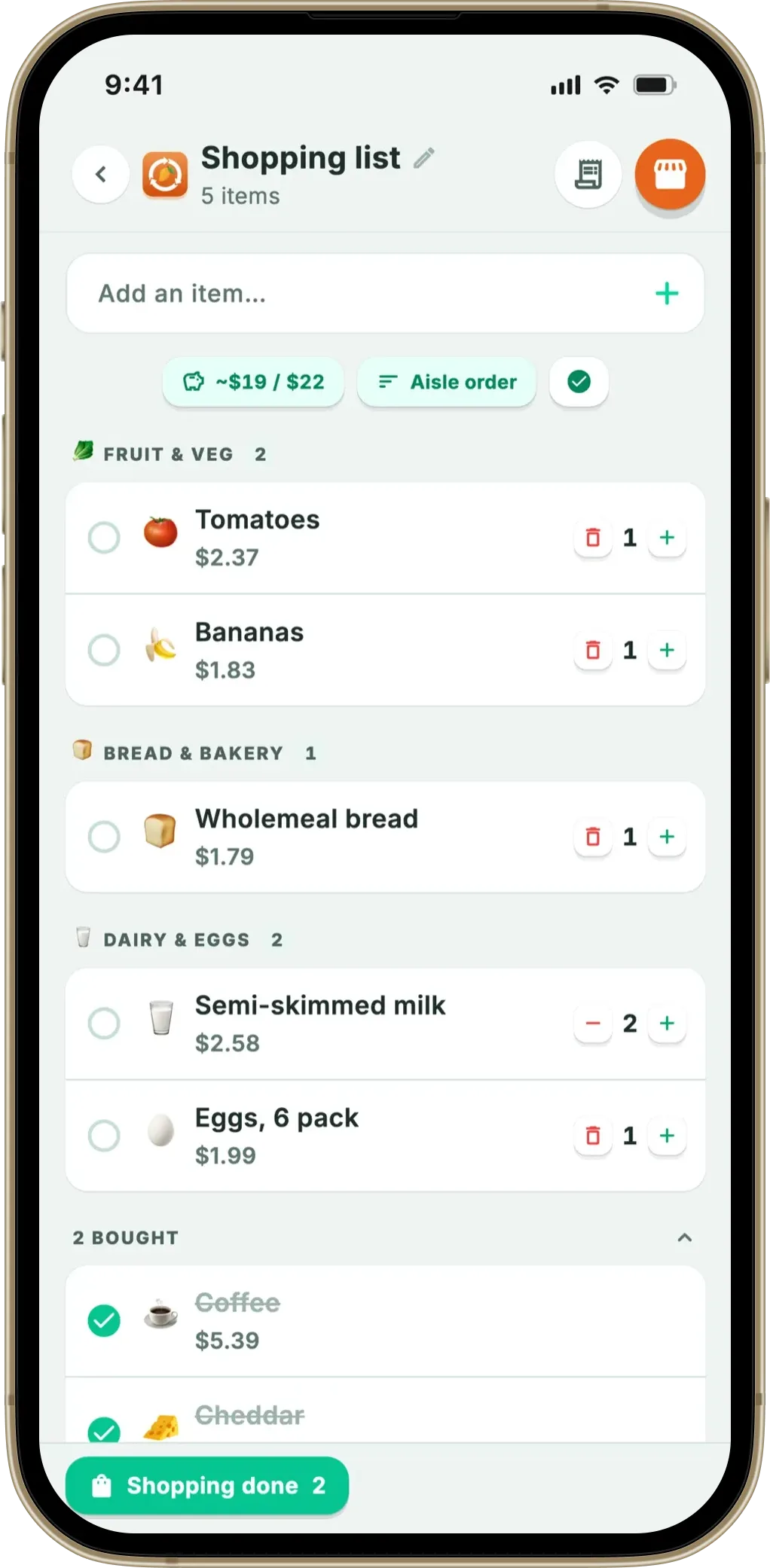
The useful side effect: a real purchase history accumulates without you doing anything extra. Every scan leaves a dated record of what you actually bought — the raw material a recurring grocery list needs, and what a standalone list app has never had. So the list reads it back, using the same pipeline as building a grocery list from a receipt, pointed at habits rather than one shop. The result sits above your list under the heading “You buy these regularly”: a row of chips, each a product your receipts say is part of your normal shopping, ready to join the list with a tap.
How the frequency estimate actually works
No black box — it’s arithmetic, and the details keep the suggestions sensible rather than random.
-
1
A recency window of about a dozen receipts. Only your most recent shops count, so the oat milk you drank all last winter fades out by itself once you stop buying it — no settings, no pruning.
-
2
A regularity ratio, not a raw total. Twelve receipts out of twelve is a staple; two out of twelve is an occasional treat. That ratio puts what you buy nearly every time at the front.
-
3
A minimum before anything counts. A product must appear on at least two receipts in the window, and three once you’ve built a longer history. One incidental purchase never becomes a “regular”.
-
4
One purchase per receipt. Three yoghurts in a single shop count as one occasion, not three — otherwise a bulk buy would masquerade as a frequent habit.
-
5
Non-groceries filtered out. Carrier bags, deposits and service charges appear on receipts, but are never offered as regular buys.
Each chip shows its evidence: a small count — “4×” — meaning four of your recent shops included it. A suggestion you can’t audit is a guess with better styling.
Cadence: the “every ~N days” part
Frequency tells you whether you buy something, not when. Because every receipt is dated, Fango can measure the gaps between your purchases of a product: take the distinct days you bought it, average the intervals, and you have an estimate — milk every four days, coffee every eighteen, washing-up liquid every six weeks. Two dated purchases are the minimum; with one there’s no interval to measure, and Fango doesn’t pretend otherwise.
That estimate drives the ordering. Once most of the usual interval has elapsed since your last purchase, the item counts as due, jumps to the front of the row and switches to an amber chip carrying a small clock and the interval in days. The most overdue lead.
So the list reorders itself around your week with no repeating reminders configured. You never set “milk, repeat every 4 days” in a scheduling screen — you shop as usual, scan the receipts, and the timing falls out of the data. Our guide on a grocery list that knows what you’re about to run out of takes the same idea from the expiry side.
Filtered against your fridge — and your list
A suggestion for something already on the middle shelf is worse than no suggestion, so every chip is checked against two things first: your fridge inventory and the list you’re looking at. Anything tracked at home, or already added, drops out of the row. No standalone list app can copy that — it needs an inventory to check against — and it lands straight on the shopping bill, as we’ve written in shop your fridge first.
When you’d rather have the whole shop back
Sometimes the fastest way to rebuild a list isn’t item by item. Under “Past purchases”, your scanned receipts appear as cards — shop name, number of items, total — so a big Saturday shop is easy to tell from a top-up. Add the whole receipt in one tap, or open it and pick individual lines.
It’s the blunt instrument next to the frequency chips, and often the right one: a fortnightly big shop repeats itself almost exactly. Items arrive with names, quantities and remembered prices, so the budget estimate updates at once — then the aisle grouping takes over, covered in our guide to a grocery list organised by aisle.
Why it’s unusual that this runs on your phone
Purchase-history features normally come with strings attached: storing your habits means a database, an account, a server and a privacy policy explaining who else sees what you eat. That’s why the feature usually turns up in loyalty and supermarket apps.
Fango’s version needs none of it. Receipts, counts, intervals, the fridge inventory and the list all live in local storage on your device — no sign-up, no sync, and no AI anywhere in the list logic. Counting how often “oat milk” appears and averaging a few date gaps doesn’t need a language model. The wider trade-offs are in our piece on food inventory apps with no account.
The honest cost: switching phones means carrying your data across with a device backup rather than a login.
What it deliberately doesn’t do
Four limits, stated plainly:
- It doesn’t predict products you’ve never bought. No “customers like you also buy” layer, and no catalogue to upsell from: if it isn’t in your receipt history, it isn’t suggested.
- It doesn’t fill the list for you. Suggestions are chips you tap; nothing is ever added automatically.
- It doesn’t order anything. No delivery integration, no supermarket account, no basket sent anywhere.
- Ticking an item off doesn’t put it in your fridge. Scanning the receipt is what puts it there, or adding it by hand — a tick says you picked something up but nothing about the date on the packet, and an invented expiry date would poison every reminder.
There’s also no barcode scanning, no recipes or meal planning, and no location-based reminders. The list is one half of a loop and the fridge is the other — both together are the subject of a shopping list and expiry tracker in one app.
Scan your receipts and Fango works out what you buy regularly and how often — the ones due again surface on your list as one-tap chips. No account and, by default, no cloud — nothing calculated off your phone.
Download on the App Store Get it on Google PlayFree for a month · No sign-up · iOS and Android
Does knowing your habits actually save anything?
The waste numbers are why any of this exists. UNEP’s Food Waste Index Report 2024 estimates that around a fifth of all food available to consumers is thrown away, with households accounting for roughly 60% of it. In the UK, WRAP puts the cost at roughly £1,000 a year per household.
We can’t offer a controlled trial of Fango users, only the mechanism — and it attacks the duplicate-buying half of the problem: a cadence-aware suggestion appears when the timing says you’d have run out, and never while the item is still in your fridge. The forgetting half is handled by the expiry reminders. Together they’re the argument in a shopping list app that reduces food waste, and the budget angle in saving money on groceries.
Fango runs on iOS and Android in eight languages, reading receipt formats from 34 countries. Free for a month, then from $2.99/month or $22.99/year — no account at any point, and your purchase history stays on your phone by default.
Frequently asked questions
How does a shopping list app learn what I buy regularly?
Most learn from your typing: words you have entered before come back as autocomplete, and a favourites screen counts how often you added them. Fango learns from your scanned receipts instead — it reads roughly your last dozen, counts how many contained each product, and estimates how many days usually pass between purchases. The record is what you paid for, not what you typed.
How many receipts does Fango need before the suggestions get useful?
A product has to appear on at least two receipts in the recent window before it counts as a regular, and at least three once you have a longer history — so the first couple of shops produce little. Two dated purchases are also the minimum for a cadence estimate. In practice a few weeks of normal shopping is enough for the staples to surface.
Does the recurring grocery list use AI or send my shopping habits to a server?
No. Every part of the list — frequency count, cadence estimate, aisle grouping, budget — is plain arithmetic on your own phone, with no account and no cloud by default. Fango’s AI has one job: reading a receipt image when you scan it. Nothing about what you buy, how often or what it costs is uploaded anywhere.
Will Fango add recurring items to my list automatically?
No. Suggestions appear as chips above the list and only join it when you tap one. Fango does not auto-fill a weekly list, does not order anything, and does not predict products you have never bought. It also filters out anything already in your fridge or already on the list.