OurGroceries is one of the most under-rated apps in this category. It’s free, it shares lists across a household in seconds, it groups items into aisles on its own, it scans barcodes, it runs on a watch and a web browser, and it’s been doing all of this for over a decade without turning into a subscription. If you’re looking for an alternative, it’s usually for one of three reasons: the banner ads, the barcode database being built for American shelves, or the fact that a list — however good — still doesn’t stop food rotting at home.
Below: what OurGroceries genuinely does well, the three gaps that send people looking, and four alternatives compared on the things that actually differ.
- OurGroceries is free with ads — its own FAQ confirms banner ads plus a paid upgrade to remove them
- Barcodes are US-first. The FAQ warns its product database is “rather U.S.-centric”
- No-ads swap: AnyList — but prices and unlimited recipe imports sit behind AnyList Complete
- If food keeps expiring: Fango is the only one here that tracks what you bought and warns you in time
What OurGroceries gets right
A fair comparison starts with the case for staying, and here it’s strong. Very few free apps in any category offer this much.
- Genuinely shared lists. Enter the same email address on every device in the household and every change appears on the others within seconds — including items being ticked off while someone is standing in the shop.
- Automatic aisle grouping. Its App Store listing describes organising items by category or aisle, including optional automatic category suggestions for new items, so the list arranges itself rather than needing you to sort it.
- Barcodes, photos and AI item recognition. The listing covers adding items by scanning a barcode, attaching a photo so your partner gets the right variety, and adding an item just by photographing it, with AI recognising what it is.
- Recipes that fill the list. Store your regular meals and add every ingredient with a single tap.
- Everywhere. iPhone, Android, Apple Watch, a browser, plus voice assistants. Lists and recipes are backed up to the company’s servers, so replacing a phone doesn’t lose them.
If your household shares one list and nothing you buy ends up in the bin, OurGroceries is doing its job and you can stop reading.
The three reasons people look for an alternative
None of these make it a bad app. They’re the specific frictions that send people to a search box.
- The ads. The company is upfront about it: the OurGroceries FAQ says the app is free and shows what it calls unobtrusive ads at the bottom of the screen to cover development costs, with an upgrade available to remove them. Google Play’s listing carries both the Contains ads and In-app purchases labels. A banner at the bottom of a list you’re reading in a cold aisle is a small thing that gets noticed every single shop.
- Barcodes stop working when you leave America. The same FAQ answers the barcode question with a yes, then adds that the product database is “rather U.S.-centric”. If you shop in the UK or Europe, one of the headline features is materially weaker for you.
- An account is compulsory for sharing. The FAQ is explicit that you need an OurGroceries account and the same email address on every device. That’s the mechanism, not a flaw — but it means your shopping habits sit on somebody’s server, and the FAQ notes that deleting an account removes the email, lists and items while system logs still keep anonymised usage information. If you’d rather nothing left the phone, see our roundup of shopping list apps without an account.
And a fourth, which applies to every list app equally: the list ends at the till. WRAP puts UK household food waste at £1,000 a year for the average household of four, and UNEP’s Food Waste Index Report 2024 estimates around a fifth of the food available to consumers is thrown away. A perfect shopping list doesn’t touch a single pound of that.
The four alternatives, compared
AnyList — the polished, ad-free swap
The most obvious upgrade if the banner is what bothers you. AnyList’s own feature comparison puts lists, sharing, meal planning, a web app and up to five recipe imports in the free tier, with AnyList Complete at $9.99 a year for an individual or $14.99 for a household. Note what Complete gates: its help pages state that AnyList Complete is required to add prices to items, so the running total is a paid feature.
Bring! — the best-looking shared list
Bring! is the design-led option and the closest match for a household that shares one list. Its help centre documents a Group by Categories setting under List View, so items arrange themselves into shop sections, and you can switch between a list and a tile view. Free with advertising; a Premium tier removes ads and adds extras such as a dark theme. Like OurGroceries, sharing runs through an account.
Apple Reminders — free, and already installed
Worth a mention because it costs nothing and most iPhone owners don’t know it exists. Apple documents that in iOS 17 and later you can choose Groceries as a list type, after which Reminders sorts items into categories such as Produce, Meat or Frozen Foods as you type, and lets you drag an item to a different category when the guess is wrong. Lists can be shared with other iCloud users. No barcodes, no recipes, no photos — but no ads either.
Fango — the list that knows what’s in your fridge
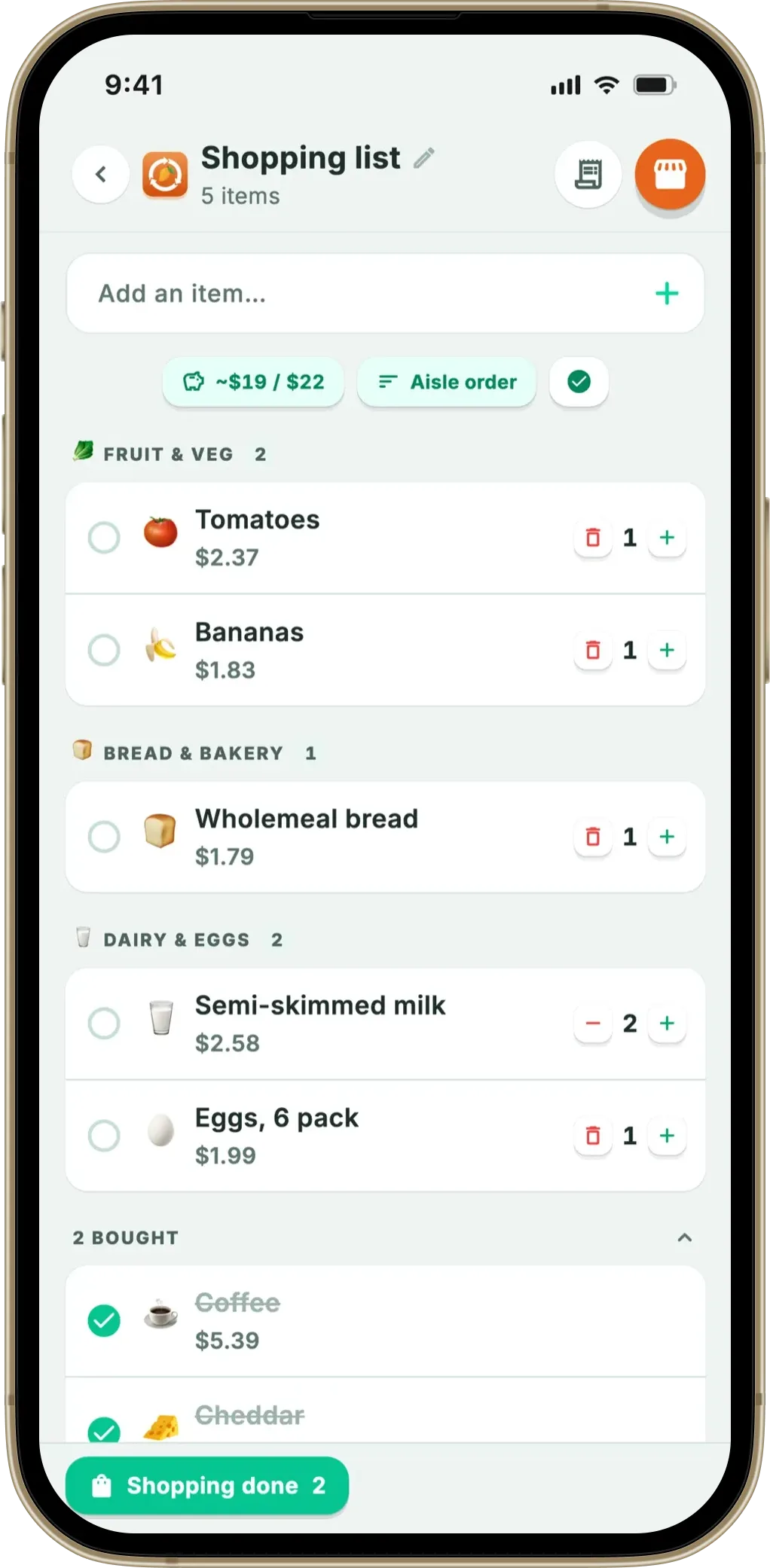
The odd one out, because it isn’t really a list app. Fango is a food waste app that grew a shopping list, so the list does the normal things — autocomplete from names you’ve used before, a remembered price estimate, anything at all added by hand including bin bags and dog food, 13 aisles in walking order, a full-screen shopping mode and a budget target that counts down as you tick things off — and then keeps going after the till. Scan the receipt and the AI reads the products, estimates how long each keeps and puts them in a fridge, freezer or cupboard list with reminders in time.
OurGroceries vs the alternatives, side by side
| What you want | OurGroceries | AnyList | Bring! | Apple Reminders | Fango |
|---|---|---|---|---|---|
| Shared household list | ✓ | ✓ | ✓ | ✓ iCloud | ✓ up to 4 people |
| Groups items by aisle | ✓ | ✓ | ✓ | ✓ Groceries list | ✓ 13 aisles |
| Free tier without ads | ✗ ads | ✓ | ✗ ads | ✓ | ✓ |
| Barcode scanning | ✓ US-centric database | ✓ | Varies by region | ✗ | ✗ receipts instead |
| Running total / budget | ✗ | Paid tier only | ✗ | ✗ | ✓ |
| Works with no account | ✗ | ✗ | ✗ | Groceries type needs iCloud | ✓ |
| Tracks expiry after you buy | ✗ | ✗ | ✗ | ✗ | ✓ |
| What it costs | Free with ads; paid upgrade | Free; Complete $9.99–$14.99/yr | Free with ads; paid Premium | Free | Free for a month, then from $2.99/mo |
← scroll →
What Fango adds — and what it gives up
What it adds. The half of the job a list app doesn’t do. Scanning the receipt puts the shop into a tracked list with a shelf-life estimate per item and a push reminder up to 14 days before the date, and that history feeds back into the list: items you buy on a regular cadence return as one-tap suggestions, and anything about to go off is flagged so you don’t buy a third one — the loop behind shopping your fridge first and a list that knows what you’re about to run out of. The aisle sorting and the suggestions are plain arithmetic on the device, not a cloud service, so nothing about your shopping leaves the phone.
What it gives up. Unlimited sharing — a Fango household stops at four people, the biggest reason to stay with OurGroceries. Also no recipes or meal planning, no barcode scanning, no web version, no watch app and no shopping list widget. Ticking an item off doesn’t put it into fridge tracking either; things get there by scanning a receipt or adding them by hand. It’s free for a month, then from $2.99 a month or $22.99 a year, against free-with-ads forever.
13 supermarket aisles, suggestions from your own receipts, and a reminder before the food you bought goes off. No account, no ads, everything on your phone.
Download on the App Store Get it on Google PlayFree for a month · No sign-up · iOS and Android
Which one is right for you?
The deciding question isn’t which app has more features — OurGroceries wins that on points. It’s whether your problem is on the shop side or the fridge side. If you’re throwing food away every week, no amount of list polish fixes it, and a shopping list and expiry tracker in one explains why the two halves belong together. If the list itself is the problem, our roundup of the best shopping list apps by use case is the faster read.
Frequently asked questions
Is OurGroceries really free?
Yes, with advertising. OurGroceries’ own FAQ says the app is free and shows what it calls unobtrusive ads at the bottom of the screen to cover development costs, and that you can buy an upgrade to remove them. Google Play labels the app both Contains ads and In-app purchases. Nothing about the core list is time-limited or gated, so free here means genuinely free rather than a trial.
What is the best OurGroceries alternative?
For a straight swap with no ads, AnyList is the usual answer, though its running total and unlimited recipe imports need the paid tier. For a better-looking shared list, Bring! is closest. If what you actually want is to stop food expiring in the fridge rather than a nicer list, that is a different category, and Fango is the app we build for it. Pick by which OurGroceries limitation is annoying you, because none of these is better at everything.
Does OurGroceries work outside the United States?
The app does, but its barcode scanner is weaker abroad. OurGroceries’ FAQ answers the barcode question with a yes followed by a warning that its product database is rather U.S.-centric, so scanning a British or European product is more likely to come back empty than scanning an American one. Everything else — shared lists, aisle grouping, recipes, the web version — works the same wherever you are.
Can I use a shopping list app without creating an account?
Only if you give up sharing. OurGroceries requires an account with the same email address on every device, because that account is what makes one list appear on two phones. Fango has no account and by default no server copy of the list; sharing is opt-in, and switching it on puts the list on up to four phones in one household without anyone creating an account. Real-time sharing still has to pass through a server — Fango’s difference is that it does not need an identity to do it.