If you’re looking for a Bring! alternative, the short answer depends on which half of Bring! you use. If it’s the shared household list that updates on your partner’s phone in real time, AnyList, OurGroceries and Apple Reminders all do that job, and so does Fango — for up to four people in one household, though without live updating. If what nags at you is the account, the cloud and the sponsored content in an app you use to buy food, Fango is the opposite bargain: no sign-up, no server copy by default, no advertising in the list — and a list wired to expiry dates and your receipt history.
Bring! is genuinely well made, which is why it has scale — Bring! Labs, the Swiss company behind it, says on its own site that it supports “over 21 million consumers worldwide throughout the entire shopping journey”. This isn’t a takedown. It’s a look at what you agree to when you use it, and what each alternative trades away in return.
- No account, no cloud by default, no ads — plus expiry tracking → Fango
- Shared household list with recipes and meal planning → AnyList
- Free shared list across phones, web and Alexa → OurGroceries
- iPhone household that doesn’t want another app → Apple Reminders
- You love the shared list and the offers → stay with Bring!
What Bring! does well
Credit where it’s due. Bring! is one of the best-looking shopping lists on either store, and its central feature is the one people keep using: the shared list. Its App Store listing describes sharing lists in real time with household members, voice and smart-search input, automatic organisation by category, recipe discovery with ingredient import, loyalty cards in an in-app wallet, multiple lists, and Apple Watch and web versions. Bring!’s own collaboration page puts it plainly: “Easily create and share shopping lists with your family, partner and flatmates.”
If the same problem shows up on the shopping side — buying what you already have — our best shopping list app comparison covers apps that read your inventory.
That real-time sync is the honest reason to stay: if two people add to one list and both see it change in the aisle, no amount of cleverness elsewhere compensates. Bring! is free to download, with Bring! Premium at £1.79 a month or £8.99 a year on the UK listing — check it for what the current tier covers, since that changes.
Why you might want an alternative
The same architecture that makes Bring! effortless is why some people go looking. Three things, all from the company’s own material.
It runs on an account, and the lists live on servers abroad. Bring!’s help centre describes logging in with Facebook, Google, Apple Sign-in or email, and deleting your user account under Profile › More Settings. Its privacy policy is direct about where the data sits: “Our servers are located in the USA.” The same document lists device IDs and IP addresses, your email, your username and user ID, and “Recipes, offers and items which interest you and/or which you added to your shopping list”, and says Bring! “discloses your personal data to service providers and partners which might be located in areas outside of the European Economic Area (EEA)”. None of that is unusual for a synced app — it’s simply a different deal from one that never sends your list anywhere, the case we make for food inventory apps with no account.
The business model is advertising, inside the app you shop with. Bring! Labs’ page for brands sells seven ad formats to FMCG and retail partners — a Sponsored Product to “place products and brands right at the moment of purchase decision”, a Sponsored Post, a Category Lead banner, a Recommended Section on the start screen “booked by the day”, a Branding Ad Showcase to “maximize your brand visibility in the Offers tab” — pitched on reach: “over 3.6 million active users with a focus on young families with high purchasing power”. We’re not claiming your data is sold; that isn’t what the sources say. But the incentive is worth naming: an app funded by brand placement has a reason to show you things to buy, and a shopping list is meant to do the opposite.
It stops at the shop door. Bring! ends when you tick the last item. Nothing tells you the yoghurt at home goes off tomorrow, or that you’ve bought oat milk three weeks running — the gap behind a lot of household waste. WRAP puts UK household food waste at roughly six million tonnes a year, costing an average family of four in the region of £1,000.
The alternatives at a glance
| Feature | Fango | Bring! | AnyList | OurGroceries | Apple Reminders |
|---|---|---|---|---|---|
| Real-time shared household list | up to 4 people | ✓ | ✓ | ✓ | ✓ |
| List stored on the provider’s servers | only with household sharing | ✓ USA | ✓ | ✓ | ✓ iCloud |
| Ads or sponsored placements in the app | ✗ none | ✓ ad platform | Not stated | ✓ free tier | ✗ |
| Automatic aisle / category grouping | ✓ 13 sections | ✓ | ✓ | ✓ | ✓ |
| Recipes | ✗ | ✓ | ✓ | ✓ | ✗ |
| AI receipt scanning into a food list | ✓ 34 formats | ✗ | ✗ | ✗ | ✗ |
| Shelf-life estimates + expiry reminders | ✓ | ✗ | ✗ | ✗ | ✗ |
| iOS | ✓ | ✓ | ✓ | ✓ | ✓ |
| Android | ✓ | ✓ | ✓ | ✓ | ✗ |
| Price (UK App Store) | Free for a month, then from $2.99/month or $22.99/year | Free; Premium £1.79/mo or £8.99/yr | Free; Complete £9.99/yr, household £14.99/yr | Free with ads; Remove Ads £0.99 / £5.99 / £9.99 lifetime | Free with your Apple device |
← scroll →
Fango — best for no account, no ads, and a list that knows your fridge
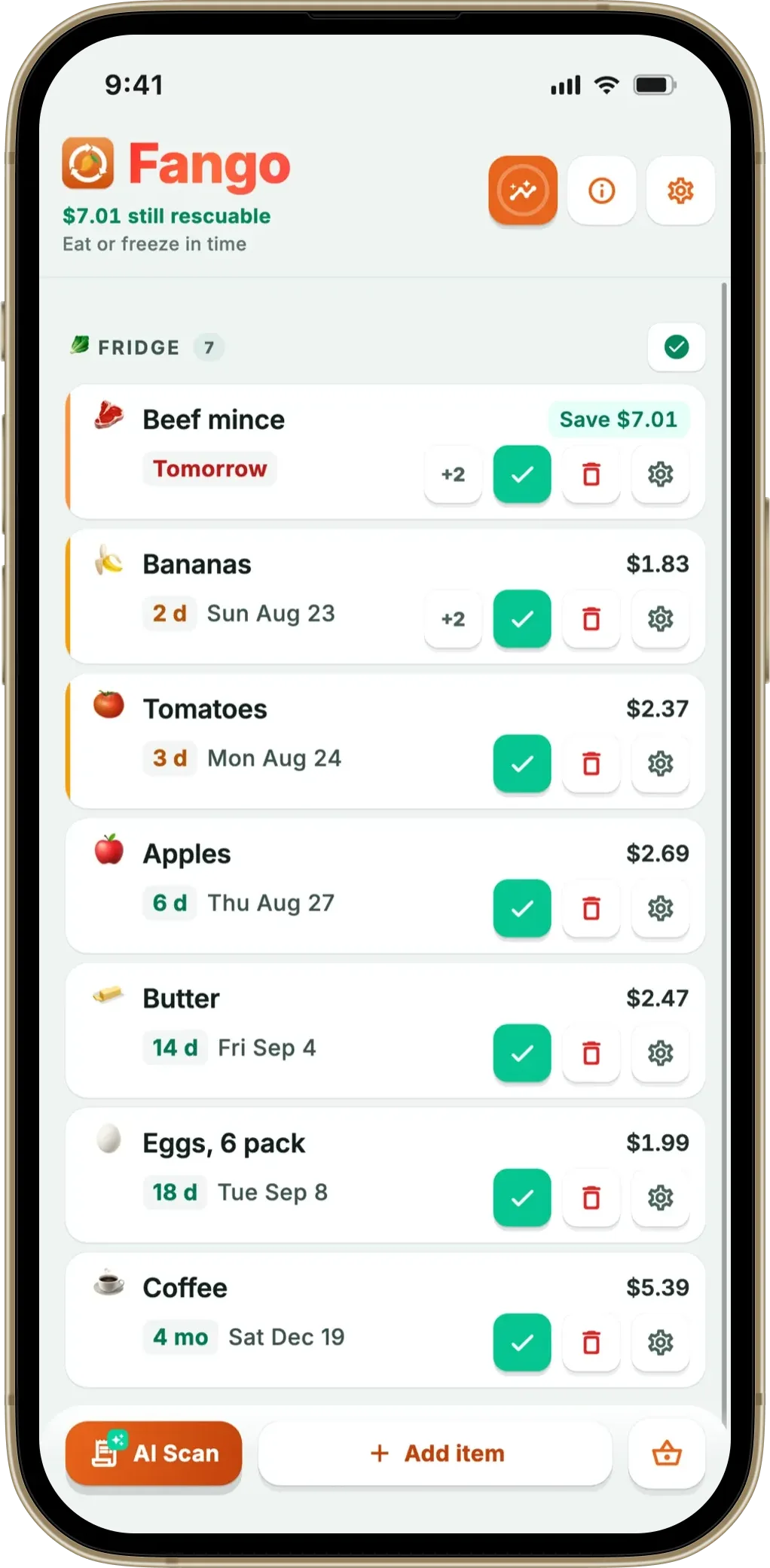
Fango is the opposite bargain to Bring!. No sign-up, no email address, and by default no server holding your list — it stays on the phone, which also means no advertising or offer content between you and your own shopping. The list does the ordinary things properly: 13 sections in shop order, from fruit and veg through to household, health and pet food, so non-food items don’t pile up at the bottom; a full-screen aisle-ordered shop mode with big rows, a “7/19 bought” progress bar and ticked items sinking out of the way; a budget pill that turns green under target and red over, counting only what’s unticked. “Shop finished” clears the ticks but keeps the rows, ready for next week.
What a pure list app can’t do is arrive from the other side of the shop. Fango scans grocery receipts — photo or PDF, formats from around 34 countries — and the products land in a fridge list with shelf-life estimates and push reminders, with slots from the same day up to 14 days ahead. That history then writes part of your next list: things you buy on a regular cadence, a running-low prompt for anything expiring within about three days, and a tidy-up offering to clear items your latest receipt shows you already bought — the loop described in a shopping list and expiry tracker in one app. The honest limits: no recipes, no barcode scanning — and ticking an item off doesn’t put it in your fridge list — a receipt scan or a manual entry does.
On the data question, without spin: with household sharing off, the list and the fridge stay on the device and only the photo or text passes through recognition during a scan. Turn household sharing on and the shared fridge, plus the lists you choose to share, travel through a server between the household’s phones — sharing doesn’t work any other way. Changes sync between the household’s phones in seconds through a silent push. The difference from Bring! is that it’s your decision rather than the condition for using the app at all.
- No account, no sign-up, no email address
- No ads, sponsored items or offer content in the list
- 13 shop-order sections, full-screen shop mode, budget target
- Suggestions from your receipt history and what’s expiring
- AI receipt scanning into a fridge list with expiry reminders
- Household sharing: the same view for up to four people, one subscription
- No personal device-to-device sync — sharing only within the household
- No recipes or meal planning
- No barcode scanning
- Ticked items don’t move into the fridge list automatically
- Costs money after the free month
Aisle-ordered list, shop mode and budget target — plus receipt scanning that fills your fridge list and reminds you in time. No account. Nothing leaves your phone unless you share a household.
Download on the App Store Get it on Google PlayFree for a month · No sign-up · iOS and Android
AnyList — best for shared lists with recipes and meal planning
If you’re leaving Bring! but not the shared list, AnyList is the most direct swap. Its own site describes staying in sync with family and friends by sharing a list, automatic grouping by category, suggestions as you type, recipes with ingredients added straight to the list, and Siri input. The paid AnyList Complete tier adds Mac and web apps, recipe web import, a meal-planning calendar, item photos, themes and folders — on the UK App Store listing, £9.99 a year individually or £14.99 for a household. Worth knowing first: that listing’s privacy section says data linked to you includes purchases, contact info, contacts, user content, identifiers, usage and diagnostics, used for app functionality, analytics and the developer’s advertising or marketing. It’s a cloud app with an account, like Bring! — you’re changing feature set, not privacy model.
- Strong shared lists, the nearest match to Bring!’s core
- Recipes plus a meal-planning calendar in Complete
- Category grouping and fast item suggestions
- Household subscription covers the whole family
- Account and cloud sync, same as Bring!
- Best features sit behind AnyList Complete
- No expiry tracking or receipt scanning
OurGroceries — best for a free shared list on everything
OurGroceries is the plain, dependable option: lists that sync in real time across phones, the web, Apple Watch and Echo devices, organised by store aisle, with notes, quantities and recipes. Its site makes the household case neatly — add milk and your partner sees it immediately, even if they’re already at the shop. The trade-off is stated openly in the FAQ: “We show unobtrusive ads at the top of the screen to help pay for development costs,” and sharing needs everyone signed in to the same account, with lists backed up on its servers. Removing the ads is cheap — the UK listing shows Remove Ads at £0.99, £5.99 and £9.99 lifetime — and one purchase covers every device.
- Free shared lists with real-time sync
- Aisle ordering, recipes, notes and quantities
- Works on phones, web, Watch and Alexa
- Cheap one-off lifetime ad removal
- Ads in the free version
- Account required for sharing; lists stored online
- App Store listing declares data used to track you
- No expiry tracking or receipt scanning
Apple Reminders — best for iPhone households who don’t want another app
Easy to overlook, and for a lot of people it’s enough. Apple’s Reminders user guide describes a shopping list “with items automatically placed in categories to make the shopping easier” — the grouping people mainly want. Sharing is built in too: Apple’s guide to sharing and collaborating in Reminders covers inviting people to a list, where everyone can add, edit and tick items and see each other’s changes. All of them need to be signed in to their Apple Account with Reminders on in iCloud, which rules it out for mixed households — there’s no Android version. No recipes, no receipt scanning, no expiry logic, but it costs nothing and is already on the phone.
- Free, already installed, no extra sign-up
- Automatic grocery categories
- Shared lists with live collaboration
- Siri, Watch and Mac out of the box
- Apple devices only — no Android
- Lists sync through iCloud
- No recipes, receipts or expiry tracking
Which app is right for you?
A shopping list is only half the problem, though. The other half is the food already at home, quietly going off — roughly a fifth of the food available to consumers is thrown away, per UNEP’s Food Waste Index Report 2024. If you shop for one, the maths is different again — a grocery list for one person covers pack sizes and the freezer rule. If your list app is perfect and you still bin half a fridge a month, see a shopping list app built to reduce food waste and building a grocery list from your receipt.
Frequently asked questions
Is the Bring! app free?
Bring! is free to download on iOS and Android, and the UK App Store listing shows Bring! Premium as an in-app purchase at £1.79 for a month or £8.99 for a year — check the listing for what the current tier includes, as it can change. The commercial model sits mainly on the business side: Bring! Labs runs an advertising platform selling sponsored products, sponsored posts and Offers-tab placements to brands and retailers.
Do you need an account to use Bring!?
Yes — Bring! is built around an account. Its help centre describes logging in with Facebook, Google, Apple Sign-in or email, and deleting your user account under Profile and More Settings. That account is what makes the real-time shared list work, and it means your lists live on Bring!’s infrastructure: the privacy policy states that its servers are located in the USA. If you would rather not create an account, Fango asks for no account at all and keeps your list and food data on the device by default — the reasoning is in our piece on food apps without cloud sync.
What is the best Bring! alternative if you don’t want an account?
Fango. There is no sign-up, no advertising and no offer content in the list, and with household sharing off nothing leaves the phone. It sorts the list into 13 shop-order sections, has a full-screen shop mode with a progress count and a budget target, and it also scans grocery receipts so the food you bought lands in a fridge list with shelf-life estimates and reminders. The trade-off is real: Bring! is still the stronger choice for a household that wants a free, real-time shared list on every platform.
Which Bring! alternative has a shared family list?
AnyList, OurGroceries and Apple Reminders all do real-time shared lists. AnyList adds recipes and a meal-planning calendar in its paid Complete tier, OurGroceries is free with ads and syncs across phones, the web and Alexa, and Apple Reminders is already on every iPhone and shares lists with anyone signed in to their Apple Account. Fango shares too, and changes reach the household’s other phones in seconds. Its shared list is capped at four people in one household, so a larger group is better served elsewhere.
The honest summary
Bring! earns its users: the shared list is excellent and 21 million people aren’t wrong. What you accept in exchange is an account, lists held on servers in the USA, and an app whose commercial engine — as Bring! Labs presents it to partners — puts brands and retailer offers in front of you at the moment you decide what to buy. For plenty of households that’s a fair swap for a list that syncs.
If it isn’t, the choice splits cleanly. AnyList, OurGroceries and Apple Reminders keep the collaboration and change only the details. Fango gives up the shared list entirely — that’s the price, and it isn’t a feature waiting to arrive, because sharing needs accounts and a server, exactly what the app is built not to have. What you get instead is a list nobody else can see, nothing being sold to you inside it, and the part no list app manages: it knows what’s in your fridge, when it expires and what you keep buying. Free for a month, then from $2.99/month or $22.99/year, on iOS and Android — more in our privacy-first food app guide.
Related reading: Best Cooklist App Alternatives in 2026.
- Bring!: Privacy Policy (data collected, server location, disclosure to partners)
- Bring! Labs: Mobile advertising for brands (ad formats and reach)
- Bring! Labs: About us (company, users, markets)
- Bring!: Collaborative — share your shopping list
- Bring! Grocery Shopping List on the UK App Store
- AnyList: official site (features and AnyList Complete)
- AnyList on the UK App Store (pricing and app privacy)
- OurGroceries: official site (sync and sharing)
- OurGroceries: FAQ (ads, accounts, upgrades)
- Our Groceries Shopping List on the UK App Store
- Apple: Reminders User Guide (shopping list with automatic categories)
- Apple: Share lists and collaborate in Reminders on iPhone
- WRAP: Household Food and Drink Waste in the UK
- UNEP: Food Waste Index Report 2024